

By Bartek Pretkiewicz, CrossVol Research · November 16, 2026
This article is for information and education only. It is not investment advice, nor an offer or recommendation to buy or sell any security. Investing involves risk, including the loss of capital.
France’s 10-year yield first closed above Italy’s on 15 September 2025, by half a basis point. The two yields then hovered around parity, Italy moved back above France in early 2026, and France has stayed above since early August 2026: on 16 November 2026, the gap reached 51 basis points (France 4.96%, Italy 4.45%), its widest in two years. The OAT-Bund spread, for its part, peaked at 174 basis points at the close on 22 October.
After thirty years of disarmament, Europe is rearming. At the NATO summit in June 2025, the allies committed to spending 5% of GDP a year on defence and security by 2035, including 3.5% on core defence, a pledge reaffirmed at the July 2026 summit in Ankara. For the euro area, the ECB estimates that the additional defence spending already approved since early 2025, including military aid to Ukraine, adds up to 1.5% of GDP cumulatively over 2025-2028.
Six chapters to answer one simple question: can Europe, and France in particular, afford to rearm?
1. The end of the peace dividend
For thirty years, Europe funded other priorities with the money it no longer spent on its armed forces. As the ECB puts it, most European countries cut their defence spending sharply after the Cold War, which led to underinvestment in military capabilities, a fragmented industrial base and growing dependence on non-European suppliers, mainly American.
This “peace dividend” did not vanish, it was spent elsewhere: pensions, healthcare, education and tax cuts absorbed the difference.
EU defence spending has risen for eleven consecutive years: it reached €418 billion in 2025, or 2.2% of GDP against 1.9% a year earlier, and is expected to reach €454 billion in 2026, 75% more than in 2021.
Hence the question: where can Europe find an extra 1.5 points of GDP for defence, when public spending already accounts for nearly half of euro area GDP (49.7% in 2025, according to Eurostat)?
2. The guns-versus-butter dilemma
A sustained defence effort can be financed in only three ways: debt, taxes or spending cuts, and each has an identifiable loser. No long rearmament escapes this “guns versus butter” trade-off.
The most telling precedent is the Korean War. Between 1950 and 1953, the United States almost tripled its military effort, from 5% to 14% of GDP, financing it mainly through taxation: the Revenue Acts of 1950 and 1951 raised taxes by about 3 points of GDP. Washington had learned from the Second World War, more than half of which was financed by borrowing, with a Federal Reserve holding rates down: once price controls lapsed in the summer of 1946, inflation broke out, above 10% in 1947.
Europe in 2026 is making the opposite choice. Through a “national escape clause”, the EU fiscal framework lets each country deviate from its spending path by up to 1.5% of GDP a year over 2025-2028 for defence spending above its 2021 level. The ECB projects the euro area deficit rising from 3.0% of GDP in 2025 to 3.6% in 2026 and 3.7% in 2027, and debt climbing from 87.1% to 89.4% of GDP in 2028, reversing the decline of 2021-2024.
Autumn 2026 may offer a first glimpse of this trade-off on the streets. In September, the French government unveiled a €54 billion savings plan for the 2027 budget, targeting social spending and local authorities, with no tax increases. On 5 November, the day after the National Assembly unanimously rejected the revenue part of the 2027 budget bill, a nationwide strike drew around 600,000 protesters according to the Interior Ministry, and around 1.6 million according to the CGT union, which accuses the budget of freezing social benefits and targeting “the most vulnerable”. In Italy, the general strike of 30 October brought tens of thousands onto the streets of more than 40 cities, partly against higher military spending.
It would be premature to read this as a rejection of rearmament, as these movements have other causes too (French student protests over teaching conditions since September, the surge in energy prices linked to the conflict in the Middle East). But they may signal the political cost of choosing between guns and butter when defence comes on top of social spending cuts, and a budget effort contested in the streets is harder to sustain. Debt is the least painful option in the short term, but it only postpones the choice: today’s interest payments become tomorrow’s spending cuts.
3. Money is not enough: the industrial bottleneck
A parliament can double a budget in a single vote; doubling production capacity takes years. With a near-single customer, irregular orders and highly specialised supply chains, manufacturers sized their plants for peacetime after thirty years of orders placed in dribs and drabs.
Money arrives faster than the equipment: the ECB estimates, from arms transfer data since 1950, that major equipment (aircraft, ships, armoured vehicles) is delivered a median two years after it is ordered, and up to four years. Since national accounts record spending on delivery, part of the effort voted today will only show up in the figures years from now. Still, 71% of the additional national defence spending planned in the euro area over 2025-2028 goes to investment.
The EU’s SAFE loan scheme shows the same lag on the financing side: of the roughly €129 billion committed in the first round, only around €13.5 billion had been disbursed to 11 countries by autumn 2026. In Poland, the largest beneficiary, President Karol Nawrocki vetoed on 12 March 2026 the law meant to give fast access to the €43.7 billion earmarked.
From decisions to deeds
Orders are following decisions, but unevenly, and deliveries are not keeping pace.
In France, orders placed by the Directorate General of Armaments (DGA) almost tripled, from €13 billion in 2020 to around €38 billion in 2025, against a target of around €44 billion, half of it for two programmes: the next-generation aircraft carrier (around €6 billion) and the third-generation ballistic missile submarines. With the fall of the government and the spending freeze in the spring, only €4 billion of new orders had been committed by the end of June 2025.
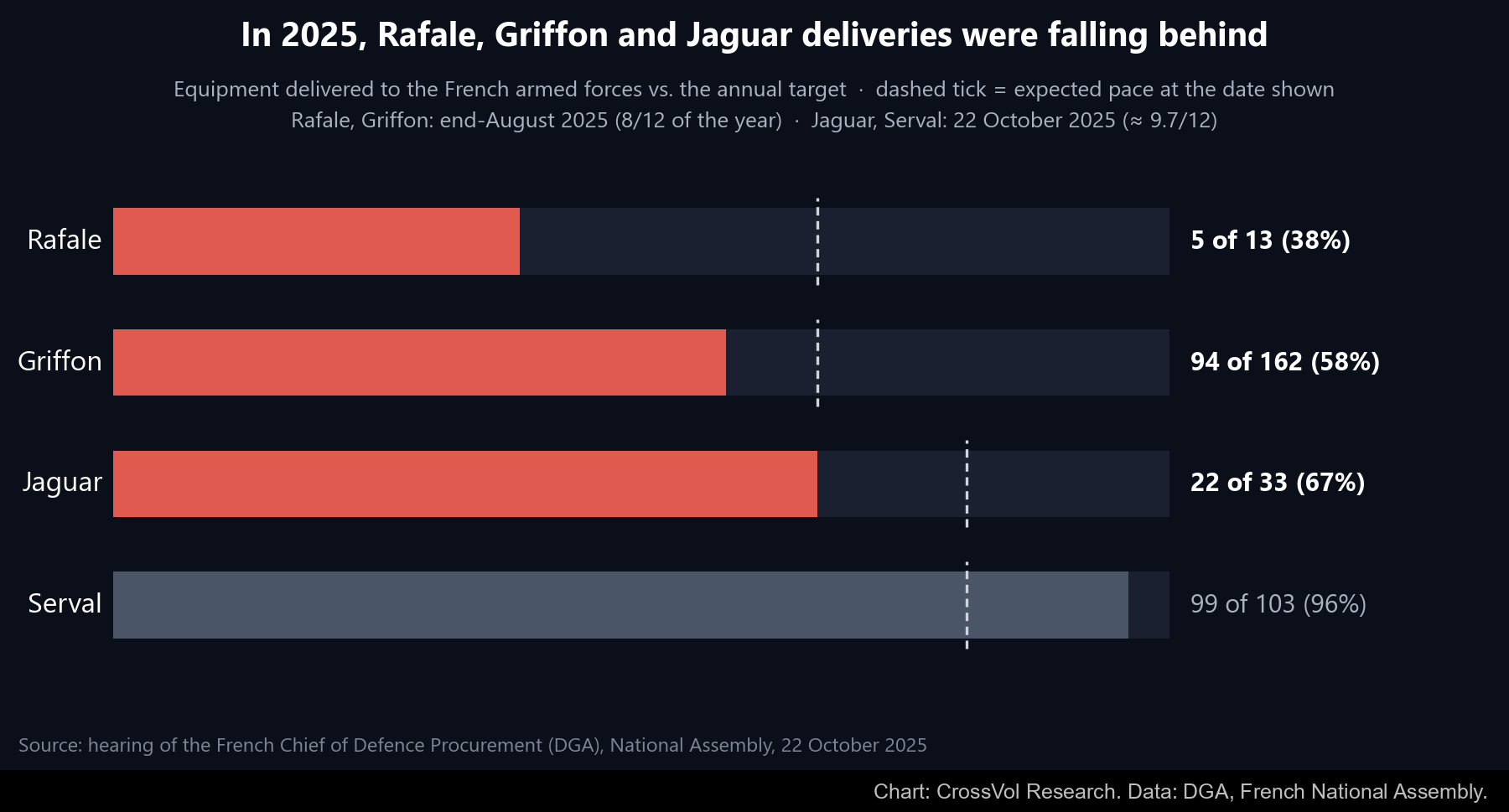
By the end of August 2025, the French armed forces had received 5 of the 13 Rafale fighters planned for the year and 94 of the 162 Griffon armoured vehicles. By late October, the Jaguar reconnaissance vehicle was also behind, at 22 of 33, while the Serval was almost on schedule (99 of 103).
Across the EU, equipment procurement reached €115 billion in 2025, but only 24% of this equipment is bought jointly by several states. Europe is buying, but it is not yet buying European.
Rheinmetall reported a record order backlog of €78 billion in the third quarter of 2026, but cut its 2026 sales forecast twice in three months: in August, because of its naval business (the F126 frigate programme), then in early November, to around €13.2 billion, citing the delayed Boxer armoured vehicle order (Arminius) and longer acceptance procedures for artillery ammunition. When supply is rigid, extra demand first translates into higher prices and longer delays, not higher volumes.
The bottleneck may not last for every product. In November, Bank of America downgraded Rheinmetall and cut its price target from €1,300 to €900, arguing that European capacity for 155mm artillery shells could rise to around 3.4 million rounds a year and overtake consumption, around 2.2 million, from 2028. Today’s shortage could turn into tomorrow’s overcapacity.
4. Sovereignty or efficiency
Buying European protects the continent’s industry, but it costs more and delivers more slowly than buying off the shelf, often from the United States. The ECB points to the costs of a fragmented industrial base: duplicated procurement, limited economies of scale, weaker incentives to innovate, and far more weapons systems than in the United States. Major joint programmes, such as the Future Combat Air System (FCAS, or SCAF in French) developed by France, Germany and Spain, have run into difficulties. Even “European” equipment relies on external supply chains: around 50% of the suppliers of the euro area’s large defence companies are located outside the EU.
The €150 billion SAFE loan instrument is designed precisely to encourage joint procurement. Provisionally allocated in full in September 2025, led by Poland with €43.7 billion, the envelope was then trimmed as several countries scaled back their requests (Italy from €14.9 billion to around €8-9 billion, Hungary to €5.4 billion); France’s loan, approved in April 2026, came to €15.1 billion. The remaining €21.3 billion went back on the table in a second round, opened on 29 October 2026 to all 27 member states. But a joint loan does not make a joint programme: each state continues to defend its national champions.
SAFE loans run for up to 45 years, with a ten-year grace period on principal, and at least 65% of the cost of the equipment financed must come from the EU, Ukraine or the EEA/EFTA countries. But this “buy European” rule only covers the €150 billion that goes through the instrument, a fraction of total spending.
5. Does war drive growth?
Does rearmament support growth, as the advocates of “military Keynesianism” argue? Yes, but modestly and mainly in the short term, and the lasting effect depends on what it buys and where.
The ECB finds that, in EU countries over 1999-2025, each euro of defence spending generated about one euro of activity, with a lag and wide confidence bands: no snowball effect, and up to 1.3 points of additional inflation in the third year.
At the euro area level, the spending already decided, more than 70% of which comes from Germany, would add 0.4 points of growth in total over 2025-2028, about 0.1 point a year, with less than 0.1 point on inflation. Reaching the NATO target entirely through borrowing would add 0.7 to 1 point over 2026-2028, but this ignores possible market tensions in highly indebted countries, precisely the risk described in Chapter 6. Equipment purchases deliver most of the gain, whereas higher military pay and headcount tend to crowd out private investment, and purchases abroad, notably from the United States, benefit the supplier country.
The lasting gain comes through research: an increase in defence spending of 1% of GDP would raise total factor productivity by 0.3% in the long run, mainly through public research. Yet the EU devotes barely 0.03% of its GDP to defence research, against 0.08% in the United Kingdom and 0.3% in the United States (2022 data). Rearmament will support activity for a few years, then fade, unless Europe invests in research and industry. For now, it is not heading that way.
6. Who can really afford to rearm?
In the euro area, the countries with the furthest to go to reach 3.5% of GDP are also, for the most part, the most indebted. Italy, France, Belgium, Spain and Portugal still need to add around 1.5 points of GDP, with debt of between 89% and 137% of GDP. By contrast, Latvia and Lithuania have already exceeded the target and Estonia is close to it, while Germany and the Netherlands have the effort to make but also the room to finance it.
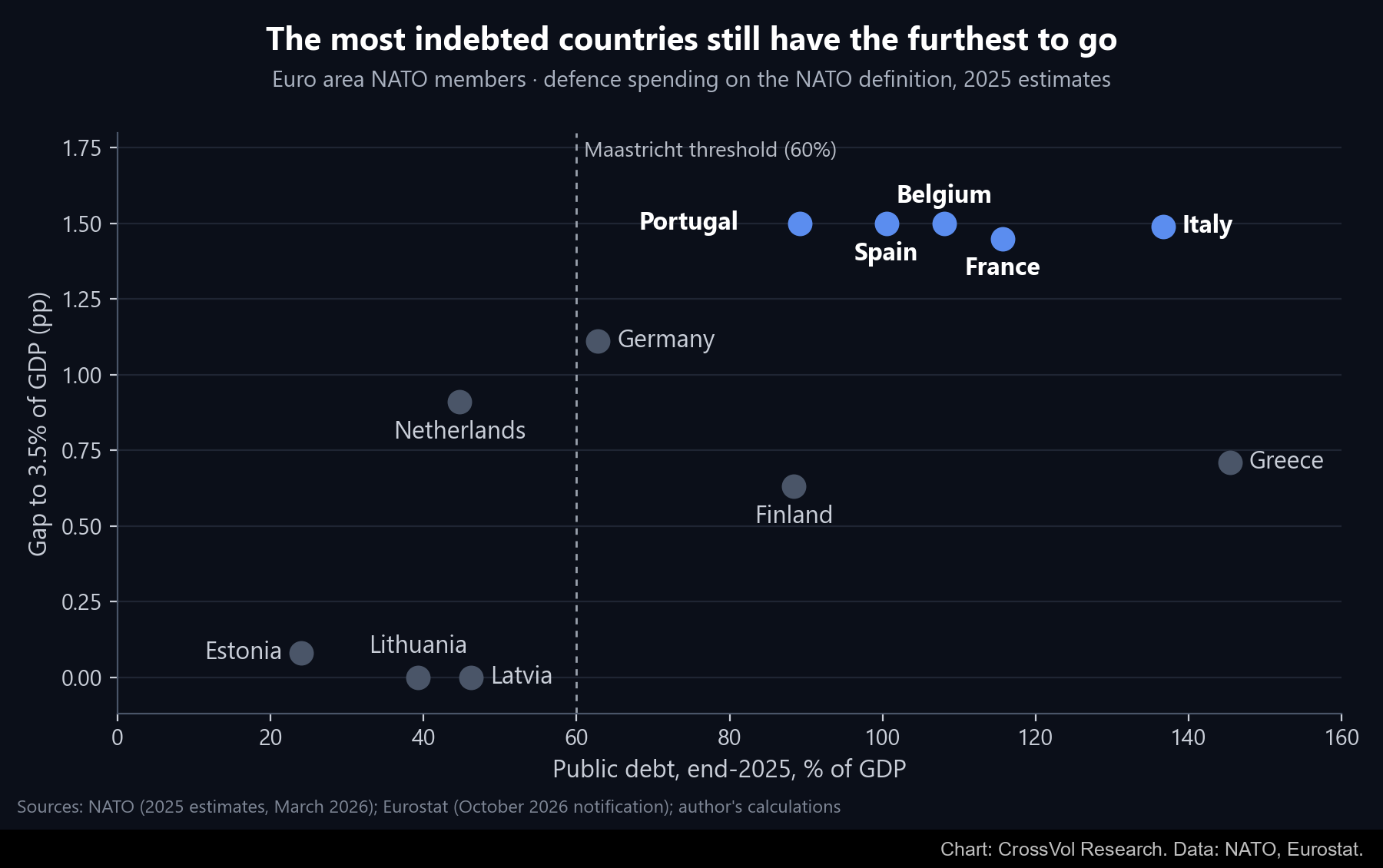
Greece is the exception among the highly indebted countries: already close to 2.8% of GDP in defence spending, it runs a budget surplus (+2.0% of GDP in 2025).
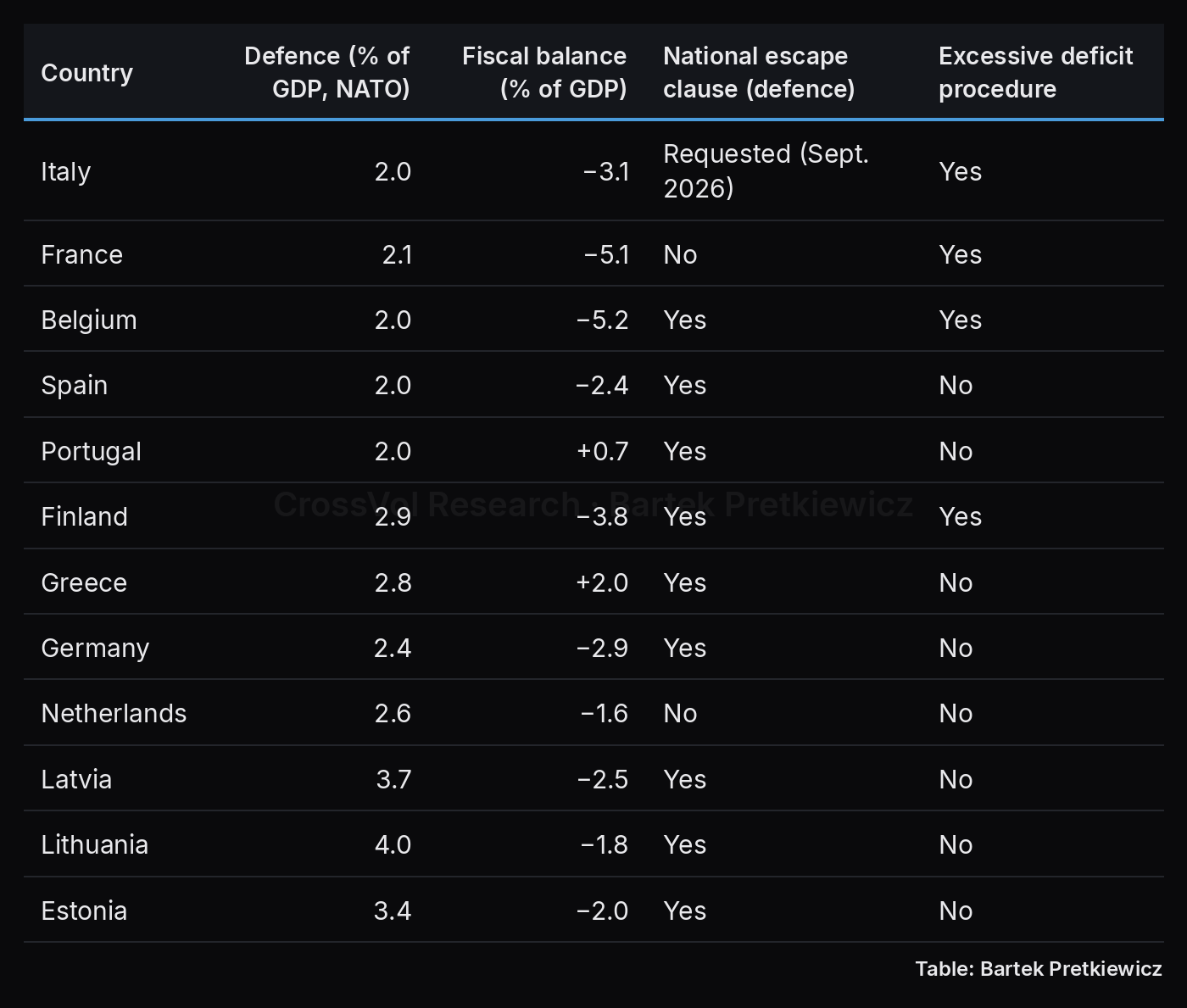
Defence spending, public finances and EU fiscal rules, 2025. Note: a negative balance is a deficit, a positive balance a surplus. Defence spending on the NATO definition, 2025 estimates, rounded. Sources: NATO (March 2026); Eurostat (October 2026 notification); ECB, Economic Bulletin 6/2026 (escape clause and excessive deficit procedures).
European flexibility benefits the strongest first
The national escape clause, which allows up to 1.5% of GDP a year in additional defence spending relative to 2021 over 2025-2028, has been activated for 14 euro area countries, including Germany, Belgium, Spain and Greece. Italy requested it on 11 September 2026. France is not among them. At the same time, seven euro area countries are subject to an excessive deficit procedure: Belgium, Bulgaria (a member of the euro area since January 2026), France, Italy, Austria, Slovakia and Finland.
The SAFE loan reveals the same hierarchy. Eight EU countries did not apply for it. For Germany and Sweden, the reason is simple: they can borrow on their own at comparable or better rates. Others stayed out for political reasons, including neutrality for Austria, Ireland and Malta. At the other end of the scale, Poland, the largest SAFE borrower, ran a deficit of 7.2% of GDP in 2025, and its finance minister has been lobbying for new European sources of defence funding.
Germany illustrates the model of rearmament financed by national debt. The 2027 budget, approved by the Bundestag budget committee on 13 November 2026 ahead of the final vote at the end of the month, provides for around €123 billion in net borrowing and around €140 billion in defence spending, counting the core budget and the special fund. And the €100 billion special fund for the Bundeswehr runs out at the end of 2027, which will shift more of the effort onto the regular budget and new bond issuance.
The real cost: the interest bill
For the most indebted countries, the constraint is not the stock of debt but what it costs each year. In the euro area, the ECB expects interest payments to rise by 0.2 points of GDP in 2026, then by a further 0.3 points over 2027-2028.
For France, the Banque de France puts a figure on the drift. In December 2025, its governor estimated that the interest bill would rise by around €7 billion every year, or €70 billion more after ten years, money that will not be available for other priorities. He speaks of “budgetary suffocation”: after ten years, this extra interest would exceed the budget of the Ministry of Education, the state’s largest spending item.
The market has already started to charge
The stress shows in the yield spread with Germany, the OAT-Bund spread. On 29 April 2026, the 10-year spread over the Bund stood at 66 basis points. It peaked at 174 points at the close on 22 October (around 178 intraday), its widest since the euro crisis of 2011, and stood at around 157 points on 16 November: it has more than doubled in six months. On 22 October, the 10-year OAT yield closed at 5.07%, its highest close in more than a decade. We covered that week in France Bond Crisis: The OAT-Bund Spread Hits 178 bp.
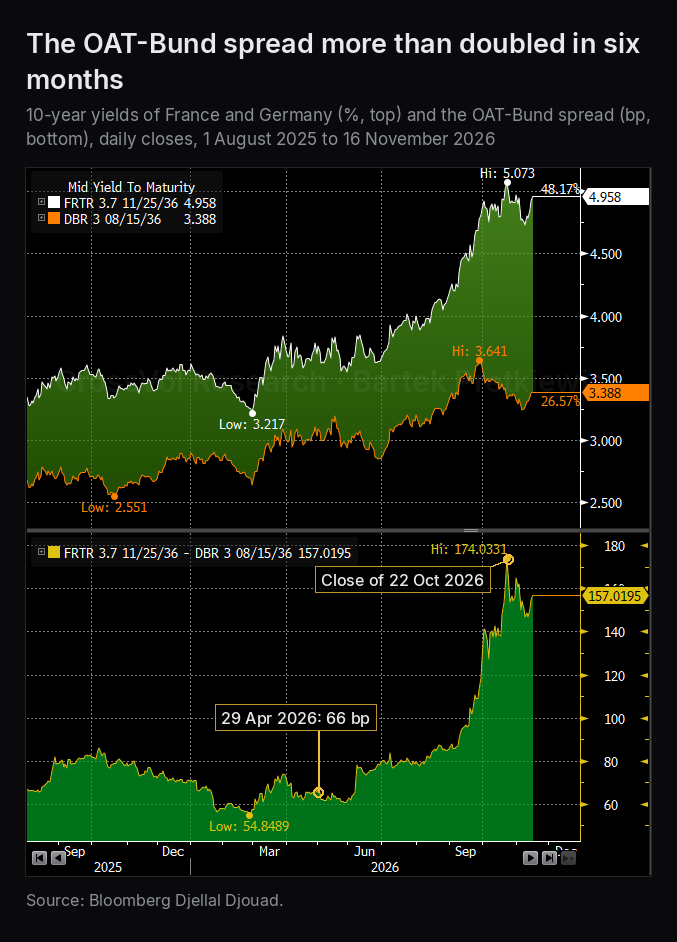
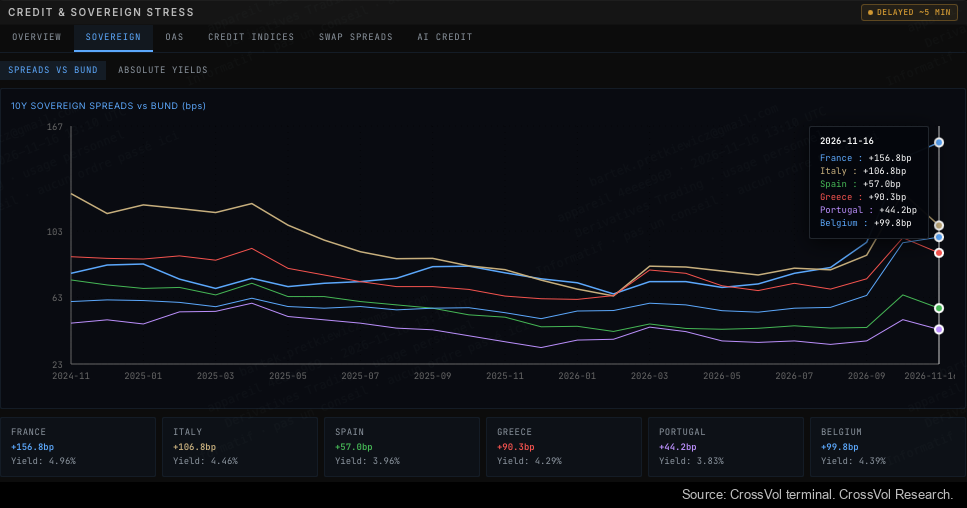
The ranking is now the reverse of the 2011-2012 crisis. In mid-November 2026, France is paying more to borrow over 10 years than Greece, Italy, Belgium, Spain and Portugal. On 16 November, the French 10-year yielded 4.96%, against 4.45% for Italy, 4.39% for Belgium, 4.30% for Greece, 3.96% for Spain and 3.83% for Portugal. Credit default swaps, the contracts investors use to insure against a default, tell the same story: on 16 November, five-year protection on France cost about 90 basis points a year, against 64 for Italy. The gap of 26 basis points is close to its two-year high of 27, reached on 22 October.
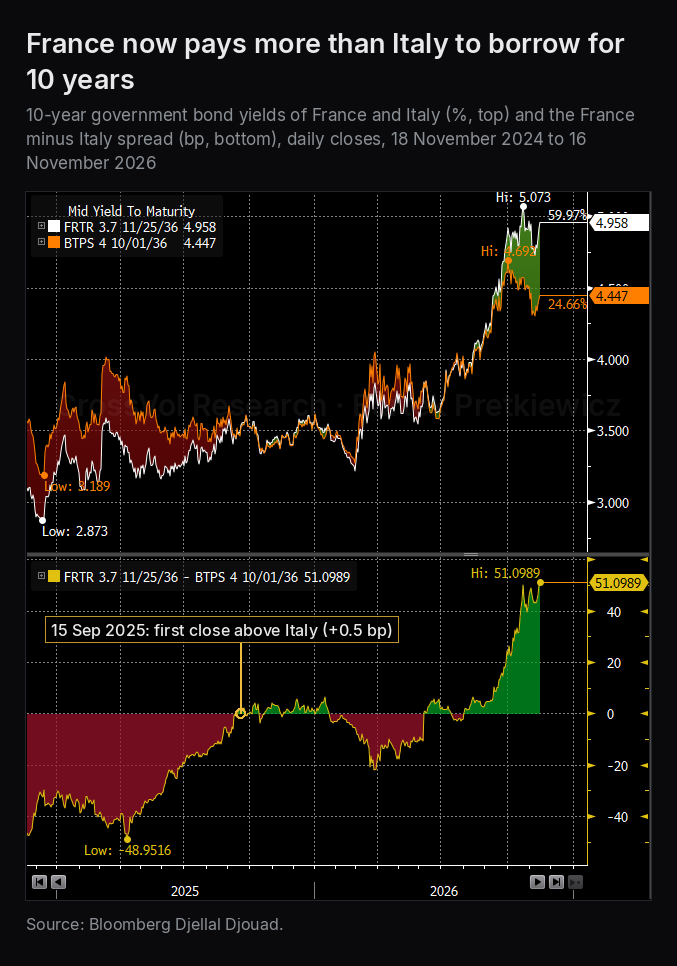
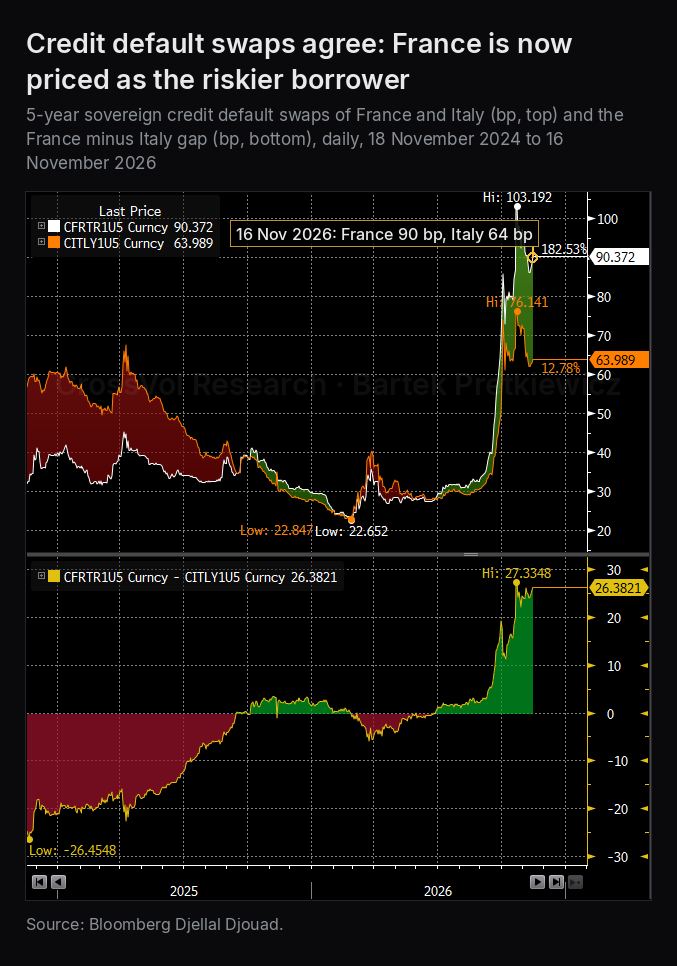
Over two years, two movements have overlapped. First, a common shock in 2026, driven by the energy shock and expectations of rate hikes: the 10-year Bund rose from 2.64% at the end of February to around 3.1% by mid-May, then to 3.64% at the end of September, about one point in seven months. Then a shock specific to France: its spread over the Bund, around 70 to 80 points until the summer, doubled from September onwards, while the spreads of Spain and Portugal stayed around 60 points or below. Belgium, another highly indebted country with a deficit above 5%, is following France with a lag. The September turn, when the long end cracked under a hawkish super-week and an energy shock, is described in The Coiled Spring.
The rating agencies remain on alert. On 23 October 2026, Moody’s kept France’s Aa3 rating with a negative outlook, whereas markets had expected a downgrade; Fitch and S&P had already lowered their ratings. Reuters highlights investor concerns about the deficit, expected at 5.4% of GDP this year and 5% in 2027 under the budget bill, and about the presidential election in April-May 2027.
The Banque de France had identified these triggers as early as January: rating downgrades, reactivation of the EU excessive deficit procedure, and outflows of volatile investors such as hedge funds. Above a 5% deficit, according to the governor, France would enter a “danger zone”.
A sovereign stress, not (yet) a credit crisis
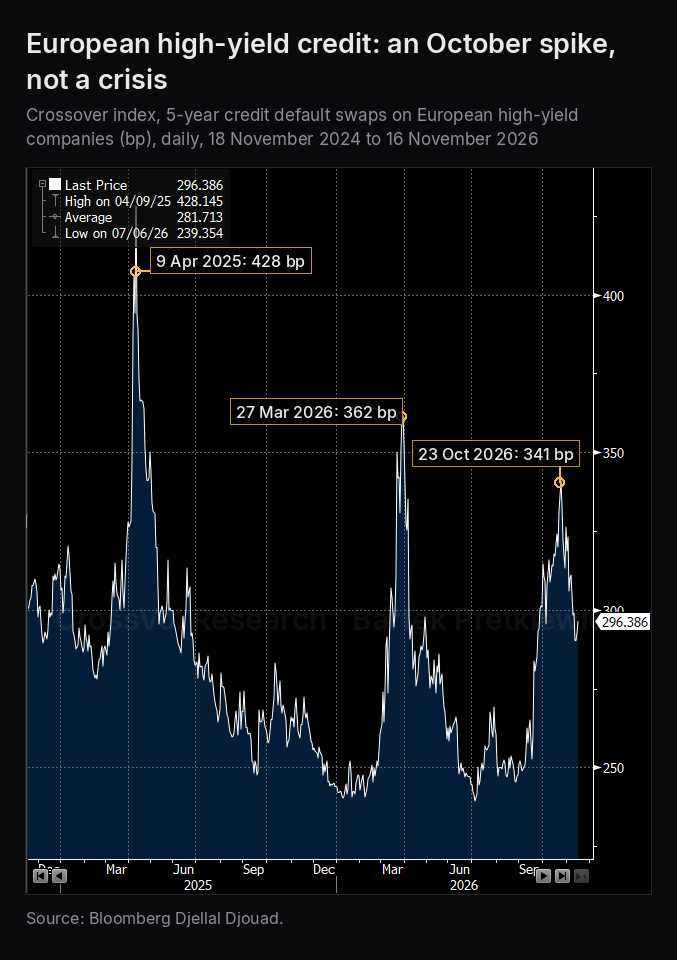
The strain on French debt briefly spilled over to companies. The Crossover index, which measures the cost of insuring European high-yield companies against default over five years, peaked at 341 basis points on 23 October 2026, the day after the OAT-Bund spread hit its high, and hours before Moody’s verdict on France’s rating. Even at that peak, it stayed below its March 2026 high of 362 points and far from the 428 points reached on 9 April 2025, and it fell back to 296 points on 16 November. For now, the stress is hitting the state, not the private economy.
At the end of October, Goldman Sachs pointed to a double pressure on European companies: rising sovereign yields, and a surge in bond issuance by US technology giants, expected at $420 billion in 2027 after $250 billion in 2026, competing for the same capital.
Even Germany is paying for its rearmament. For years, the Bund yielded significantly less than swap rates: investors paid a premium for its scarcity. With Berlin borrowing heavily for defence and infrastructure, and the ECB no longer buying, that premium has largely gone: in mid-November 2026, the 10-year Bund yields about 16 basis points more than the 10-year €STR swap, and only about 6 points less than the Euribor swap, levels that have barely moved over the past year.
This nuance matters when reading the French spread. It is measured against a benchmark that has itself lost most of its scarcity premium, so the gap of about 157 points is, if anything, a conservative measure of investors’ distrust of France.
The weakest link is the tie between the French state and its banks. In October 2026, rising borrowing costs revived fears of a “doom loop” between banks and sovereigns in the euro area: European bank stocks lost around 8% in two weeks, and Société Générale and Crédit Agricole fell more than 15% from their highs. French banks hold large amounts of French government debt: if it deteriorates, they are directly affected, and with them lending to the economy. The stress has already reached dollar funding for European banks, as shown in Why the Euro Is Falling Against the Yen. Every billion of rearmament financed by borrowing adds to this risk.
The ECB is no longer a shock absorber
French debt is being refinanced in a tighter monetary environment, with an ECB that is raising rates and no longer buying government bonds. Why this inflation episode is not a rerun of 2022 is the subject of Same Symptoms, Different Disease.
On 10 September 2026, the ECB raised its three key interest rates by 25 basis points, its second hike since June, bringing the deposit facility rate to 2.50%, citing inflationary pressures linked to the conflict in the Middle East. Inflation rose from 2.9% in July to 3.3% in August, with energy prices up 14.3%; the ECB still expects an average of 3.0% in 2026 and 2.5% in 2027. On 29 October, it left its key rates unchanged (deposit facility 2.50%, main refinancing operations 2.65%, marginal lending facility 2.90%), without committing to any particular rate path. Since then, inflation has reached 4.0% in October (flash estimate), and market pricing puts the probability of a further hike on 17 December at around 97%.
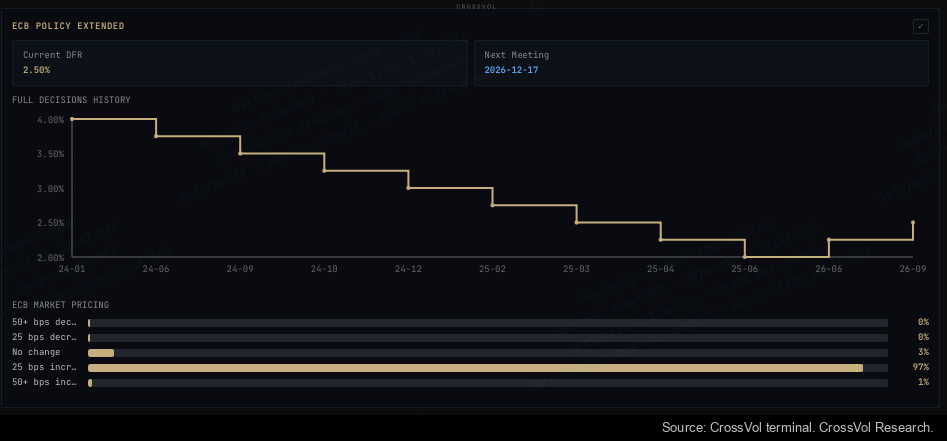
At the same time, the ECB no longer supports the bond market. Between 2015 and 2022, its asset purchase programme (APP) made it one of the main buyers of euro area government bonds. Since July 2023, it no longer replaces maturing securities, and the portfolio has shrunk from €2,698 billion at the end of November 2024 to €2,031 billion in October 2026. Every OAT that matures must now be refinanced with private investors, at the price they demand.
That leaves the Transmission Protection Instrument (TPI), created in 2022 to counter disorderly and unwarranted spread widening. But its activation requires a set of cumulative criteria, the first being compliance with the EU fiscal framework: not being subject to an excessive deficit procedure, or not having been found to have failed to correct one’s deficit. France is under such a procedure. However, in its 2026 recommendation to France, the Council of the EU states that, based on the Commission’s assessment of effective action of 3 June 2026, the procedure “is held in abeyance”. France is therefore not excluded, but activation would remain a decision of the ECB’s Governing Council: this safety net is far from automatic. Christine Lagarde will also step down as ECB President on 7 February 2027, about nine months before her term ends in October 2027. The date, announced on 29 October, gives EU leaders time to appoint her successor before the French presidential election in April 2027, so any decision to activate the TPI for France could fall to that successor.
France: when interest eats up the defence effort
At this pace, the increase in France’s interest bill alone will, within six years, equal the entire defence effort still needed to reach 3.5% of GDP.
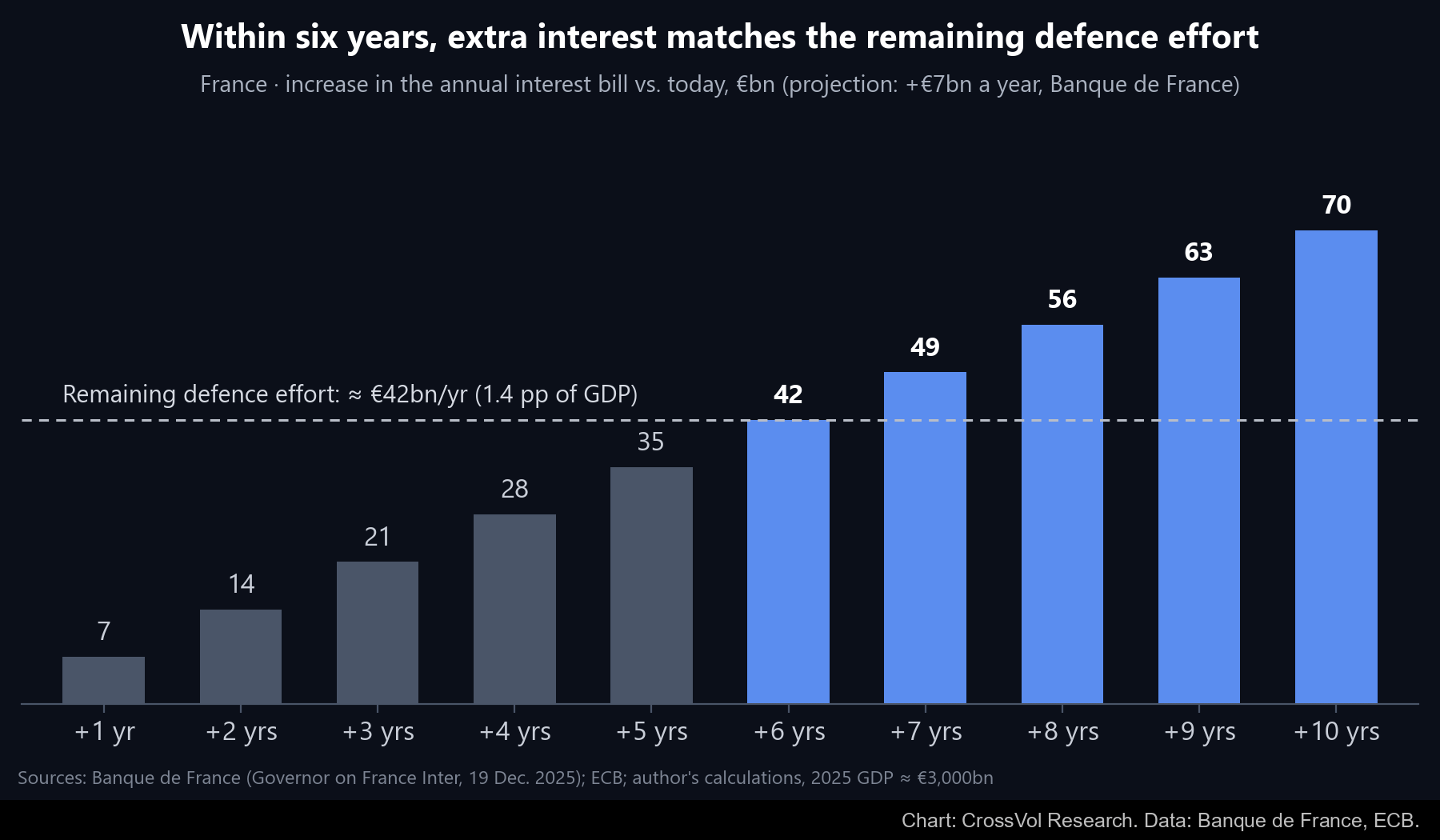
The remaining effort, around 1.4 points of GDP (3.5% minus about 2.1%, the NATO estimate for 2025), amounts to roughly €42 billion a year. With an interest bill rising by around €7 billion every year according to the Banque de France, the extra interest will reach that amount within six years. And this estimate dates from December 2025, when the OAT yielded around 3.55%; it now yields close to 5%.
This calculation sheds light on the role of SAFE for France: every billion borrowed on the terms of the EU’s signature rather than at the OAT rate reduces the cost of rearmament. But France’s SAFE loan, €15.1 billion, remains small compared with an annual effort of around €42 billion. French rearmament will therefore be financed mainly by the state itself, at the price set by the market.
Conclusion
The 3.5% target is shared, but the bill is not. European rearmament risks proceeding at two speeds: the countries of the north and east will pay cash, while those of the south and west will borrow or wait.
Can rearmament be financed?
At the euro area level, and as things stand, the answer is yes. Even with the defence effort, the ECB projects a deficit peaking at 3.7% of GDP in 2027 and debt remaining just below 90% of GDP in 2028. The national escape clause offers up to 1.5 points of GDP of leeway, and Germany, which accounts for more than 70% of the additional spending, has the means to finance it.
For France, the answer is more complicated. The figures are clear: a remaining defence effort of around €42 billion a year, an interest bill rising by €7 billion every year, a deficit expected at 5.4% of GDP this year and 5% in 2027 when the Banque de France places the “danger zone” above 5%, and a commitment to return to 3% in 2029. Financing rearmament on top of everything else would mean widening a deficit that the market already charges more for than Greece’s or Italy’s. Europe will not step in: of the roughly €800 billion of ReArm Europe, around €650 billion corresponds to national fiscal flexibility, in other words national debt, and only €150 billion to European loans. In a note of 5 November, Intesa Sanpaolo judged SAFE insufficient for Italy and France to finance their additional spending.
French rearmament is therefore affordable, but only at the cost of explicit choices: reallocating spending, raising revenue, or pooling more at the European level, beyond the €15 billion of the SAFE loan. Without such choices, interest rates will decide in place of politicians, and every additional point on rates will shrink the room for defence accordingly.
For markets, this debate boils down to the OAT-Bund spread, and the central scenario remains a persistently wide spread in the run-up to the 2027 presidential election, when the passage of a credible budget looks unlikely.
But two events could trigger a sharp tightening: the adoption, against the odds, of a 2027 budget that markets deem serious, or ECB intervention through the TPI, which is far from a given for a country under an excessive deficit procedure.
The potential scale is significant. The spread is around 157 basis points, compared with 66 points at the end of April, and a simple return to spring levels would mean around 90 points of tightening, within a few sessions if the trigger is the ECB. The risk for French debt is therefore not one-way. The stress can build slowly, budget after budget, or deflate in one go on a political or monetary decision.
This verdict, however, rests on a scenario with no further escalation in the Middle East. ECB projections assume that the energy support measures introduced by governments will be largely reversed in 2027. If the conflict worsened, oil would push inflation back up and lead the ECB to raise rates further, increasing the cost of debt, first and foremost in France. Governments would also have to support households and businesses against the energy bill once again, out of the same fiscal room as defence. The energy side of this risk is covered in Oil Above $100: What Futures Curves, Crack Spreads and Gas Spreads Say.
Ultimately, the real limit to rearmament may not be financial, it is the lack of a clear project that would justify the effort asked of Europeans.
FAQ
Can France afford to rearm?
Yes, but at the price set by the bond market. France still needs about 1.4 points of GDP, roughly €42 billion a year, to reach NATO’s 3.5% target, while its interest bill is rising by around €7 billion a year and its deficit is expected at 5.4% of GDP in 2026.
Why does France pay more to borrow than Italy?
Investors now see more risk in France’s public finances and politics: a deficit above 5%, a 2027 budget rejected by the National Assembly, and a presidential election in April 2027. On 16 November 2026, the French 10-year yielded 4.96%, against 4.45% for Italy and 4.30% for Greece.
What is the OAT-Bund spread?
It is the gap between the 10-year yields of France (OAT) and Germany (Bund), the main gauge of French sovereign risk. It rose from 66 basis points at the end of April 2026 to 174 at the close on 22 October, and stood at around 157 on 16 November.
What is the EU’s SAFE defence loan?
SAFE is a €150 billion EU loan instrument for defence, funded by EU bonds. Loans run for up to 45 years, and at least 65% of the cost of the equipment must come from the EU, Ukraine or EEA/EFTA countries. Poland is the largest borrower; France’s loan is €15.1 billion.
How much does Europe spend on defence?
EU countries spent €418 billion on defence in 2025, 2.2% of GDP, and are expected to spend €454 billion in 2026, according to the European Defence Agency.
Can the ECB protect French bonds?
The ECB’s Transmission Protection Instrument can buy the bonds of a country facing disorderly spread widening, but only if it complies with EU fiscal rules. France is under an excessive deficit procedure that the Council of the EU says is held in abeyance, so France is not excluded, but activation is a decision of the ECB’s Governing Council, possibly under Christine Lagarde’s successor, and this safety net is far from automatic.
Related reading on CrossVol Research
The OAT-Bund Spread Explained: France, Germany, and Sovereign Risk
France Bond Crisis: The OAT-Bund Spread Hits 178 bp and France Now Pays More Than Italy and Greece
Why the Euro Is Falling Against the Yen: French Stress Has Reached Dollar Funding
The AI Depreciation Bomb: The Chips Last Three Years, the Loans Last Ten
EUR/USD and EUR/JPY Forecast: The Euro Keeps Falling While FX Volatility Sleeps
Stock Market Week in Review (October 19-23, 2026)
This article is for information and education only. It is not investment advice, nor an offer or recommendation to buy or sell any security. Investing involves risk, including the loss of capital.
Sources
European Central Bank
Economic Bulletin, Issue 6/2026 (PDF, French edition): article “Defence spending and its short and longer-term macroeconomic effects”, fiscal developments, statistical table 6.6
Defence spending and its short and longer-term macroeconomic effects
Philip R. Lane, “Europe’s defence build-up”, 17 August 2026
Monetary policy decisions, 11 June 2026
Monetary policy decisions, 10 September 2026
Monetary policy decisions, 29 October 2026
ECB President Lagarde to step down on 7 February 2027, 29 October 2026
The Transmission Protection Instrument, 21 July 2022
Banque de France
Governor’s hearing before the Senate Finance Committee, 14 January 2026
France Inter, 19 December 2025: “L’étouffement budgétaire”
Letter to the President of the Republic, May 2026
ECB Economic Bulletin 6/2026 (Banque de France page)
Reuters
France plans €54 billion savings drive as protests grow, 17 September 2026 (via Internazionale)
Mass protests sweep Italy during nationwide strike, 30 October 2026 (via Internazionale)
France spared Moody’s ratings downgrade as it struggles with unrest, 23 October 2026 (via Euronext)
Press
Euronews, “Polish President Nawrocki vetoes law unlocking €44bn in EU defence loans”, 12 March 2026
Institutions
Public Sénat, hearing of Sébastien Lecornu, Minister for the Armed Forces, 1 July 2025
Eurostat, government expenditure 2025 (release of 22 April 2026)
European Commission, ReArm Europe / Readiness 2030 and SAFE
Bundestag, Budget Committee, 2027 federal budget, 13 November 2026
Economic history
Congressional Research Service, Financing Issues and Economic Effects of American Wars (RL31176)
Federal Reserve History, From WWII to the Treasury-Fed Accord
Bank research
Bank research notes: Intesa Sanpaolo (5 Nov. 2026), Bank of America (Nov. 2026), Goldman Sachs (Oct. 2026)
Rheinmetall, quarterly statement Q3 2026, 5 November 2026
CrossVol
CrossVol terminal, November 2026: 10-year sovereign yields and spreads over the Bund, EUR swap spreads, ECB monetary policy, APP portfolio, euro area macroeconomic indicators
Bloomberg (Djellal Djouad): 10-year government bond yields and spreads, sovereign CDS and European high-yield credit, closing prices to 16 November 2026
CrossVol Research is the research desk of CrossVol (crossvol.com), an options analytics platform for derivatives traders.
How to cite: Bartek Pretkiewicz, CrossVol Research, "France Now Borrows Above Italy: The Real Cost of Rearming Europe", 16 November 2026. https://newsletter.crossvolresearch.com/p/france-borrows-above-italy-cost-of-rearming-europe
Incredible Article !
Thanks for the great insights, super comprehensive and interesting