


By Djellal Djouad
The OAT-Bund spread is the gap between the yield on the French 10-year government bond (the OAT) and the yield on the German 10-year Bund, measured in basis points. It is the euro area's cleanest market gauge of French sovereign and political risk, because it strips out the shared level of euro rates and leaves only the premium investors demand to hold France over Germany.
When that premium rises, markets are pricing more fiscal, political, or credit stress in France. When it falls, they are relaxing. Below we define the spread precisely, show how to read it, walk through what actually drives it, and explain why it matters far beyond the rates desk.
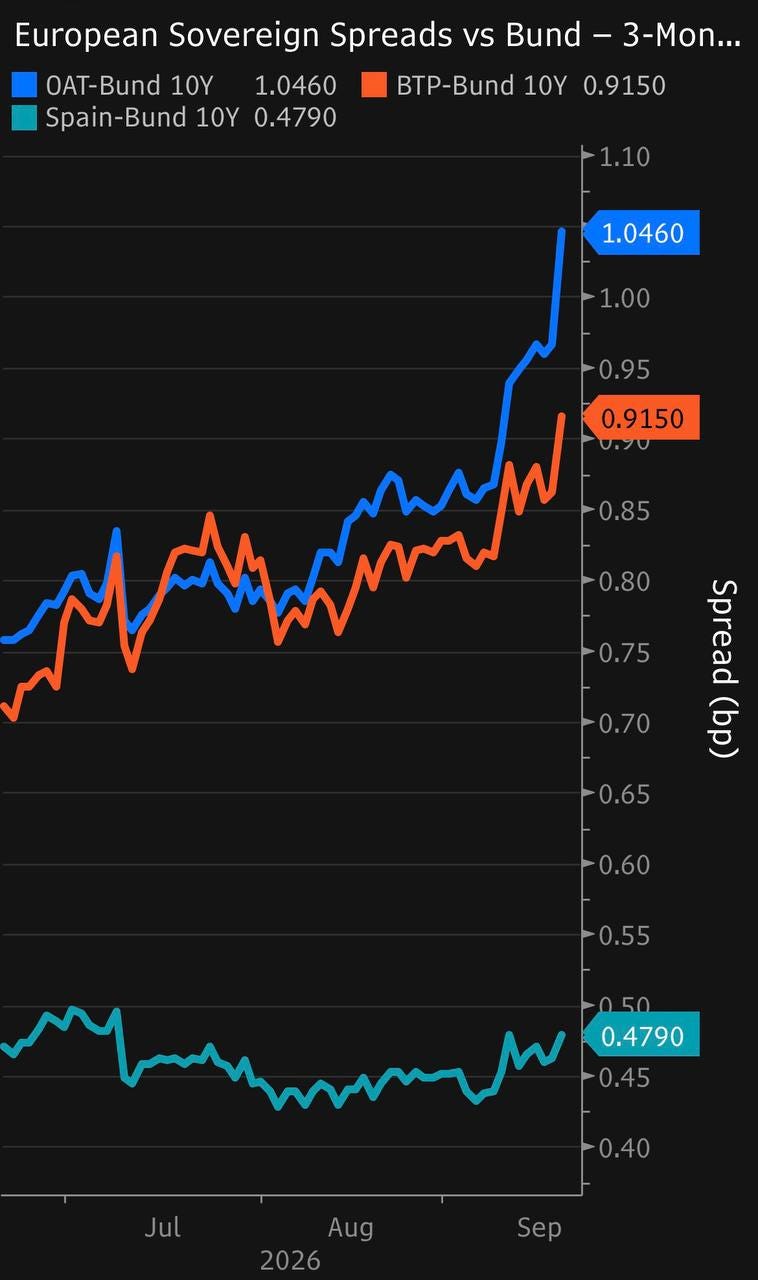
What Is the OAT-Bund Spread
OAT stands for Obligations Assimilables du Tresor, the standard fixed-rate bonds issued by the French Treasury. The Bund is the equivalent German federal bond. Both are benchmark 10-year instruments, both are denominated in euros, and both share the same currency, the same central bank, and broadly the same monetary policy path.
Because those common factors are identical, subtracting the Bund yield from the OAT yield removes the shared component. What remains is the market's assessment of France relative to Germany: the extra compensation an investor requires to lend to Paris rather than Berlin for ten years.
The Bund is treated as the euro area's risk-free benchmark. It is the deepest, most liquid, highest-rated large sovereign market in the bloc, so it is the natural anchor. Every other euro sovereign is quoted as a spread to Bund. The OAT-Bund spread is therefore the single most watched read on French credit and, by extension, on political and fiscal confidence in the euro area's second-largest economy.
How to Read It
The spread is quoted in basis points, where one basis point is one hundredth of one percent. If the OAT yields 3.40 percent and the Bund yields 2.35 percent, the spread is 105 basis points.
A tight spread, historically in the 20 to 50 basis point range, signals that markets view France as a close cousin of Germany: fiscally credible, politically stable, and firmly part of the core. A wide spread signals stress. As the number climbs through 60, 80, and past 100 basis points, investors are demanding a meaningfully larger risk premium and are treating France as drifting away from the core toward the periphery.
Traders watch for a fragmentation threshold, the level at which a rising French premium starts to look like a euro area cohesion problem rather than a France-only story. There is no official line, but sustained moves above roughly 80 to 100 basis points tend to attract European Central Bank attention, because disorderly spread widening can impair the transmission of monetary policy across the union.
Context comes from comparison. The BTP-Bund spread does the same job for Italy, and the Spain-Bund spread for Spain. For most of the past decade France sat comfortably tighter than both, reflecting its core status. Reading OAT-Bund alongside BTP-Bund and Spain-Bund tells you whether a move is idiosyncratic to France or part of a broader repricing of euro periphery risk.
What Drives It
Four forces do most of the work.
Fiscal deficits come first. France has been running a budget deficit above 5 percent of GDP, with official projections keeping it above that line into 2026 and 2027, well beyond the European Union's 3 percent reference. Persistent large deficits mean heavy net issuance of OATs, and more supply plus a weaker debt trajectory pushes the spread wider.
Political risk is the second driver and often the sharpest. Fragmented parliaments, contested budgets, no-confidence votes, and the recurring difficulty of passing spending cuts all inject uncertainty about whether France can stabilize its finances. Political shocks tend to move OAT-Bund faster than any other input.
Ratings are the third. Downgrades or negative outlooks from the major agencies formalize the deterioration and can force some rules-based investors to reassess. Each notch lower narrows the perceived quality gap between France and higher-yielding peers.
Energy and inflation form the fourth. Energy-driven inflation shapes the ECB policy path and the level of euro rates, and it hits fiscal balances through subsidies and support measures, feeding back into the deficit picture.
The result has been striking. The OAT-Bund spread pushed to around 104.6 basis points, described as the widest since the 2012 euro crisis. Even more telling, France at times traded wider than Italy, an inversion that would have seemed almost unthinkable a few years ago, when Italy was the archetypal periphery risk and France sat firmly in the core.
Why It Matters Beyond Rates
The OAT-Bund spread is not just a rates instrument. It is a risk signal that transmits into equities.
French banks are the clearest channel. They hold large books of domestic sovereign debt, their funding costs track French credit, and their profitability is sensitive to the shape of the domestic curve. A widening spread pressures bank valuations directly. The same logic extends to domestic cyclicals: utilities, real estate, construction, and other rate-sensitive, France-exposed names all carry an implicit OAT-Bund beta.
That beta is why the spread matters to volatility desks. When OAT-Bund widens on a political or fiscal shock, French financials and cyclicals tend to sell off together, correlation inside the index rises, and single-stock and index volatility both lift. A sovereign spread that most people file under macro rates ends up expressing itself as equity vol and as a change in the correlation regime. For anyone trading French or euro area equity derivatives, watching OAT-Bund is watching a leading indicator of the equity risk backdrop.
Related CrossVol Research
For the mechanics of how the spread feeds equity dispersion and correlation, see Dispersion and the OAT-Bund Channel, which maps the sovereign-to-equity transmission in detail.
For the rates and central bank backdrop that sets the level of euro yields, see The Coiled Spring: A Hawkish Super-Core, which frames the policy path that anchors the Bund side of the spread.
FAQ
What is the OAT-Bund spread?
It is the difference between the French 10-year OAT yield and the German 10-year Bund yield, quoted in basis points. Because both bonds are euro-denominated core sovereigns, the spread isolates the extra premium investors demand to hold France over Germany.
Why does the OAT-Bund spread widen?
It widens when French sovereign risk rises relative to Germany. The main drivers are large and persistent budget deficits, political instability such as contested budgets and no-confidence votes, ratings downgrades, and inflation dynamics that worsen the fiscal path or lift euro rates.
What is a normal OAT-Bund spread?
Historically France traded tight to Germany, often in the 20 to 50 basis point range, reflecting core status. Recent levels around 104.6 basis points, the widest since 2012 and at times wider than Italy, are far from that historical norm.
What does the OAT-Bund spread tell you?
It tells you how much extra risk premium markets attach to France versus Germany, and therefore how much fiscal and political stress is priced in. It also acts as a leading signal for French bank and cyclical equity volatility and correlation.
Djellal Djouad
Further reading