


By Djellal Djouad. October 25, 2026.
Market data as of the October 23 close.
This article is for educational purposes only. It is not investment advice. Trading bonds, futures and options involves substantial risk of loss.
France now borrows like the periphery
On Friday, October 23, 2026, France paid more to borrow for ten years than Italy, Greece, Spain and Portugal. The price of insurance against a French default closed above the price of insurance against a Mexican one.
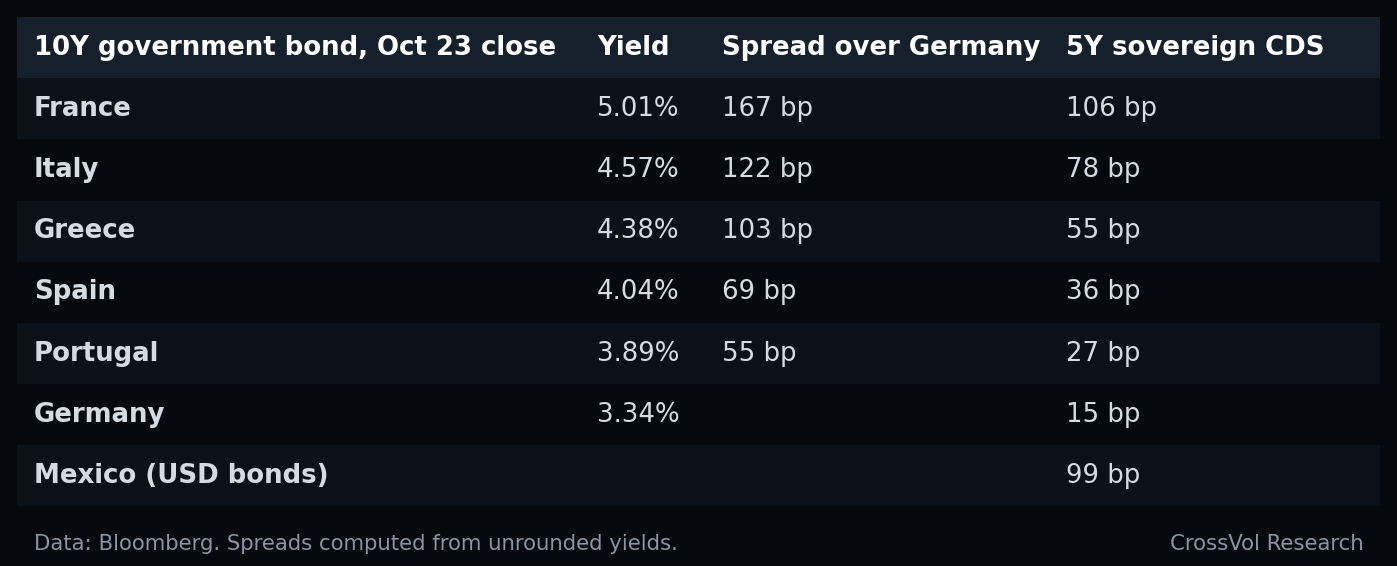
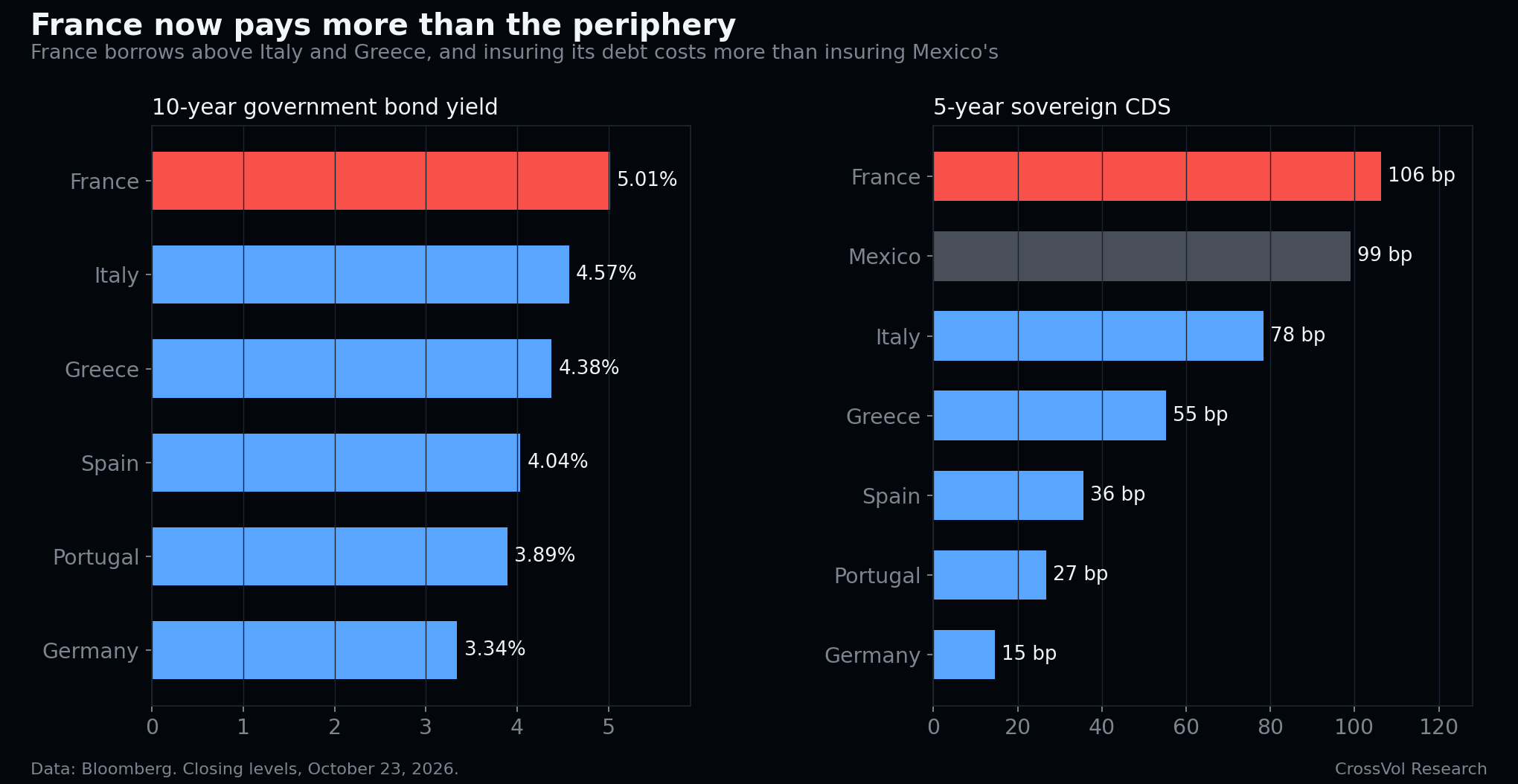
Fifteen years ago, the euro crisis was a story of Greece, Italy, Spain and Portugal paying for their debt while France sat with Germany in the core. This week the order flipped. France pays 45 bp more than Italy and 64 bp more than Greece for ten-year money.
Key terms.
A basis point (bp) is one hundredth of a percentage point: a yield moving from 5.00% to 5.01% has risen 1 bp.
The OAT-Bund spread is the gap between the French 10-year yield (OATs are French government bonds) and the German 10-year yield (Bunds). Germany is the euro area's safe-haven borrower, so the spread measures the extra yield investors demand to hold French risk.
The euro area core (Germany, the Netherlands, and until now France) borrows cheaply. The periphery (Italy, Spain, Portugal, Greece) historically paid a risk premium.
A CDS (credit default swap) is an insurance contract against a borrower's default. At 106 bp, insuring 100 million of French debt for five years costs about 1.06 million a year.
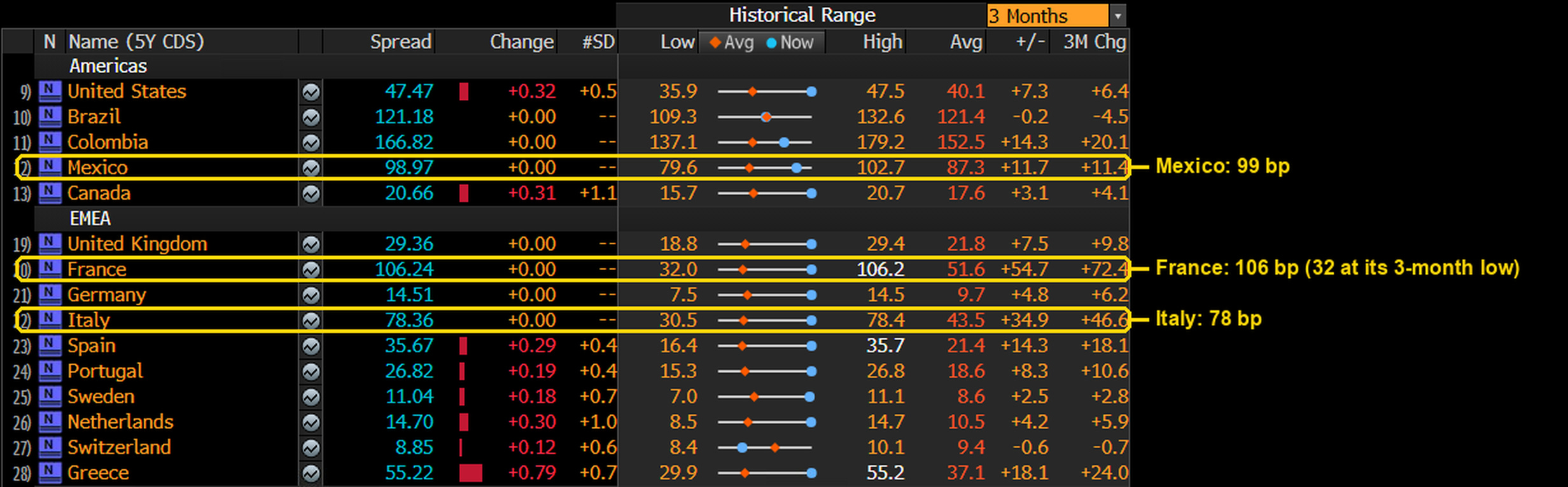
Three months ago, French five-year insurance traded as low as 32 bp. It has more than tripled.
The week the French bond market broke a record
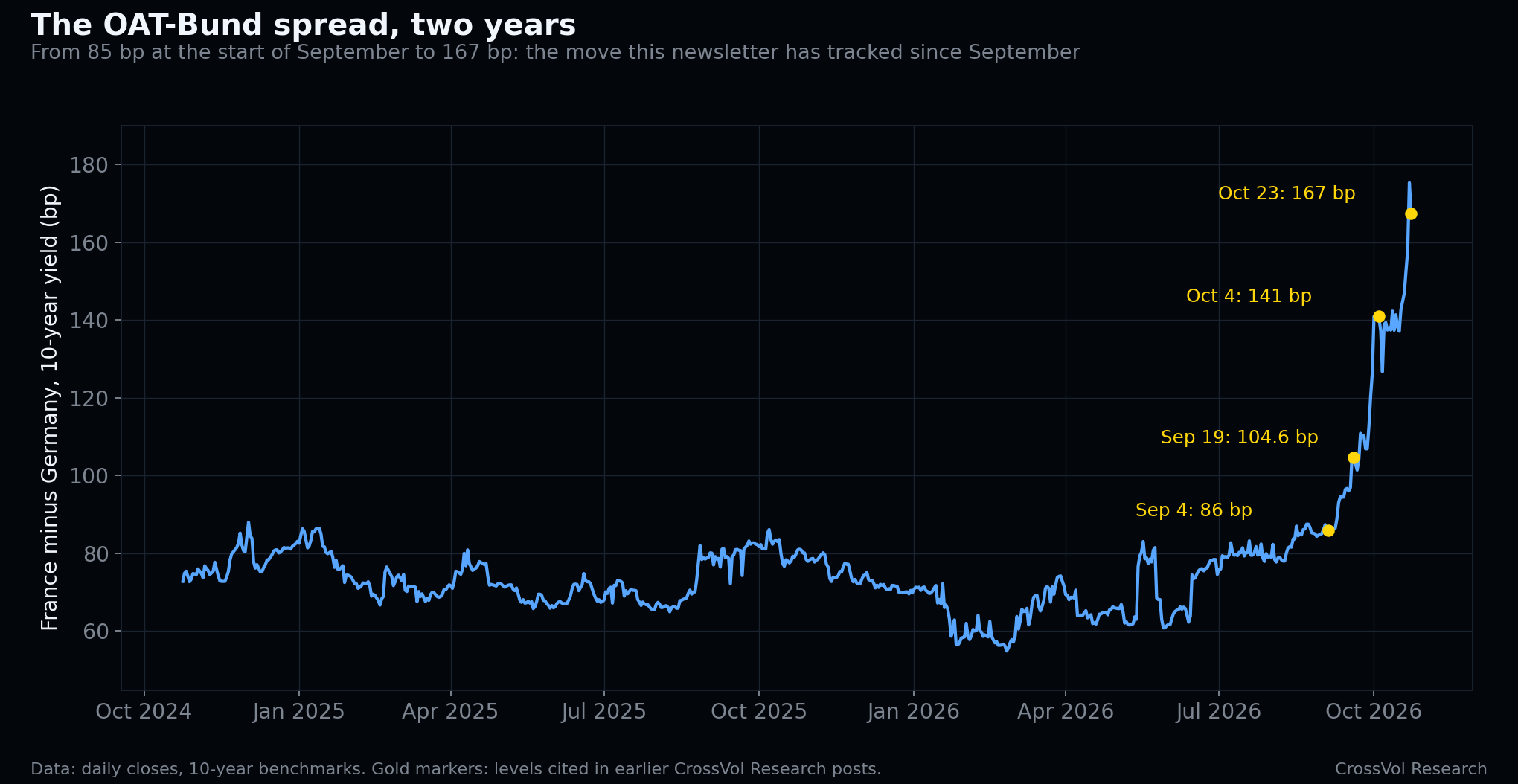
OAT-Bund 10Y: +29 bp in one week, from 138 bp to 167 bp. According to Bloomberg, it is the second biggest weekly widening on records going back to 1990. On Thursday, October 22, the spread reached 178 bp, its highest since the 2011 euro debt crisis.
French 10Y yield: 5.01%, after closing at 5.08% on Thursday, the highest in 24 years. In three months, the French yield is up 105 bp. The German one is up 17 bp.
French 2Y yield: +22 bp to 3.80%, while the German 2Y fell 5 bp. The two-year gap between France and Germany went from 47 bp to 74 bp in five sessions.
Euro-OAT futures, exchange-traded contracts on French government bonds, lost 1.9% on the week. Open interest, the number of contracts outstanding, rose by about 101,000 in the four days to Thursday, +15%: a record build-up of new positions.
CAC 40 (tracked by the $EWQ ETF): -2.2% on the week and -4.5% year to date, -8.9% for a dollar-based investor. It is the only major European index down for the year. The DAX is up 2.8%, Milan 8.0%, Madrid 9.7%.
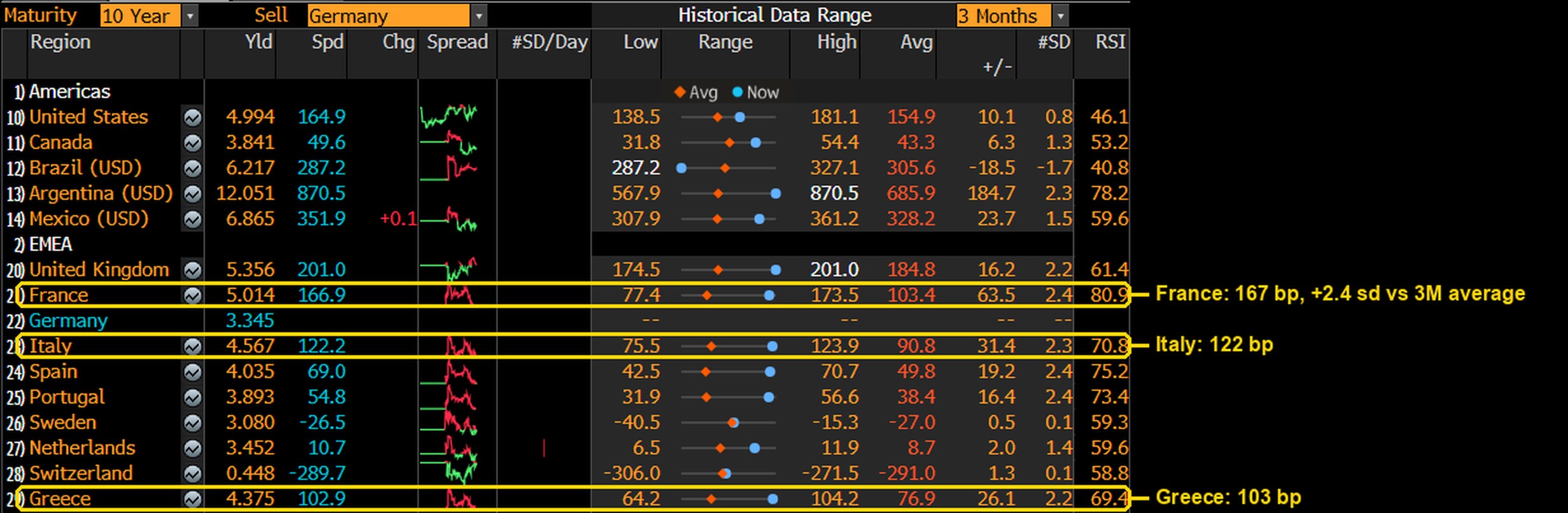
The French spread now sits 2.4 standard deviations above its three-month average. This newsletter has tracked it since September: 86 bp on September 4, 104.6 bp on September 18, when I called it "a structural repricing, not a headline", 141 bp on October 4, and 167 bp today.
Why the French 2-year yield is the real alarm
When investors worry about a country's long-term debt path, the long end of the curve, made of bonds with long maturities, usually sells off first. That is a term premium story: lenders want extra yield for tying up money for decades.
France did the opposite this week. Its 2-year yield rose as much as its 10-year (+22 bp and +21 bp) and its 30-year rose half as much (+11 bp). The gap between the French 2-year and 30-year shrank by 11 bp: a bear flattening, short rates rising faster than long rates.
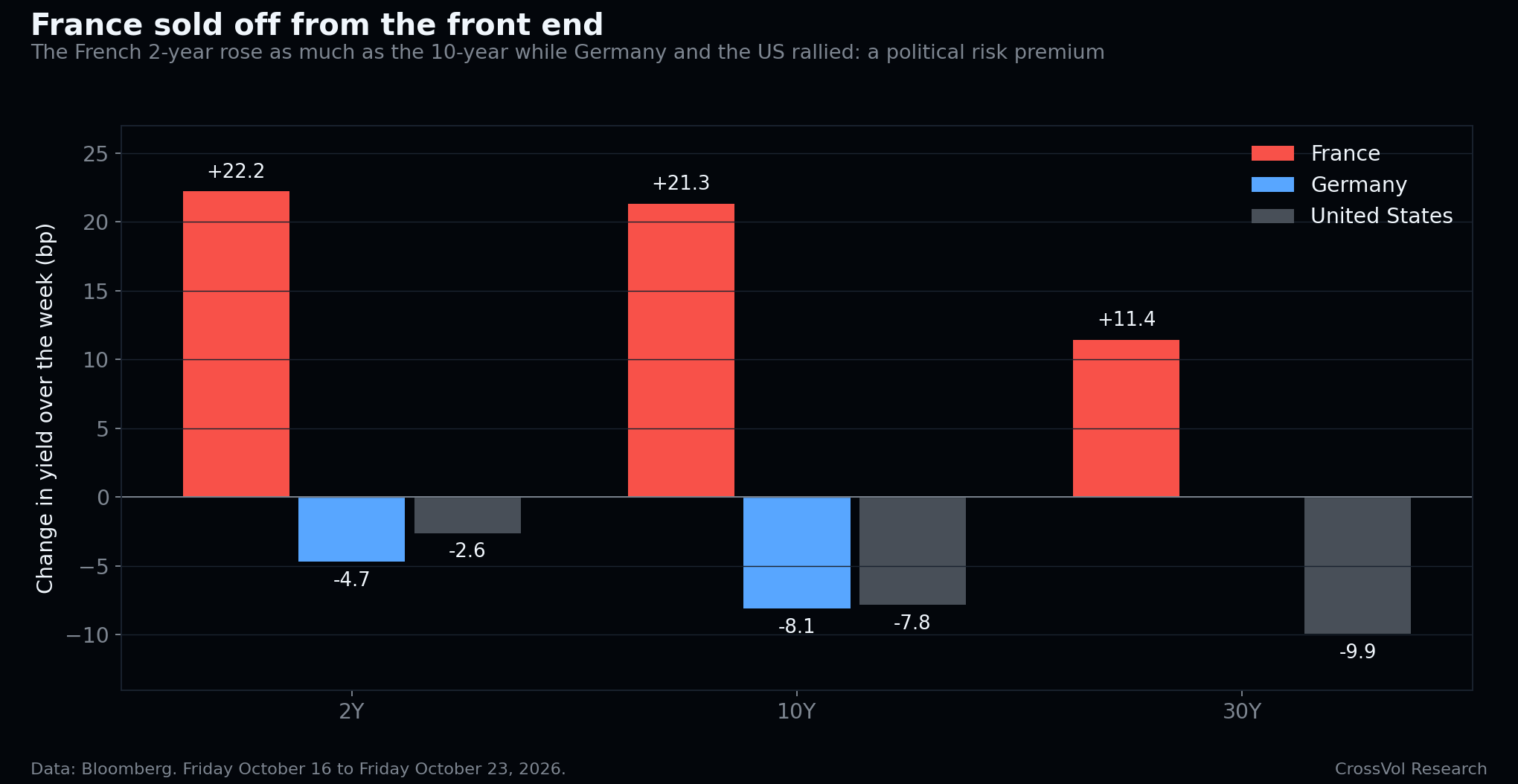
The United States offers the contrast. The New York Fed's estimate of the US 10-year term premium (the ACM model) fell from 98.5 bp on October 8 to 63.9 bp on October 22, and Treasuries rallied across the curve.
A two-year bond matures before any fiscal plan can repair the debt ratio. Investors who dump it are pricing the next eighteen months: a budget without a majority, a presidential election in six months, and a street in open revolt. That is a political risk premium sitting at the front of the curve. Italy's curve showed the same front-end stress on its way into the 2011 crisis.
Moody's: a reprieve that reads like a warning
Late on Friday, Moody's kept France at Aa3 with a negative outlook. Aa3 is the fourth step of Moody's scale; each step is called a notch, and Moody's now rates France one notch above S&P and Fitch, which both cut it in 2025. The market had largely expected a downgrade. The statement still reads as a warning:
> "Slower growth and a higher deficit have pushed France's debt burden somewhat higher than previously expected. Bond yields have risen more rapidly than we expected, while widespread social protests have erupted which could constrain fiscal consolidation efforts."
And:
> "Despite the challenging political and social environment, our baseline assumption is that a deficit-reducing budget for 2027 will eventually be adopted, possibly by decree."
Source: Moody's statement as reported by Bloomberg, October 23, 2026.
Moody's base case already allows for a budget adopted by decree. The deficit is running at 5.4% of GDP this year, against a 5% target for next year. The government has no majority, and the National Assembly rejected the revenue part of the 2027 social security budget on Friday. Debt servicing costs are heading toward about 2.9% of GDP by 2027, against about 1.3% in 2020.
The reprieve should give French bonds a mild lift when markets reopen. The trajectory is unchanged, and France still sits one notch above where the two other major agencies already rate it.
The street has become a market variable
The bond market moved on the street this week, not on a fiscal data point.
October 17-18: more than half a million people marched, public buildings were attacked, about 3,000 stores were looted and 2,700 people were arrested, according to Bloomberg.
For October 24, authorities planned 20% more police than the previous Saturday, special intervention units, and soldiers to guard sensitive buildings. President Emmanuel Macron said only union-organized protests would be authorized, and that "the general recommendation is that there be no demonstrations in the coming days".
October 23: a shooting in Trappes and La Verrière, west of Paris, left one dead and four wounded. The national anti-terrorism prosecutor took the case, Interior Minister Laurent Nuñez called it a terrorist crime, and press reports described a racist motive.
October 24: the Interior Ministry counted 410,000 marchers (800,000 according to organizers), 1,314 arrests and 53 police officers injured. In Orléans, barricades were still up on Sunday.
October 30: the "gilets jaunes" (yellow vests) are calling for "casserolades", pot-banging protests, in front of the National Assembly on Friday, in "defense of public freedoms" against what they call an authoritarian drift.
November 5: the unions, led by the CGT, have called a general strike across the country, starting that day, covering transport, schools and hospitals.
Investors who used to buy France at 50 bp over Bunds "now won't even think about touching it", RBC BlueBay's chief investment officer told Bloomberg. When the natural buyers step back, the price is set by the marginal seller, and in a trending market that seller is the trend follower (or CTA, a systematic fund that buys what rises and sells what falls). The record build-up in OAT futures fits that picture.
The France Risk Gauge: a proprietary model, now at 81 out of 100
Standard risk dashboards treat France as a bond story. To capture the rest, I built the France Risk Gauge, a proprietary CrossVol model. The formulas stay in-house; here is what it does.
What it measures. One question: how much stress is France under, from the bond market to the street to the institutions? The answer is a single reading from 0 to 100, split into four zones: green (calm), amber (tension), orange (confidence crisis) and red (peril).
What goes in. Five blocks, each built from data that updates during the day:
The bond market: the OAT-Bund spread, the most direct price of French risk.
France against Italy: how France trades relative to the euro area's historical weak link.
Sovereign ratings: Moody's, S&P and Fitch, ratings and outlooks, updated automatically when an agency acts.
Political fear: daily counts of reported unrest and looting, attacks and far-right violence, and civil-war rhetoric, built from news wires and checked against official tallies (Interior Ministry, prosecutors) and weekly conflict-event data.
Constitutional risk: signals of governance by exception (protest bans, states of emergency, talk of constitutional revision, election delays or emergency powers), organized around three constitutional branches explained below.
How it reads. Each political and constitutional signal is compared with its own recent history, so a high reading means "unusual for France over the past six months", not just "a lot of headlines". The market blocks carry the most weight, because money is the final judge; the political blocks explain why money moves.
What it is for. Separating the fiscal part of the French risk premium from the political part, in real time.

On Sunday the gauge read 81 out of 100, in the red zone. The bond block alone reads 69. The political block pushes it into the red: over the past seven days, reports of unrest and looting ran at about six times their usual high level, and reports of attacks and far-right violence at about seven times.
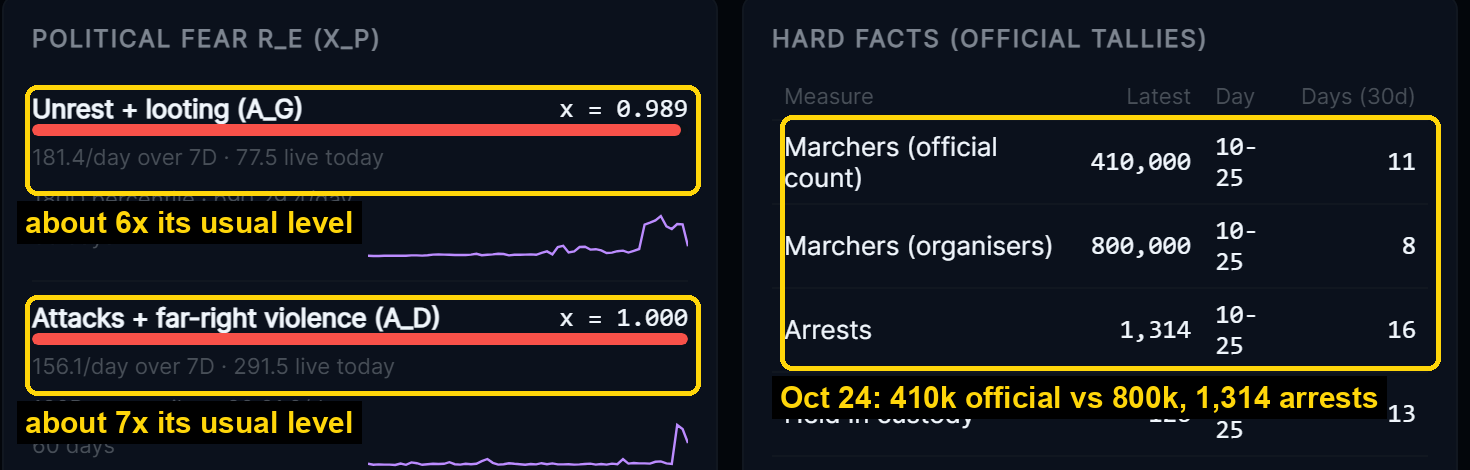
The gauge does not try to predict riots. It measures how much of the move in French debt is political rather than fiscal. This week, most of it was.
The model: fear of the extremes sells the status quo
The gauge rests on a reading of how political shocks travel into prices.
Each shock gets attributed to one camp. Riots and looting feed the "danger from the left" story. An attack like Trappes feeds the "danger from the right" story. The two alternate, so the fear of extremes never comes back down. When fear is moderate, voters look for a providential figure from the center or the republican right: centrists such as Édouard Philippe or Gabriel Attal, and figures of the republican right such as Bruno Retailleau, Xavier Bertrand or David Lisnard. When fear becomes extreme, even a providential candidate looks like a gamble, and the status quo becomes the safe haven.
For a derivatives trader, the structure is familiar:
fear of the extremes plays the role of implied volatility, the price the market puts on future swings;
the providential figure is the protection you get sold;
the OAT-Bund spread is the volatility index that confirms the fear;
when fear reaches the tail, buyers stop paying for protection and go to cash, which here means the status quo.
The bond market prices this political volatility continuously and in size. That is why the spread works as France's political volatility index.
Constitutional risk: what Articles 16, 89 and 7 really allow
The constitutional block exists because the tail risk in France is governance by exception, not just a bad budget. The texts define which tails are real.
Article 16 gives the President exceptional powers when the institutions, the independence of the nation, the integrity of its territory or its international commitments are under serious and immediate threat, and the regular functioning of the constitutional public authorities is interrupted. It gives powers, not time: it does not extend a mandate. Under the Constitutional Council's 1992 decision (92-312 DC), the Constitution cannot be revised while Article 16 is in force.
Article 89 governs constitutional revision. The same text must pass both chambers, then either a referendum or a three-fifths majority of Parliament sitting together in Congress. No revision is allowed while the territory is under attack.
Article 7 allows, and in some cases obliges, the Constitutional Council to postpone the presidential election only if a candidate dies or becomes incapacitated around the filing deadline or before the vote. Civil unrest is not a ground. During a vacancy of the presidency, the Constitution cannot be revised either.
The plausible tail is therefore the slow one: budgets passed by decree, protest bans, emergency measures, and an election campaign run under them. The gauge splits this into three branches (a revision under internal peril, an Article 7 delay, Article 16) and reports the most open one. This week, the revision branch saturated, led by protest bans: 22 reports a day, against a 90th percentile of 1.6.

For bond pricing, the slow version is enough. Institutional risk is what turns a deficit problem into a front-end problem.
Can the ECB save French bonds?
The obvious backstop is the European Central Bank. Its Transmission Protection Instrument (TPI) lets it buy a country's bonds, with no size limit set in advance, when spreads widen in a way it judges disorderly and unjustified by fundamentals. Purchases focus on maturities of 1 to 10 years, the exact segment under stress. Eligibility conditions include compliance with EU fiscal rules and an assessment of debt sustainability.
Two obstacles:
France has been under an excessive deficit procedure (the EU process for countries above the 3% deficit limit) since July 2024. Its fiscal path makes the "unjustified by fundamentals" test hard to pass, and the conditionality is political.
Former ECB president Mario Draghi said recently that ECB intervention for France is still a distant prospect. The race to succeed Christine Lagarde (Klaas Knot or Pablo Hernández de Cos) is increasingly framed around who can stand up to the bond vigilantes, investors who sell a government's debt to punish its fiscal policy. As Bloomberg put it on Sunday: "Never has market speculation focused so ominously on such a large and pivotal member of the currency bloc."
Until the ECB signals otherwise, trend followers remain the marginal price setters.
French bonds: the levels a quant trader watches
These are the levels and dates I am watching. They are a framework, not a recommendation.
OAT-Bund 10Y. 167 bp (high 178). What would change the reading: A close above 180 bp opens a test of 200 bp, where the ECB intervention debate becomes unavoidable. A close back below 150 bp would mean the political premium is leaking out.
France-Germany 2Y. 74 bp. What would change the reading: The cleanest gauge of political risk. If it keeps widening while the 10Y spread stabilizes, the market is pricing the next 18 months rather than the next decade.
France 5Y CDS. 106 bp. What would change the reading: The gap to Italy (78 bp). France trading wider than Italy on CDS signals a lasting re-rating rather than a squeeze.
CAC 40 vs DAX. CAC -4.5% YTD, DAX +2.8%. What would change the reading: French banks and domestic stocks carry the sovereign risk. A further spread widening without CAC underperformance would be an unusual divergence.
National Assembly. Budget debate resumes next week. What would change the reading: Any use of decree powers is within Moody's base case. The market will read the deficit number, not the procedure.
ECB decision. October 29. What would change the reading: Explicit language on TPI eligibility is the biggest potential spread compressor.
Yellow vests "casserolades". October 30. What would change the reading: First test of the protest bans in front of Parliament.
General strike. From November 5. What would change the reading: The biggest street test since the crisis began. The gauge's political block will measure it in real time.
Spreads already price a lot of political risk. But the natural buyers have left, positioning follows the trend, and the backstop is not in sight. In that setting, relief rallies like Friday's (-7 bp, the biggest daily tightening since October 6) can be sharp, and still short-lived.
FAQ: the French bond crisis in four questions
Why does France pay more than Italy to borrow? Because investors now price French political risk above Italian fiscal risk. Italy has a stable governing majority; France has a 5.4% deficit, no majority, an election in six months and mass protests. The 10-year gap reached 45 bp in France's disfavor on October 23, 2026.
What is the OAT-Bund spread today? 167 bp at the October 23, 2026 close, after a high of 178 bp on October 22, the widest since the 2011 euro crisis. It was 85 bp at the start of September.
Did Moody's downgrade France? No. On October 23, 2026, Moody's kept France at Aa3 with a negative outlook, one notch above S&P and Fitch, while warning that protests could constrain fiscal consolidation and that the 2027 budget may be adopted by decree.
Can the ECB stop the selloff? It has the tool, the TPI, but France's excessive deficit procedure complicates eligibility, and former ECB president Mario Draghi called intervention a distant prospect.
Further reading on CrossVol Research
The OAT-Bund Spread Explained: France, Germany, and Sovereign Risk (September 19, 2026): the basics of reading the spread.
Dispersion and the OAT-Bund Channel (September 19, 2026): written at 104.6 bp, "a structural repricing, not a headline".
Volatility Is Starting to Talk Even While the VIX Sleeps (October 4, 2026): France as the epicenter of cross-asset volatility, at 141 bp.
Stock Market Week in Review, October 19 to 23, 2026 (October 25, 2026): the AI selloff, the Treasury rally and oil at $117.
This article is for educational purposes only and does not constitute investment advice or a recommendation to buy or sell any security. Bonds, futures, CDS and options carry substantial risk, including the loss of more than the initial investment for leveraged instruments. Past patterns do not guarantee future results.