


By Djellal Djouad. November 5, 2026.
Market commentary for educational purposes. This is not investment advice and not a recommendation to buy or sell anything. Figures are as of the dates given, markets move fast, and stocks, bonds and derivatives can lose far more than you expect.
For months I have told clients that the AI build-out carries a cost the market refuses to price. The chips bought in 2023, 2024 and 2025 keep wearing out, in economic terms, much faster than the accounts say. Every year adds a new layer of hardware to depreciate on top of the old one, and the bill grows faster than the revenue it is supposed to pay for.
This week the mood on Bloomberg is the opposite. Bloomberg Intelligence writes that much of the bad news already appears priced into tech credit spreads, that record order books show investors are paid for supply rather than for credit risk, and that rising Ebitda, earnings before interest, tax, depreciation and amortization, will keep leverage in check. I disagree. One of my clients, David Wolf, an engineer, built a cost model of an AI data center to test my thesis. I have checked it cell by cell and corrected it where it was wrong. The conclusion survives, and it comes down to one number: how long a GPU really lasts. At the end I explain why French banks sit on the wrong side of this.
What the accounts assume
Every hyperscaler depreciates its servers in a straight line, over lives it chooses itself. Microsoft, Alphabet and Oracle use six years, and so does CoreWeave, the largest of the GPU renters. Meta uses five and a half years since January 2025. Amazon is the only one that went the other way: from January 2025 it cut the life of part of its servers and network gear from six to five years, citing the faster pace of technology, particularly in artificial intelligence. None of them shows a separate life for GPUs. The accelerators sit in the same bucket as switches and storage.
This year the trend has been to stretch lives, not shorten them. Nebius, a GPU renter that used four years, moved to five from the first quarter of 2026. Microsoft now depreciates its data center buildings over 25 years instead of 15, from the fiscal year that began in July. Even on these long schedules the charge is exploding. Microsoft's depreciation expense rose 56% to $34.3 billion in the fiscal year to June. Oracle's nearly doubled to $7.6 billion. Meta's depreciation and amortization was up 44% in the third quarter.
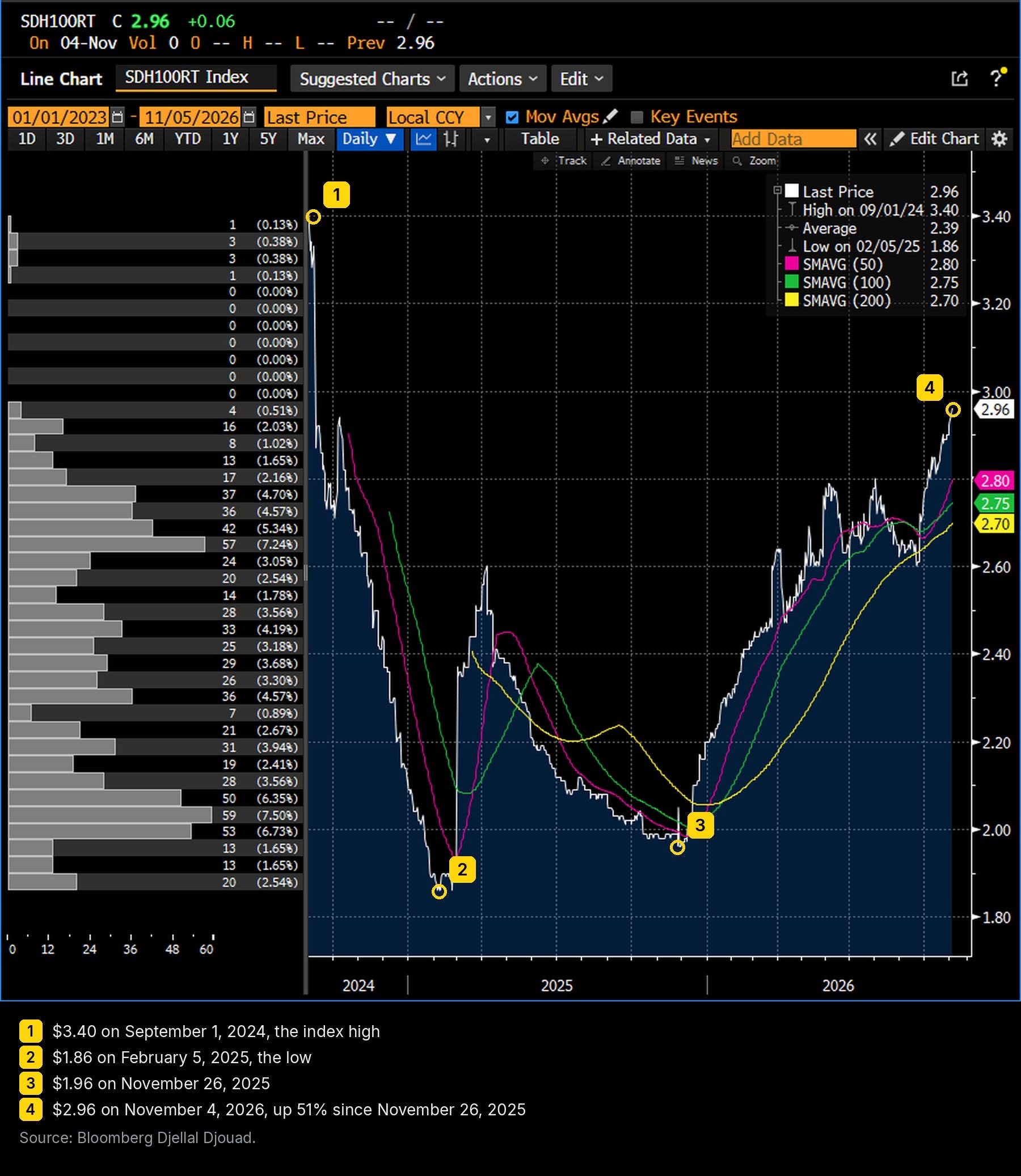
Michael Burry argued a year ago that stretched lives would understate the industry's depreciation by $176 billion between 2026 and 2028. Steve Eisman answered last month that Burry is focusing on the wrong risk, because older chips keep finding users. Both have a point, and the market data shows why. An H100 rented for up to about $8 an hour at the 2023 peak. The Silicon Data H100 rental index, which Bloomberg carries, started at $3.40 in September 2024 and fell to $1.86 by February 2025, minus 45% in five months. It was still at $1.96 at the end of November 2025. Then it rebounded to $2.96 on November 4, up 51%, probably because power, not chips, became the bottleneck. Hardware loses its value in steps, every time a new generation arrives, and scarcity can lift the whole staircase for a while. It never makes a 2023 chip a 2026 chip.
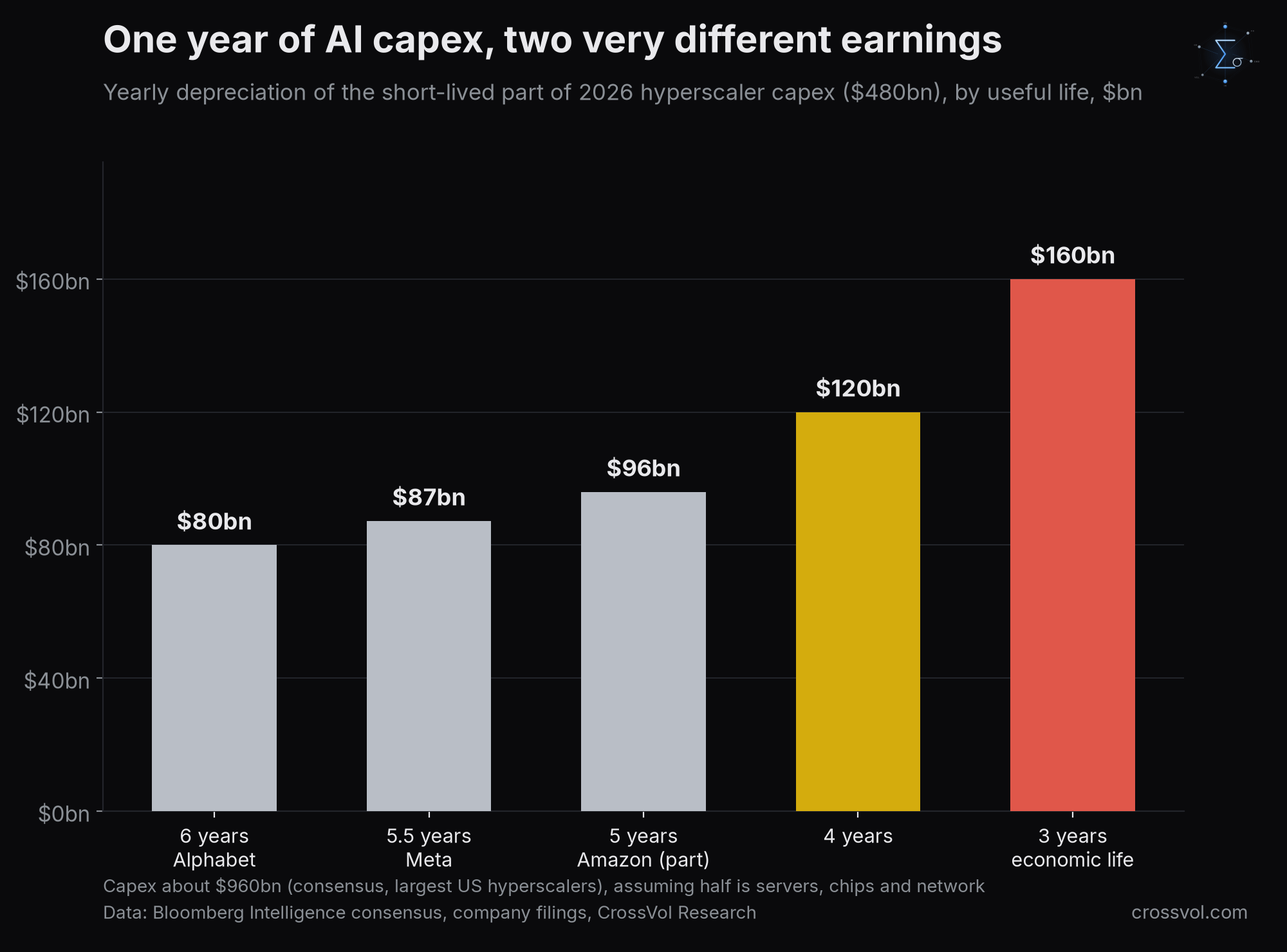
The scale makes the question anything but academic. Bloomberg Intelligence's consensus puts 2026 capital spending by the largest US hyperscalers, now including SpaceX, at close to $960 billion: about $220 billion for Amazon, $195 billion to $205 billion for Alphabet, close to $200 billion for Microsoft. Bloomberg Intelligence sees Amazon and Alphabet near or above $300 billion each in 2027. Microsoft has put the share of its spending on short-lived assets, mostly chips and servers, at roughly half, and at about two-thirds in a recent quarter. Take only half of $960 billion as hardware and change nothing but the useful life: the yearly depreciation of this single vintage goes from $80 billion at six years to $160 billion at three. That is $80 billion a year of cost that a six-year schedule pushes into later years, for one year of spending.
David's $1 billion data center
David's model is simple, which is its strength. A $1 billion site: 60% for GPUs and servers, 7% for the network, 25% for power and cooling, 8% for the building. At $40,000 per GPU, server included, that buys 15,000 GPUs. The site draws 25 megawatts, pays Texas power at 6.5 cents per kilowatt-hour, employs 30 people, borrows at 8% and rents its GPUs at $3.90 an hour, 70% of the time. Depreciation is straight-line: five years for the GPUs and the network, fifteen for power and cooling, thirty for the building.
On those inputs the site costs $2.95 per GPU-hour, financing included, and earns a 24% margin. That is the number that goes on the cover of a pitch book. David did not stop there. An adjusted version adds the costs people forget (insurance, local property tax, software, sales and overheads) and lets the rental price fall 15% a year: the margin turns to minus 11.5%. A dynamic sheet starts from a $2.50 contract price, lets supply grow faster than demand and lets ageing GPUs lose 15% a year against new ones: the site loses money every year and never recovers its cumulative losses.
The arithmetic is right. Some inputs are not, and they do not all err in the same direction.
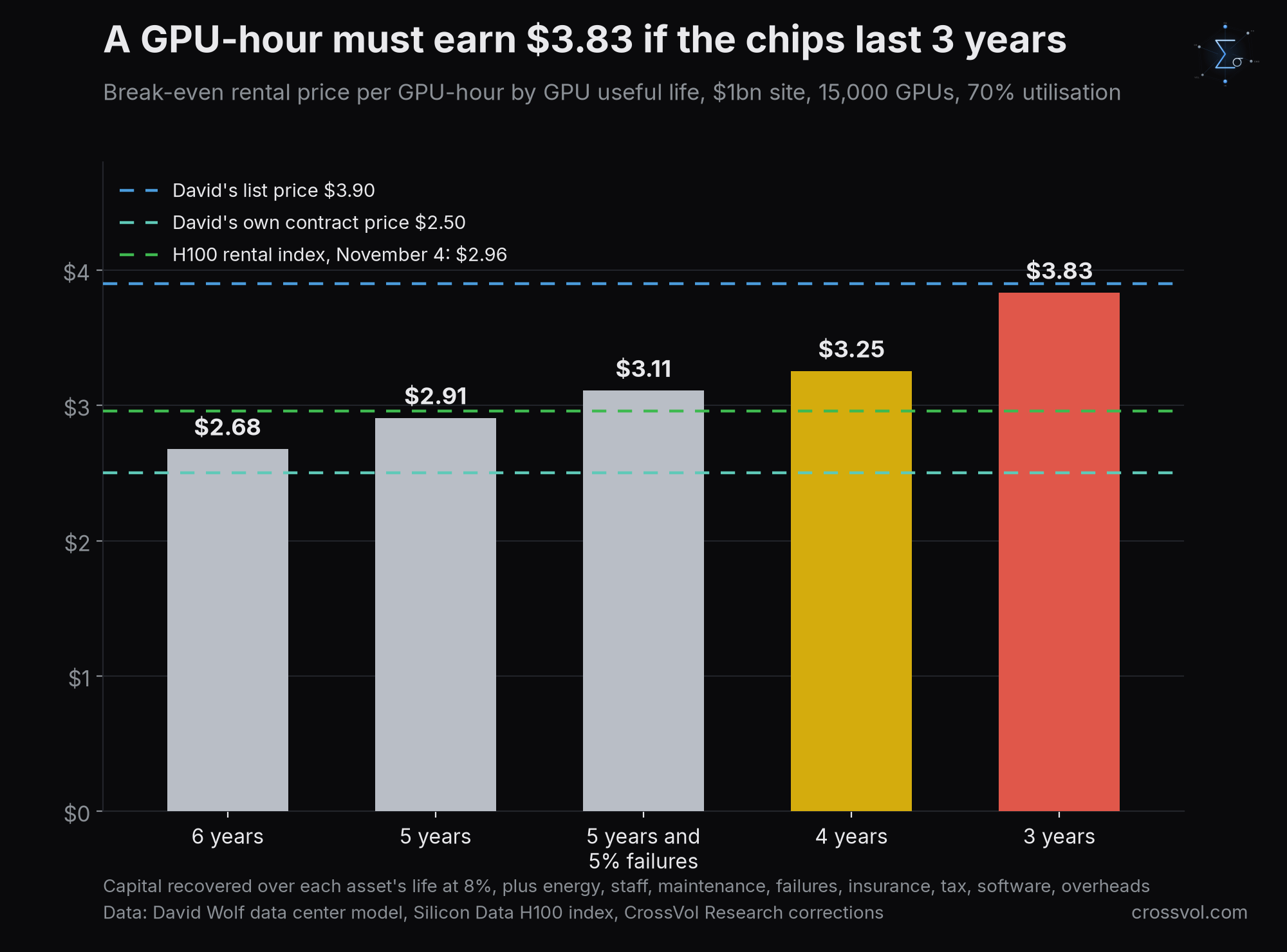
1. The price is too high for this chip. $40,000 per GPU and 25 megawatts for 15,000 of them describe a Hopper site, H100 or H200. $3.90 an hour is more than even an H200 rents for today, $3.48 on October 24. The H100 rents at $2.96, and David himself uses $2.50 for contracts in his dynamic sheet. At $2.50, his first sheet loses $42 million a year, a margin of minus 18%, before any forgotten cost.
2. The financing is charged too hard, and correcting it helps the operator. His adjusted version compares a price averaged over five years with the interest of the first year on the full $1 billion. Debt is repaid as the assets depreciate, so the interest falls every year. The clean method recovers each asset's cost over its life at the 8% borrowing rate, like a mortgage payment, and discounts the falling rental prices at the same rate, which is what I mean below by today's money. Done that way, his adjusted case roughly breaks even, a margin of about plus 2%, against a cost of $2.91 per GPU-hour on a five-year life. So his adjusted loss came from the financing method. The real losses come from the next point.
3. The GPUs do not last five years. This is the heart of the matter. A five-year schedule spreads the $600 million of GPUs at $120 million a year. If the chips are economically obsolete after three, the true cost is $200 million a year. The difference, $80 million a year on this one site, is $0.87 on every GPU-hour sold, pushed into the future by the accounting. On a three-year life the break-even price jumps to $3.83.
Put the corrected cost next to today's market and the whole case hangs on that one assumption. At the H100's $2.96, the site earns 9% of its revenue if the chips last six years, 2% if they last five, and loses 29% if they last three. Even at David's $3.90, held flat for three years, the margin is under 2%.
4. Failures are too low. David assumes 2% of the GPU fleet is replaced each year once the warranty has run out. When Meta trained Llama 3 on 16,384 H100s, it logged 419 unexpected interruptions in 54 days, including 148 faulty GPUs and 72 memory failures. Annualised, that is close to 10% of the fleet, though not every incident means a replacement. Something like 4% to 6% a year is more realistic. With 5% instead of 2%, the break-even on a five-year life rises from $2.91 to $3.11.
5. Prices do not glide down 15% a year. They move in steps: the H100 index lost 45% between September 2024 and February 2025, then gained 51% over the past year. Starting from David's own $2.50 with his 15% decline, the five-year price is worth $1.90 an hour in today's money, a third below the $2.91 that even a five-year life requires.
6. Power is billed at full load. David charges 25 megawatts around the clock while the GPUs work 70% of the time. Idle chips draw less, so this input is slightly harsh on the operator, by at most five cents per GPU-hour. It does not change the answer.
The loan outlives the chips
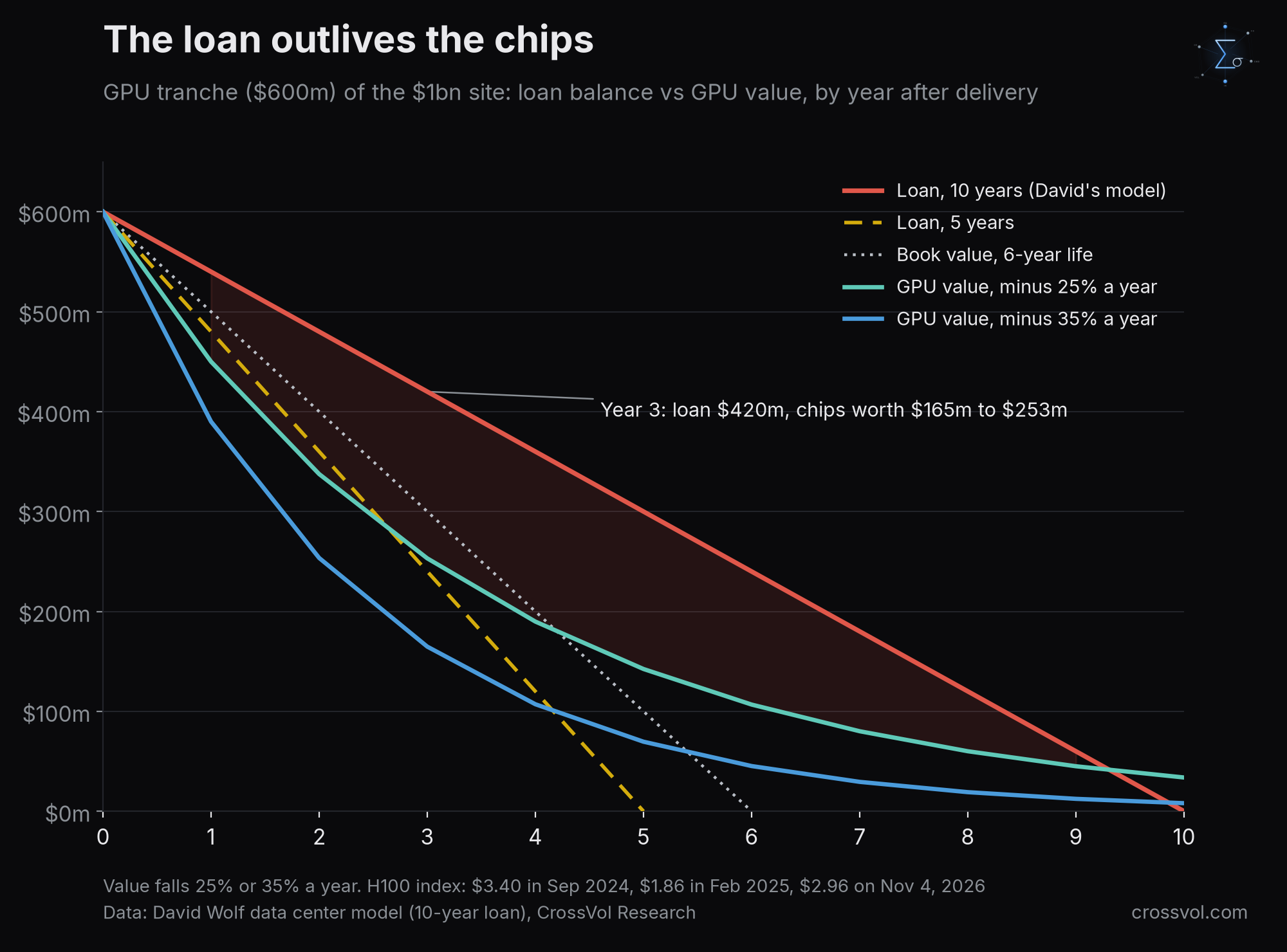
One more detail in David's dynamic sheet matters to whoever lends the money. He finances the site with a 10-year loan. The GPUs are depreciated over five years and, in my view, lose most of their economic value in three. The debt outlives the collateral.
Take the $600 million of GPUs. After three years, a 10-year loan still has $420 million outstanding. If the chips lose 25% to 35% of their value a year, they are worth between $165 million and $253 million. Even a five-year loan is worth more than the chips for the first two years at a 25% annual loss, four years at 35%. Matching the loan to a five-year life would raise the GPU debt service, with level payments, from $89 million to $150 million a year, another $0.66 per GPU-hour in cash. Lenders know this, which is why they lend mainly against the rental contracts. The real collateral is then the tenant's promise to keep paying, and several of the largest tenants of this cycle, OpenAI first, burn cash.
Why Bloomberg's calm does not reassure me
The Bloomberg Intelligence numbers are good. It is the reading I disagree with.
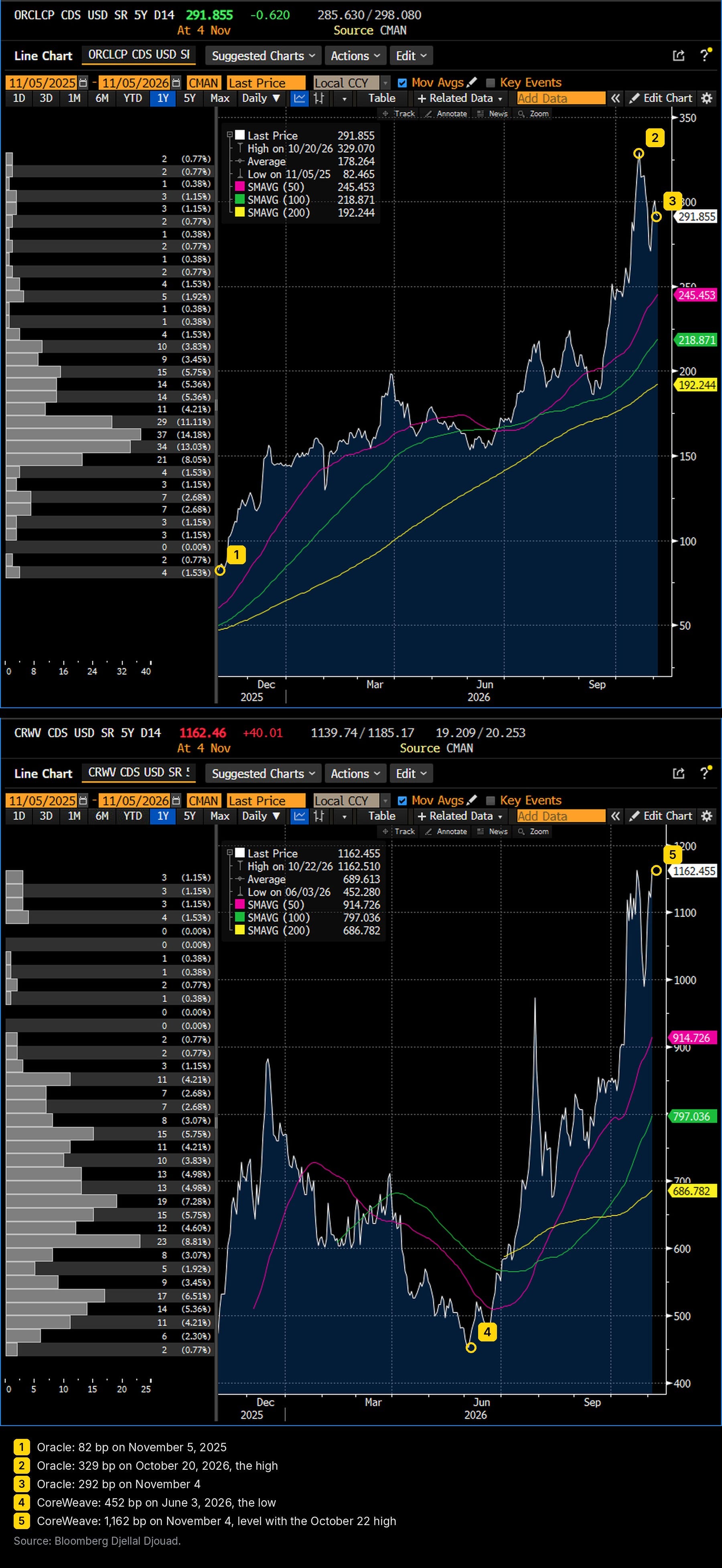
The credit market has already started to charge. On Bloomberg, the cost of insuring Oracle's debt for five years, its credit default swap, has gone from 82 basis points a year ago to 292 on November 4, after 329 on October 20. CoreWeave's has more than doubled since June, from 452 to 1,162 basis points on November 4, level with its October 22 high. These are builders and tenants of the AI boom, and the market already charges more to carry their risk.
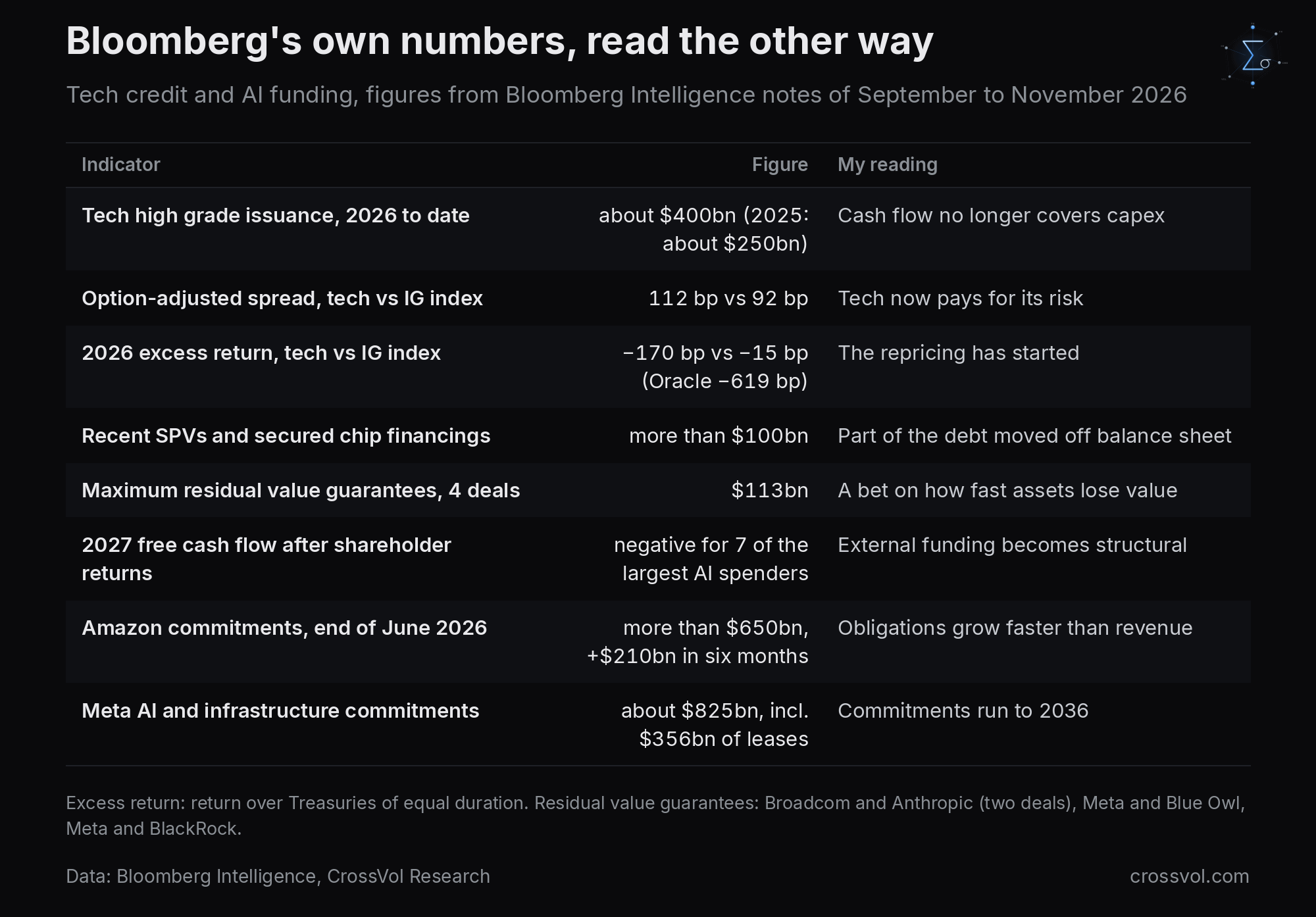
Ebitda leaves out the one cost this trade is about. The argument that leverage stays contained because Ebitda grows about 29% a year through 2031 measures cash generation before depreciation. If the hardware has to be replaced every three years, that replacement is an operating cost in all but name, and Ebitda overstates what is left to service debt.
The supply is the symptom. Investment grade bond issuance by tech companies is about $400 billion this year, against about $250 billion in all of 2025. Tech bonds pay about 112 basis points more than Treasuries, against 92 for the whole investment grade index (a basis point is a hundredth of a percentage point), and their return over Treasuries is minus 170 basis points this year, against minus 15 for the index. Oracle and SpaceX trade closer to BB than to their ratings. Bloomberg reads this as compensation for supply. Supply is what capital intensity looks like when cash flow no longer covers it.
Free cash flow is turning negative. On Bloomberg Intelligence's own estimates, SpaceX, Alphabet, Meta, Oracle, Amazon, CoreWeave and Microsoft all have negative free cash flow in 2027 once dividends and buybacks are paid. Alphabet has already announced an $80 billion stock sale, including $10 billion placed with Berkshire Hathaway. Amazon's commitments, meaning debt, leases and purchase obligations, passed $650 billion at the end of June, $210 billion more than six months earlier. Meta's future AI and infrastructure commitments are about $825 billion, including $356 billion of leases that start as late as 2036.
A residual value guarantee is a bet on depreciation. More than $100 billion of special purpose vehicles and secured chip financings have been arranged recently. Four of the largest, Broadcom with Anthropic twice, Meta with Blue Owl and Meta with BlackRock, carry up to $113 billion of residual value guarantees. A residual value guarantee is a promise by the tenant or sponsor, Meta in the Meta deals, to pay the investors any shortfall if the asset is worth less than an agreed value when the lease ends. If data centers and their hardware lose value faster than planned, that promise becomes a debt.
Why French banks are on the wrong side
French bank shares bounced this morning, Société Générale by 2.3%, BNP Paribas and Crédit Agricole by 1.9% each in early trading, after Banque de France governor Emmanuel Moulin said in Paris that French banks and insurers are well equipped to absorb higher yields. Late on Tuesday, Fitch had moved the outlook on BNP Paribas and Crédit Agricole to negative, four days after doing the same for France itself. The reason is mechanical: Fitch rates both banks one notch above France, and wrote in May that they would be downgraded if France is. The ten-year OAT-Bund spread, the extra yield France pays over Germany, went from 85 basis points at the end of August to 165 on October 30, after a closing high of 174 on October 22, and stood near 151 this afternoon, with the French ten-year yield at 4.78% against 3.26% for Germany. I covered the spike on October 25 and, on October 31, how the stress had reached dollar funding.
Credit markets saw it first. BNP Paribas's five-year credit default swap almost doubled between February and October, from 37 to 73 basis points, and was still at 67 this afternoon.
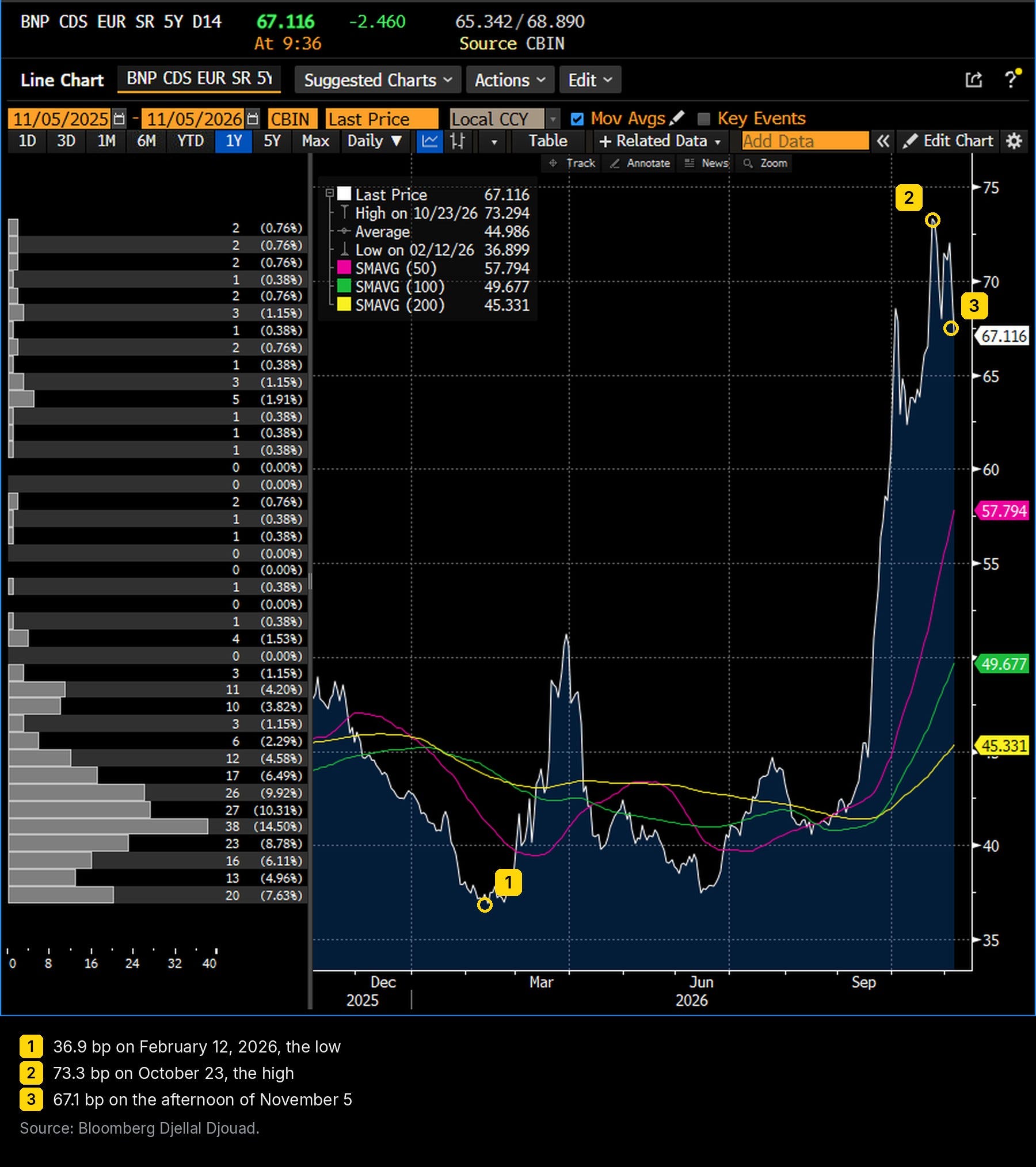
Now look at where the same banks have been lending.
Société Générale says it took part in a $2.6 billion delayed draw facility, a loan drawn as the chips are delivered, for CoreWeave, whose credit default swap now trades at 1,162 basis points, to buy Nvidia GB200 chips for OpenAI's workloads in Texas, which it calls one of the first GPU financing transactions in the global banking sector. It also led a $600 million financing for a Virginia data center leased by CoreWeave, and describes GPU renters as an asset class it expects to grow exponentially.
BNP Paribas is one of the four administrative agents, the banks that run the loan for all the lenders, on the roughly $18 billion loan for the Oracle-linked campus in New Mexico, one of the large AI financings in Bloomberg Intelligence's own table.
BNP Paribas, Crédit Agricole CIB, Natixis and La Banque Postale are among the seven lenders of Mistral AI's $830 million debt for a Paris-area data center holding 13,800 Nvidia GB300 chips.
BNP Paribas, Crédit Agricole CIB and Société Générale were among the four lead banks of a £2.45 billion financing for Virtus Data Centres in September, and Société Générale and Crédit Agricole CIB were among the coordinators of a $1.24 billion loan for an AirTrunk campus in Tokyo in March.
To be fair, French banks are not the biggest lenders to US data centers. Japanese, American and Canadian banks lead those tables. The risk for a French bank is not the size of its AI book. It is that the AI exposure sits on a balance sheet already tied to its sovereign: according to Fitch, as reported this week, French government bonds held directly are worth 15% to 30% of the banks' core capital, and 30% to 60% with their insurance arms. Fitch calls that exposure moderate and estimates that a one point widening of the French spread cuts their core capital ratios by less than 0.1 point. Here is how faster depreciation reaches that balance sheet.
The ratios assume a five or six-year life. A data center loan is sized on the cash flows of the site, and its loan-to-value on what the site owns. With a five or six-year hardware life, both look comfortable until the first contract renewal at a lower price. Nothing shows in the accounts before that.
The collateral is the tenant. On the assumptions above, GPU-backed debt is under water against the hardware itself within a year or two. What protects the lender is the rental contract, and behind several of these contracts stands a tenant that burns cash, OpenAI first.
The big lenders are filling up. The $38 billion of construction loans for two Oracle-linked Vantage campuses took months to sell and, according to a Bloomberg report in October, banks' internal limits on concentrated AI exposure are becoming relevant. My guess is that the next loans go to the banks that still have room.
Dollars cost a French bank more. The US loans are in dollars. A French bank funds them in a market where its sovereign now pays more than Italy and where the euro-dollar basis, the extra cost of swapping euros into dollars, has turned against European borrowers.
The risk may not go far. Banks shift part of their credit risk through significant risk transfers, selling the risk of a loan portfolio to outside investors while keeping the loans, and Brussels is reviewing the rules when insurers take that risk. A French lender was reported in July to be preparing one on data center loans. Part of that risk may end up with insurers, and many French insurers belong to banking groups that hold the same government bonds.
Europe has no growth cushion. European shares fall more than world shares when oil rises, and their thin technology weight offers no growth story to offset it. French bank shares trade inside that index, with their sovereign on their books.
What would prove me wrong
First, the 2026 rebound. If power stays the bottleneck for years, old chips keep renting at decent prices and their economic life stretches toward the book life. The Democrats' sweep of Tuesday's midterm elections could slow permits for new sites and keep power scarce for longer, which would help.
Second, contracts. Microsoft's chief financial officer said in January that a lot of the GPUs it buys are already contracted for most of their useful life. That protects Microsoft. It does not remove the risk, it moves it to the tenant, and Steve Eisman, who disagrees with Burry on depreciation, says the real danger is the dependence on OpenAI and Anthropic.
Third, the site may be worth more than its chips. A campus with its power already connected keeps value even when its GPUs do not.
None of this changes the arithmetic of a GPU bought at today's prices and depreciated over six years. It changes who bears the loss, and when.
What I watch
The H100, H200 and Blackwell rental indices, and how fast the next generation pushes them down.
Any change of useful life in the next annual reports, due from late January.
Residual value guarantees, lease commitments and stock sales in hyperscaler disclosures.
French bank credit default swaps, the price of insurance against their default, the OAT-Bund spread and the next rating reviews of France.
My thanks to David Wolf, who built the model, tested my thesis with an engineer's eye and let me take his work apart in public.
Market commentary for educational purposes. This is not investment advice and not a recommendation to buy or sell anything. Past moves do not predict future ones, and leveraged products can lose more than the amount invested.
How to cite: Djellal Djouad, CrossVol Research, "The AI Depreciation Bomb: The Chips Last Three Years, the Loans Last Ten", 5 November 2026. https://newsletter.crossvolresearch.com/p/ai-bubble-gpu-depreciation-data-centers-french-banks
Fantastic article!
A huge thank you for taking the time to dig into my model, challenge it, correct it, and turn it into something genuinely actionable.
For me, one of the most valuable things to watch from here will be the H100, H200 and Blackwell rental indices, and how quickly each new generation puts pressure on the previous one.
Combined with the framework in the article, this should give readers a very good window into what is happening beneath the surface of the AI data center economics, well before everything necessarily shows up in the financial statements.
Thanks again for the great work.
David
Thank you for this article, as rigorous as it is insightful. You make a complex subject accessible and show how to test a thesis before defending it, which is very helpful for my own analysis. A nod as well to David's work, which served for your demonstration. Thank you for sharing.