


By Djellal Djouad. November 10, 2026.
This article is for educational purposes only. It is not investment advice and not a recommendation to buy or sell anything. Options and futures carry a high risk of loss, and leveraged products can lose more than the amount invested.
Bank of America has just written a sentence that every equity investor should read twice. Semiconductor earnings cuts "could start in 1Q if policy changes translate into 2H27 capex moderation. Under a scenario where 2027E AI capex is cut by 20%, [we] estimate 35-40%+ downside to AI Semis EPS. This alone would reduce 2027E S&P 500 EPS by 7-8%."
My view is that a cut of that size would tip the US economy into recession in the second quarter of 2027. Not through the arithmetic of capex alone, which is smaller than people think, but through three amplifiers: stock market multiples, AI credit and the Fed. Here are the numbers.
What did BofA actually say?
BofA tracks what analysts expect Microsoft, Amazon, Alphabet, Meta and Oracle to spend on capex, meaning data centers, chips and servers. Its data, as of November 6, show estimates for 2027 already revised up by more than 90% this year, the fastest pace in the series. Estimates for 2026 now stand roughly 160% above where they started two years earlier.
The bank's logic: AI chipmakers depend on a handful of buyers. If those buyers cut 2027 budgets by 20%, AI semiconductor earnings fall 35 to 40% or more, and since those companies are now a large slice of the index, S&P 500 earnings for 2027 fall 7 to 8%.
Would a 20% AI capex cut cause a recession on its own?
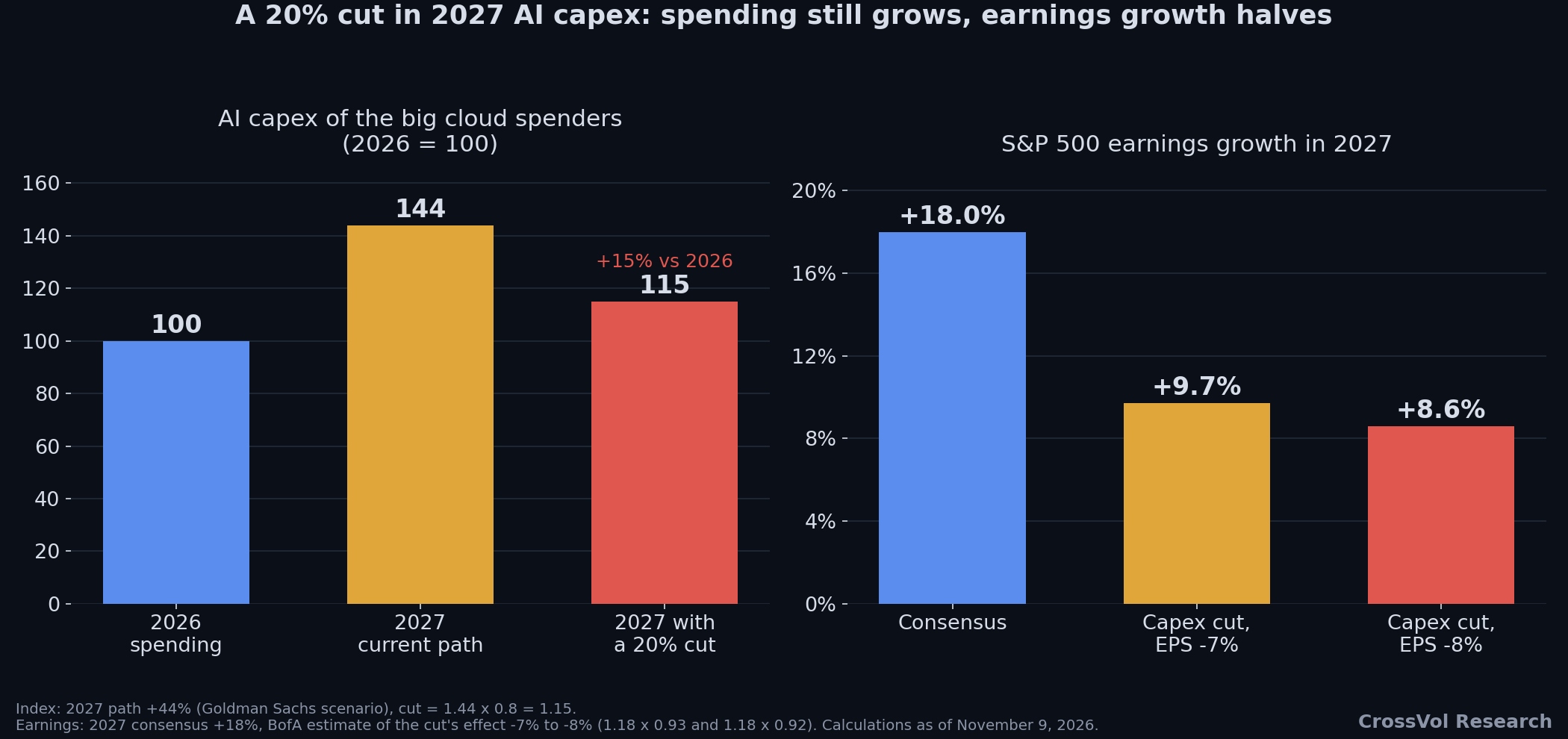
No. In a scenario Goldman Sachs cited on November 8, AI capex grows about 44% in 2027. Cut that by 20% and spending is still about 15% above 2026 (1.44 x 0.8 = 1.15). Growth collapses, the level does not fall.
The direct hit to the economy is real but limited. On our estimate, it takes about 0.6 percentage point off US growth, and 0.3 to 0.4 point once you remove the chips and servers that are imported. On earnings, the 2027 consensus for the S&P 500 is about +18%. Take 7 to 8% off the level and growth drops to between +8.6% (1.18 x 0.92) and +9.7% (1.18 x 0.93). That is a slowdown, not an earnings recession.
Our angle is that BofA counts only the chipmakers. If capex is cut because the returns on AI disappoint, the cloud companies will also have to write down the value of their GPU fleets, which would hit their own profits. The shock to S&P 500 earnings would then be larger than 7 to 8%. We showed on November 5 why the chips last three years while the loans last ten.
Michael Burry shared a chart over the weekend that frames the cycle: net investment by S&P 500 companies (capex minus depreciation) has reached 2.07% of nominal GDP, close to its 2000 levels. Past peaks of that ratio came with the Nasdaq top in March 2000, the S&P 500 top in late 2007 and the shale top in July 2014.
How much can multiple compression add to the fall?
Goldman Sachs puts the Nasdaq 100 at about 18.4 times expected earnings for the next twelve months. That looks cheap only if those earnings are right. A price is earnings multiplied by a multiple, so the two losses compound.
A worked example, with our assumptions written out. Earnings estimates fall 8%, in line with BofA. The multiple falls 15%, from 18.4 to about 15.6, because long-term rates rise or growth slows. The price falls by 1 minus (0.92 x 0.85), which is about 22%. Neither move needs to be extreme. Together they turn an earnings trim into a bear market.
Could a hot CPI and PPI this week bring back a Fed hike?
Yes, and this is the near-term trigger. October CPI comes out today, Tuesday, November 10, at 8:30 a.m. New York time (14:30 Paris). October PPI follows on Friday, November 13, at the same time, according to the official calendar of the Bureau of Labor Statistics.
The market did not wait for the number. This morning in London, before the release, Fed Governor Christopher Waller said he would back at least a quarter point hike at the December 8 and 9 meeting, and opened the door to a half point move if inflation runs hot. Overnight index swaps now price a December hike in full, at 100.4% against 83.1% earlier this morning.


With 165,000 jobs created in the latest payroll report, the labor market does not ask for help. Hot inflation figures would lock in that hike and make half a point a real option. The chain is then direct: higher long-term yields, lower multiples for tech, and more pressure on AI borrowers whose credit spreads have already widened sharply. We described on October 29 how the megacaps did not outrun the Fed, and on October 30 how credit, AI stocks and Treasuries already price a US slowdown.
What does it mean for 401(k)s and household spending?
This is where a market problem becomes an economic one. US retirement assets reached $51.2 trillion at the end of June 2026, according to the Investment Company Institute, including $19.9 trillion in IRAs and $10.8 trillion in 401(k) plans. A large share of that money sits in index and target date funds that follow the S&P 500 or the broad US market, and the ten largest companies now weigh close to 40% of the S&P 500. Retirement savers are, without choosing it, heavily invested in the AI complex.
Federal Reserve data for the second quarter show households holding $74.0 trillion of stocks directly and indirectly, about 48% of their financial assets on our calculation, and household net worth at a record 8.28 times disposable income. Moody's Analytics has estimated that the top 10% of earners account for about half of US consumer spending. Those households own most of the stocks. When earnings and multiples fall together, their 401(k) statements fall, confidence falls, and spending follows. That wealth effect is the bridge from a capex cut to a recession.
How does this become a recession by Q2 2027?
Through three channels, in this order.
First, markets. Earnings cuts for chipmakers can start in the first quarter, BofA says, while the capex slowdown itself would show in the second half of 2027. The market will not wait for the second half: it will price the cuts in the first half, and the wealth effect will start then.
Second, AI credit. The cost of insuring Oracle's debt for five years rose from about 84 basis points a year ago to 304 on November 5. CoreWeave's rose from 452 in June to 1,289 on November 5, its high. Ten-year loans backed by chips that last three years do not survive a spending cut. We explained in July why AI debt made the US investment grade index prettier and more fragile.
Third, the Fed. If inflation forces it to hike into a slowdown, it removes the cushion that usually stops a market fall from becoming a recession.
Each channel alone is a slowdown. Together, with a stock market this concentrated and households this exposed, they meet in the second quarter of 2027. Last Thursday's 6.4% fall in the Nasdaq 100 was the setup, as we wrote in Stock Market Crash: What Happens Next.
What would prove me wrong?
Soft CPI and PPI figures this week, which would take a December hike off the table. Cloud companies raising 2027 budgets with evidence that AI revenue covers the depreciation. And credit spreads on Oracle and CoreWeave tightening back. None of these is visible today.
This article is for educational purposes only. It is not investment advice and not a recommendation to buy or sell anything. Options and futures carry a high risk of loss, and leveraged products can lose more than the amount invested. Figures are as of November 9, 2026, unless stated otherwise.
Further reading
How to Trade Earnings With Options: My Nebius (NBIS) Earnings Trade, Step by Step
The AI Depreciation Bomb: The Chips Last Three Years, the Loans Last Ten
Stock Market Crash: What Happens Next, From a Dead Cat Bounce to the AI Bomb
How to cite: Djellal Djouad, CrossVol Research, "AI Capex Cut: How a 20% Cut Could Tip the US Into Recession in 2027", 10 November 2026. https://newsletter.crossvolresearch.com/p/ai-capex-cut-recession-2027-stocks-401k
Un focus sur les marges exceptionnelles des boites Semis. Si réduction des Capex + arrivée de nouveaux concurrents plus compétitifs, elles seront contraintes de brader leurs prix pour faire du volume. C’est un principe de commerce de base et les marges diminueront pour retrouver des niveaux d’avant super cycles. Il y a une erreur de grille de lecture : l'industrie des semi-conducteurs a toujours obéie à une logique cyclique par le passé (suivant les cycles industriels et automobiles).
Le piège des multiples est bien présent et vouloir évaluer les géants des puces et de l'intelligence artificielle comme des valeurs de croissance pures à long terme occulte le fait qu'ils traversent actuellement un super-cycle d'investissement (les Capex massifs dans l'IA).
Le retournement de marge est inéluctable. Une fois que les besoins massifs d'infrastructure (les data centers) seront en grande partie satisfaits ou que la concurrence s'intensifiera, ces entreprises connaîtront mécaniquement un retour de balancier sur leurs volumes et leurs marges bénéficiaires exceptionnelles (qui atteignent parfois des sommets de $70% à $80%). C’est de la simple logique au final.
The Fed may be the weakest of your three amplifiers. In 1994 and 2018, both tech-led selloffs under a hiking Fed, the market bottomed in December and had recovered by mid-February once the Fed changed course, so policy ended up absorbing the shock rather than spreading it. A 20% capex cut would itself pull the hike odds down, since it removes the demand the hawks are leaning against. What would the Fed have to do in your scenario to become an amplifier, keep hiking into Q1?