


By Djellal Djouad. October 18, 2026.
Data as of the close of Friday, October 16, 2026. VIX futures reopen Sunday evening, New York time.
Risk warning. This article is for education only. This is not investment advice. Futures and options, including VIX futures, VIX options and volatility exchange-traded products, can lose more than the initial investment. Leveraged and inverse products can lose most of their value in a single day.
Key takeaways
The VIX closed Friday at 19.99, up 21% on the day. Some commentators have raised the prospect of a sharp Monday selloff. Our models say the setup matters more than the level.
The VIX futures curve has inverted at the front. The October contract settled at 19.91, November at 19.24 and December at 18.95. One month ago the same months traded at 17.97, 18.65 and 19.03.
Volatility exchange-traded products hold about 64,700 more VIX futures contracts long than short. In February 2018 the fragile side was short volatility. Today it is the other way around.
If VIX futures jump 10 points in a session, our models put the forced buying by these products at about 18,300 contracts, or 8.4% of the recent average daily volume of the two front months.
VIX calls outstanding with less than three months to expiry stand at 8.96 million contracts, near the highest level we have recorded. About 42% of it expires on Wednesday, October 21.
The hedging of S&P 500 option dealers now amplifies moves, with the index 1.4% below the level where it would damp them.
1. Where we are
We have been writing about this for a month. On September 23, The VIX Is Too Calm for a 3.4 Sigma Rates Shock showed stocks and bonds falling together while equity volatility barely moved. On September 25, The Crash Fuse Is Lit argued that this cycle's fuse runs through AI spending financed by debt. On October 4, Volatility Is Starting to Talk Even While the VIX Sleeps flagged our cross asset volatility composite at systemic. On Friday, in Here We Are, equity volatility caught up.
The VIX measures the 30 day volatility of the S&P 500 that option prices imply. It closed Friday at 19.99, up 21% on the day, after trading as high as 22.31. VIX futures let investors buy or sell that number for a future date, one contract per month.
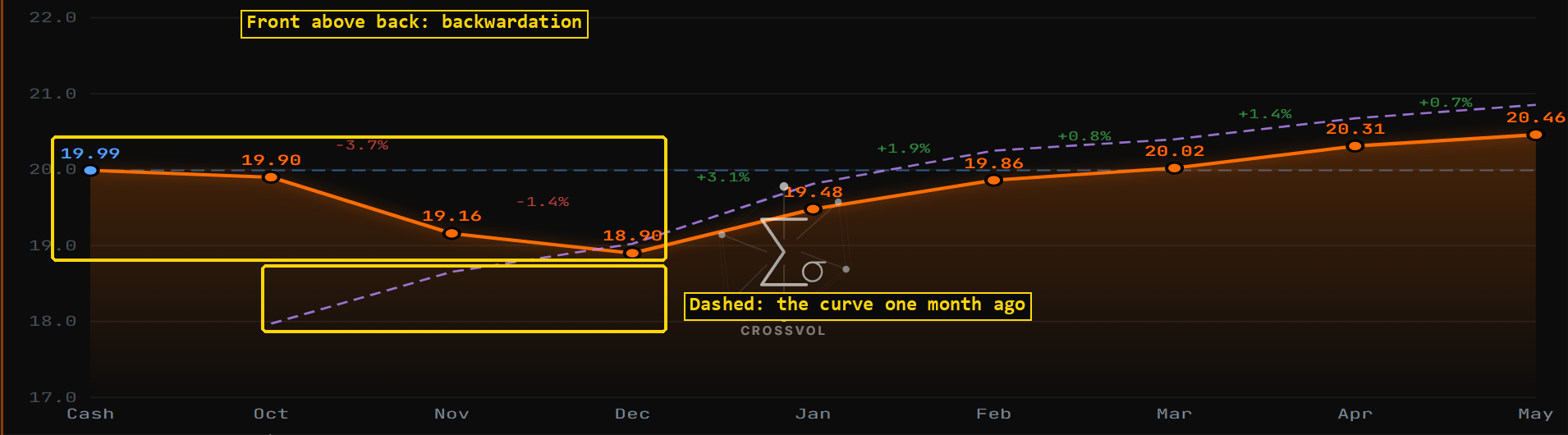
A futures curve lines up the price of every delivery month. In calm markets, later months cost more than near months, because investors pay up for protection further out. That shape is called contango. When the near months trade above the later months, the curve is in backwardation: investors pay more for protection now than later. That is what stress looks like on this curve.
One month ago, on September 17, the curve sloped up in the usual way: 17.97 for October, 18.65 for November, 19.03 for December. On Friday the front sat above the next months: 19.91 for October, 19.24 for November, 18.95 for December.

Two of our gauges confirm the stress. Our 30 day VIX futures gauge traded 0.68 points below the VIX index itself, one of its lowest readings of the past year. And November traded 3.4% below October, one of the steepest inversions of the past year. A future below the index itself means the market expects the spike to fade over the next month, while near-dated protection stays expensive.
2. Who is positioned, and how
Behind the VIX sit exchange-traded products that hold VIX futures. They let investors buy or sell volatility like a stock. Some are long volatility, such as $VXX, $VIXY, $UVXY (1.5 times leverage) and $UVIX (2 times). Others are short, such as $SVXY (minus 0.5 times) and $SVIX (minus 1 times). Each product tracks an index of short dated VIX futures. Every evening, the leveraged and inverse ones must reset their exposure to stay at their target leverage. That rebalancing is mechanical: it ignores the news.

Open interest is the number of contracts outstanding. Our models put these products at about 84,200 VIX futures contracts long and 19,900 contracts short on Friday, a net long position of about 64,700 contracts. Each contract moves $1,000 per VIX point, so the net position gains or loses about $65 million for each point the futures move.
This is the opposite of February 2018. On February 5, 2018, the risk sat with products that were short volatility. When the VIX exploded, they had to buy back futures into the close, and that buying fed the spike. The largest of them was terminated within days.
Today the short side is small, about 7% of the open interest of the two front months, and the long side dominates. That changes the shape of the risk, and some risk remains.
3. Why a shock would be amplified

Leveraged long products and inverse products both have to buy VIX futures after a day when volatility rises, and sell after a day when it falls. A product with twice the leverage that gains 20% in a day ends the day with too little exposure, so it buys. An inverse product that loses 20% ends the day with too much short exposure, so it buys back.
Our models put the buying needed after a 10 point jump in VIX futures at about 18,300 contracts. That is 8.4% of the recent average daily volume of the October and November contracts, and 6.3% of their open interest. On February 5, 2018, about 116,000 VIX futures contracts traded in a single minute just after the close, roughly a quarter of the whole market. We are well below that level. But forced buying grows with the size of the move, and in a disorderly market the volume available to absorb it tends to shrink.
The second layer is the options market on the VIX itself. Open interest in VIX calls expiring within three months reached about 8.96 million contracts on Friday, near the highest level we have recorded, and up 9.7% in five sessions. Call volume over the past week ran about 1.5 times its usual pace. Investors are buying protection against a volatility spike.
Dealers are the banks and market makers that sell options to investors and hedge the risk. The dealers who sold those calls hedge them with VIX futures. Gamma measures how fast an option's hedge changes when the underlying moves. Dealers who are short calls are short gamma: as the VIX rises, they must buy more VIX futures to stay hedged. That buying adds to the products' buying, on the same side, at the same time.
The third layer is the S&P 500. When option dealers on the S&P 500 hold a large long gamma position, they sell rallies and buy dips, which pins the index and keeps realized volatility, the volatility the index actually delivers, low. That damping is gone for now. Dealer gamma on both the S&P 500 and the Nasdaq 100 is negative in our model. The S&P 500 closed at 7,659, 1.4% below 7,766, the level where dealer hedging switches from damping moves to amplifying them. The Nasdaq 100 is 4.1% below its own switch level. Below that line, dealers sell into weakness and buy into strength.
4. What our models say about the next few days
These are scenarios, not forecasts. They describe what the positioning implies if a given move happens.
Scenario 1: the stress continues. If VIX futures add another 10 points, our models expect the products to buy about 18,300 contracts at the close. Dealers short VIX calls would add to that buying, and S&P 500 dealers would sell into weakness instead of absorbing it. Three mechanical buyers on the same side can make a volatility move overshoot. The short products have a hard limit: SVIX loses everything if its index doubles in a day, which would take a jump of about 19 points on VIX futures.
Scenario 2: the stress fades. If the VIX falls back, the same products sell futures at the close, about 6,000 contracts for a 10% drop in their benchmark index (about 2 points on VIX futures today). The curve can return to contango. The long products have their own limit: UVIX loses its entire value if its index falls 50% in a day, close to 9.6 points on VIX futures today. And the S&P 500 needs to climb back above 7,766 for dealer hedging to damp moves again. Until that line is recovered, a calmer market stays fragile.
The dates that matter:
Tuesday, October 20. The products finish moving their exposure from the October to the November VIX future, at about 2,700 contracts a day in this final stretch.
Wednesday, October 21. The October VIX futures and options expire: on expiry, a contract stops trading and is settled. About 3.8 million of the 8.96 million calls in our three month count are October calls. How much of that protection is rolled into November, rather than left to expire, will show how much fear remains.
Late October. Earnings from the largest cloud and AI data center operators. The October 8 session, driven by OpenAI headlines, was a day our models flag as AI specific, with the Nasdaq 100 falling three times as much as the S&P 500 while Treasury yields fell.
October 28. The Federal Reserve's policy decision.
5. The AI channel
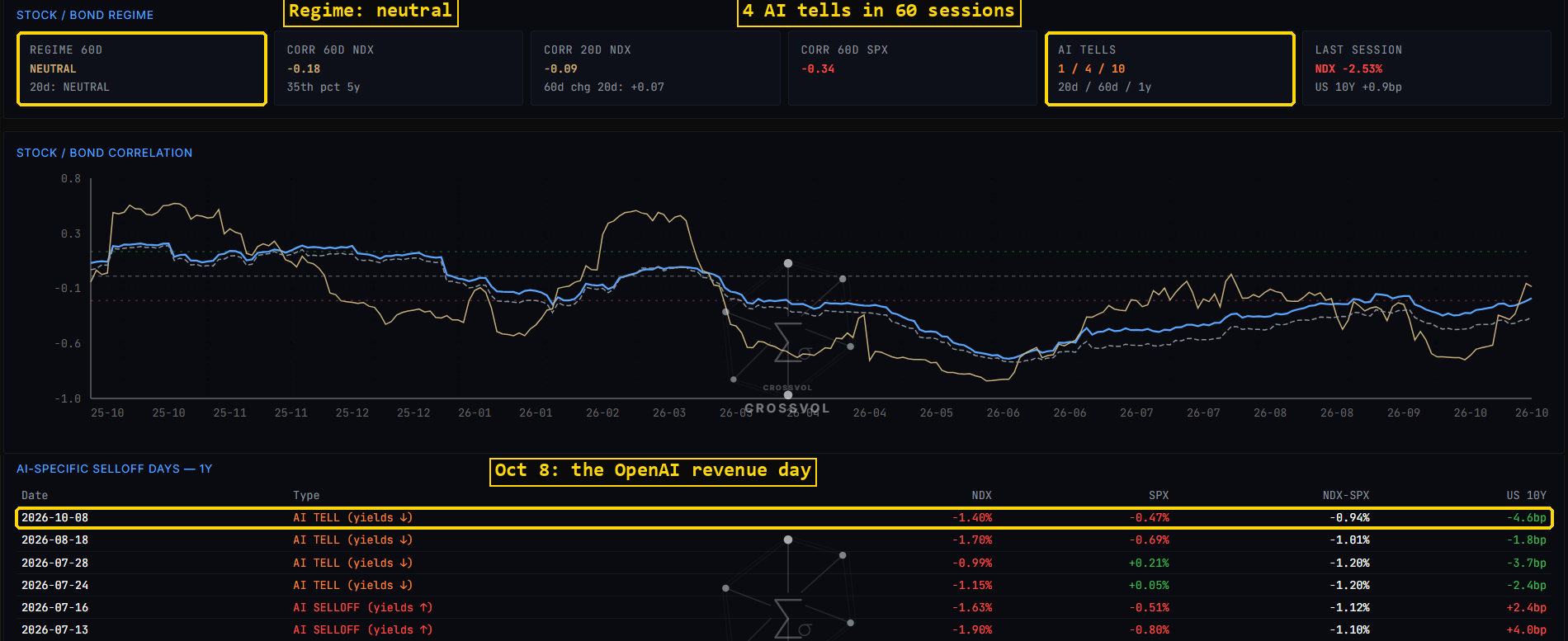
Our stock and bond regime model is neutral. The recent correlation between Nasdaq 100 returns and changes in the 10 year yield is minus 0.18. A positive reading would mean stocks and yields fall together, so Treasuries hedge an equity portfolio. A negative reading means they do not. At minus 0.18, bonds are not yet a reliable hedge. AI specific sessions behave differently: on those days, yields fall with stocks. We have counted four of them in the past three months.
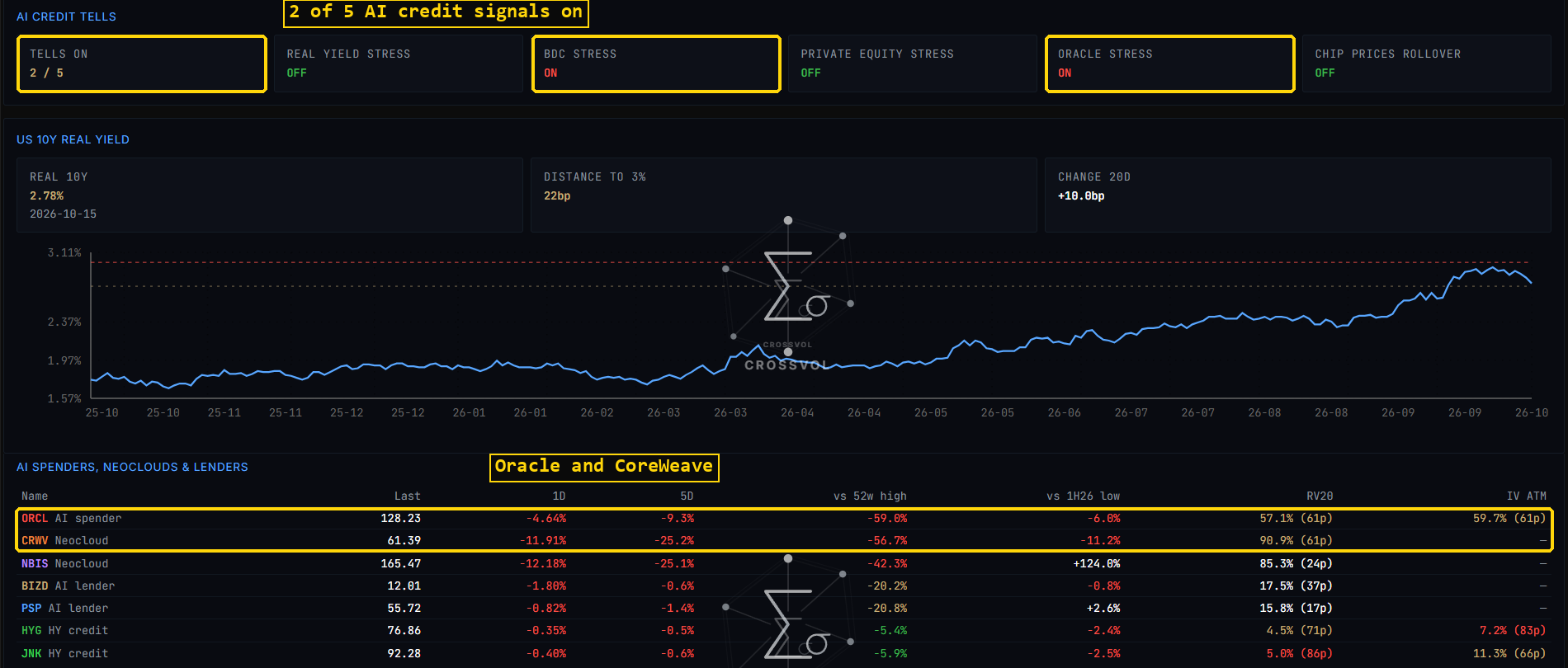
On the credit side, two of our five AI credit signals are on. $BIZD, a fund of business development companies that lend to mid-sized firms, is at its lowest level of the year. $ORCL is 59% below its 52 week high, with implied volatility near 60%. $CRWV fell 25% over five sessions. The US 10 year real yield, the Treasury yield after inflation, was at 2.78% on Thursday, near its highest level of the past year. Producer prices for semiconductors, a gauge of the AI spending race, dipped 0.34% in September after a 26% rise over twelve months. One month down is not a rollover, and we are watching the next print.
Bottom line
The VIX woke up on Friday, and it woke up loaded the other way. In 2018 the fragility sat with sellers of volatility. Today it sits with the mechanics that buy volatility when it rises: leveraged long products, dealers short VIX calls, and S&P 500 dealers who stopped damping moves. Each of these forces is moderate, and all three point in the same direction if the next shock comes. This week's expiry, next week's earnings and the Fed decision are the three dates to watch.
Risk warning. This article is for education only. This is not investment advice. Futures and options, including VIX futures, VIX options and volatility exchange-traded products, can lose more than the initial investment. Leveraged and inverse products can lose most of their value in a single day.
Limpide….as usual