


By Djellal Djouad. November 22, 2026. Market data: close of Friday, November 20, 2026.
This article is for educational purposes only. It is not investment advice and not a recommendation to buy or sell anything. It is not medical advice either: no drug discussed here should be taken outside a prescription or a clinical trial. Tesofensine is not approved by any regulator, and BAM15 has never been tested in a clinical trial. Options carry a high risk of loss, and option prices quoted here can change quickly.
Among the weight loss drugs that will follow Ozempic, the race for the biggest number on the scale is over. On May 21, Eli Lilly reported that retatrutide, its weekly triple-hormone injection, cut body weight by 28.3% on average after 80 weeks at the top dose, and that 45.3% of patients on that dose lost at least 30% of their weight. Five months earlier, in a trial in people with knee osteoarthritis, 18.2% of patients on the top dose had stopped treatment because of side effects, against 4.0% on placebo, and Lilly wrote that some of those stops were for "perceived excessive weight loss". When patients quit a drug because it works too well, efficacy has stopped being what separates the winners.
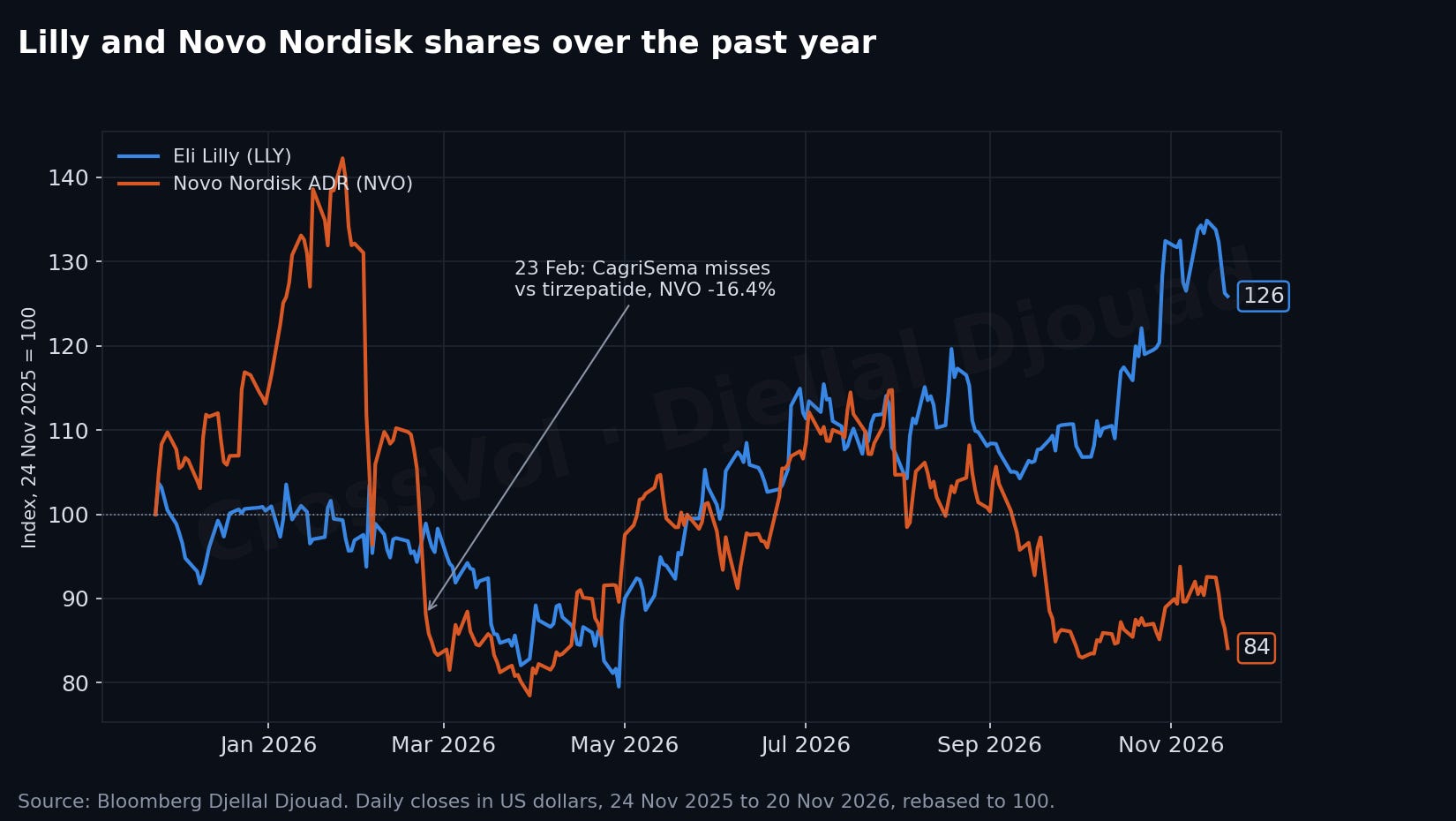
My thesis, in one paragraph: retatrutide has won the efficacy race, and the stock market knows it. Lilly's shares are up 26% over the past year and Novo Nordisk's US-listed shares are down 16%. The next phase of the obesity market will be decided by three things that a headline weight-loss number hides: how much of the weight lost is fat and how much is muscle, how many patients can stay on the drug, and what insurers and governments will pay. On those three counts the board is more open than share prices suggest. Novo's CagriSema, written off after it lost to Lilly's tirzepatide in February, now faces a low bar in its next trial, and the options market does not price that readout as a special event. Two other molecules, tesofensine and BAM15, have no coverage from any major bank. Both deserve a sourced public file, if only to show why one is a small regulatory option for a Stockholm-listed biotech and the other cannot be an investment today.
The four molecules at a glance
Retatrutide (Eli Lilly). A weekly injection that mimics three gut and pancreas hormones: GLP-1 and GIP cut appetite, glucagon raises energy use and the burning of liver fat. Best data: 28.3% weight loss at 80 weeks (TRIUMPH-1). Next: a US filing planned for the first quarter of 2027.
CagriSema (Novo Nordisk). A weekly injection of semaglutide, the drug in Ozempic and Wegovy, plus cagrilintide, a long-acting version of amylin, a hormone that signals fullness. Best data: 23.0% at 84 weeks, short of tirzepatide's 25.5% (REDEFINE 4). Next: an FDA decision expected in the fourth quarter of 2026, then REDEFINE 11 results in the first half of 2027.
Tesofensine (Saniona; Medix holds Mexico and Argentina). A daily pill that keeps three brain messengers (serotonin, noradrenaline, dopamine) active for longer, which cuts appetite. Best data: about 10% average weight loss at 24 weeks in Medix's phase 3 in Mexico (the company did not say whether net of placebo), never published in full. Next: a decision by COFEPRIS, Mexico's drug regulator, pending since the February 2025 resubmission.
BAM15 (no listed owner; university patents licensed to private start-ups). Makes mitochondria, the cell's power plants, burn fuel as heat (a "mitochondrial uncoupler"). Best data: mice only. Next: no human trial registered.
A word on the numbers. Obesity trials report two averages. The first counts patients as if they had all stayed on the drug; the second counts everyone who was randomized, including those who stopped, and is lower: 25.0% for retatrutide's top dose in TRIUMPH-1. Comparisons across trials are rough, because the patients, the durations and the doses differ. The only clean comparisons are head-to-head trials, and there are few of them.
Retatrutide: the race is won, the bill comes next
The evidence is broad. In TRIUMPH-1 (2,339 adults without diabetes who had obesity, or overweight with a weight-related condition), weight fell 19.0%, 25.9% and 28.3% at the 4 mg, 9 mg and 12 mg doses after 80 weeks, against 2.2% on placebo. In an extension to 104 weeks, open only to patients with a body mass index of 35 or more who had completed the first 80 weeks and tolerated their dose, the 12 mg arm reached 30.3%. People with type 2 diabetes lost about 20% of their weight (20.8% at 12 mg in TRIUMPH-2) and, in a head-to-head trial against Ozempic's highest dose, it cut blood sugar more (HbA1c, the three-month average of blood sugar, fell 2.2 points against 1.8) and weight twice as much (20.9% against 9.4%). In knee osteoarthritis (TRIUMPH-4), weight fell 28.7% at 68 weeks and knee pain scores dropped by about three quarters, against 40% on placebo, a percentage Lilly computed after the fact.
The bill is just as clear. At 12 mg in TRIUMPH-1, 42.4% of patients had nausea (14.8% on placebo), 25.3% vomited (4.8%), and 12.5% reported dysesthesia, an unpleasant or abnormal skin sensation such as tingling (0.9%). 11.3% stopped because of side effects, against 4.9% on placebo. In TRIUMPH-4 that share reached 18.2%, and Lilly said the stops were "highly correlated with baseline BMI": among patients with a body mass index of 35 or more, 12.1% stopped at 12 mg, so leaner patients quit more often. Against Ozempic in diabetes, 7.9% stopped on retatrutide 12 mg, against 2.7%. Retatrutide also raised heart rate in its phase 2 trial, published in the New England Journal of Medicine in 2023, with a peak around week 24 and a decline after. Lilly's phase 3 releases report lower blood pressure (systolic pressure fell 14.0 mmHg at the top dose in TRIUMPH-4, a figure Lilly flags as not adjusted for multiple testing) and better blood fats, but give no heart-rate figures. The FDA review should.
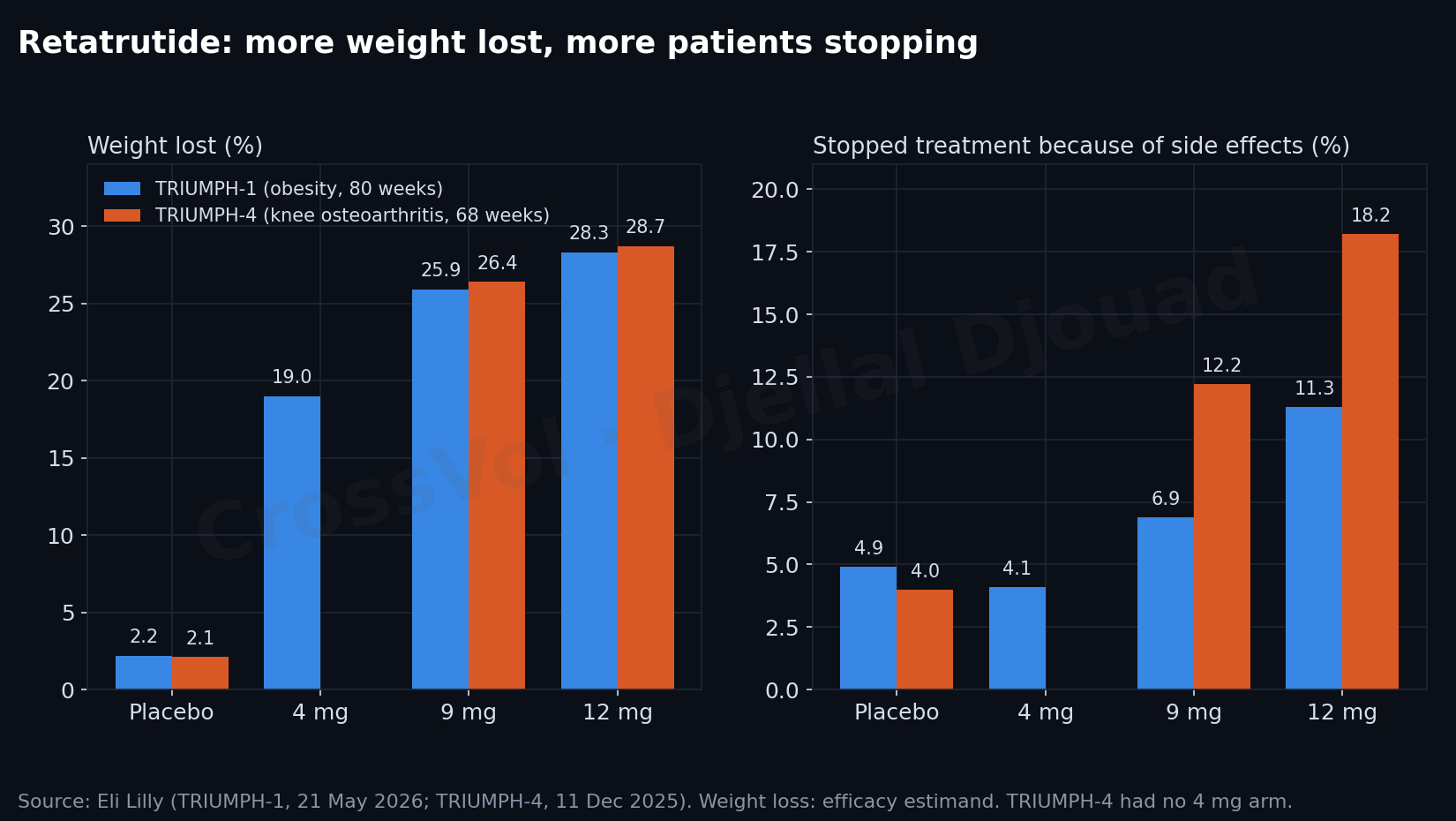
The chart is the whole thesis. Going from 9 mg to 12 mg adds 2.4 points of weight loss in TRIUMPH-1 and 2.3 points in TRIUMPH-4, and raises the share of patients who stop by 4.4 and 6.0 points. Beyond about 25%, each extra point of efficacy costs tolerability. That is why I expect retatrutide to become a drug for severe obesity, for men and for people with type 2 diabetes (in those last two groups, Lilly's management says it is the first agent to exceed 20% weight loss), while tirzepatide and cheaper options cover the rest. Bloomberg Intelligence makes the same point on price: used mainly by specialists for severe obesity if priced above Zepbound, or with lower doses priced alongside Zepbound and a premium for the higher ones.
Lilly plans to file in the United States in the first quarter of 2027, which points to a decision around early 2028. A head-to-head trial against tirzepatide, TRIUMPH-5 (about 800 adults, 80 weeks), is under way. Lilly has given no date, but the registry entry lists November 2026 for the last primary measurement, so results could come in the first half of 2027, before the options below expire. Its result matters more to my thesis than any other: a wide gap with similar tolerability would prove that efficacy still decides.
The market has priced most of this. Lilly closed at $1,347.11 on Friday, for a market value of $1.27 trillion, after a 69.6% rise from its lowest close of the past year, on April 29, to its highest, $1,443.50 on November 13. Part of that premium has little to do with any single trial: in If the AI Trade Breaks, Where Do You Hide? on November 19, health care rose 0.47% on average, and was up 61% of the time, on the 31 sessions of 2026 when chip stocks lost 3% or more. Lilly is the largest health care stock in that refuge.
Trade on Lilly (one branch). If retatrutide's tolerability and price become the story, the downside comes from a stock priced for the good outcome. A defined-risk way to express it is a put spread (buying a put and selling a lower one to cap the cost) through the filing, the likely TRIUMPH-5 readout and the first-quarter results: buy the June 17, 2027 $1,300 put and sell the $1,100 put. Priced on my Bloomberg on Sunday, November 22, at 3:13 p.m. Paris time, from Friday's closing quotes, it costs $67.58 per share at mid-market (the average of bid and ask), or $78.90 when buying at the offer and selling at the bid. It breaks even at $1,232.42, 8.5% below Friday's close, and pays its maximum of $200, about 3 times its cost, at or below $1,100. The options expire on Thursday, June 17, because Friday, June 18, 2027 is the Juneteenth market holiday. Implied volatility, the yearly swing priced into options, sits between about 35% and 39% on Lilly from December to June, highest on the February and March expiries, which include fourth-quarter results expected on February 4.
CagriSema: priced for failure, which makes the next readout interesting
On February 23, Novo reported that CagriSema produced 23.0% weight loss at 84 weeks against 25.5% for tirzepatide in REDEFINE 4, missing its goal of showing it was not worse. Novo's US-listed shares fell 16.4% that day. They are now 41% below their January 26 high, and analysts followed: Barclays cut its risk-adjusted peak-sales estimate from $12 billion to $2 billion, and Bloomberg Intelligence, which had expected $7 billion of obesity sales by 2030 before the trial, notes that consensus estimates for CagriSema's contribution over 2026 to 2030 have nearly halved.
The drug is still on track. Novo announced its FDA filing on December 18, 2025, at the 2.4 mg/2.4 mg dose, and expects a decision in the fourth quarter of 2026. In September, a lower dose (1.0 mg/1.0 mg) beat tirzepatide 5 mg in people with type 2 diabetes (12.4% against 9.1% at 60 weeks in REIMAGINE 5) and, in adults with overweight or obesity, produced 21.0% weight loss against 2.0% on placebo at 68 weeks in REDEFINE 9. The trial that matters is REDEFINE 11: about 600 people, 80 weeks, against placebo, with what analysts describe as a stricter protocol for bringing patients who had to lower their dose back up to the full dose. The registry entry that matches it lists March 2027 for the last primary measurement, so results should come in the first half of 2027. A 7,000-patient cardiovascular outcomes trial, REDEFINE 3, follows, with primary completion estimated for September 2027.
The bar is low. Before its first phase 3 results, in December 2024, Novo had said it expected about 25% weight loss. A result in that zone in REDEFINE 11, with fewer patients stopping, would put CagriSema back in the tirzepatide conversation, as a better-tolerated option built on the best-known molecule in the class. A result near REDEFINE 1's 22.7% would change little, and that is roughly what the share price already assumes. The options market agrees: on Novo's US-listed shares, at-the-money implied volatility is 36.7% for June 2027, the expiry that should cover REDEFINE 11, below the 39.1% of March 2027, which spans full-year results on February 3. Nobody is paying up for the readout. My view: CagriSema will reach the market as a second-tier drug, but the stock's reaction to REDEFINE 11 is asymmetric, because expectations are close to zero.
Trades on Novo (one per branch). Both are priced on my Bloomberg on Sunday, November 22, at 3:10 p.m. Paris time, from Friday's closing quotes, for options expiring on Thursday, June 17, 2027. Novo's US-listed shares closed at $37.82.
If REDEFINE 11 surprises: buy the $40 call and sell the $50 call, for $2.35 per share at mid-market ($2.56 at market), $235 per contract of 100 shares. It breaks even above $42.35, 12% above Friday's close, and pays its maximum of $10.00, 4.3 times its cost, at or above $50, a level the shares last closed above on July 30 ($51.61).
If it disappoints or the FDA delays: buy the $35 put and sell the $27.50 put, for $2.09 per share at mid-market ($2.28 at market). It breaks even below $32.91, 13% under Friday's close, and pays its maximum of $7.50, 3.6 times its cost, at or below $27.50.
The call spread costs a little more than the put spread ($2.35 against $2.09), breaks even after a slightly smaller move (12% against 13%) and pays a third more at most ($10.00 against $7.50). That is the asymmetry: the market charges about the same for both branches while the bad news is already in the price. I prefer the call spread; the put spread is the hedge for holders of the shares.

Tesofensine: a cheap pill for Mexico, and a small option for Saniona
Tesofensine is the oldest idea of the four. The Danish company NeuroSearch developed it for Parkinson's and Alzheimer's disease; it failed there, but patients lost weight. It is a daily pill that blocks the reuptake of three brain messengers, noradrenaline, dopamine and serotonin, which cuts appetite. In a 24-week phase 2 trial in Denmark, published in The Lancet in 2008, patients lost 4.5%, 9.2% and 10.6% more weight than on placebo (2.0%) at 0.25 mg, 0.5 mg and 1.0 mg, and heart rate rose by 7.4 beats per minute at 0.5 mg. Two caveats belong next to those numbers. In 2013 The Lancet attached an expression of concern to the paper, after the Danish medicines agency found problems at two of the five trial sites, including side effects that were under-recorded. And the phase 3 program planned around 2010, 5,000 to 7,000 patients with a cardiovascular study, never ran. NeuroSearch handed the drug in 2014, without any upfront payment, to Saniona, a small biotech listed in Stockholm and based near Copenhagen.
Saniona licensed Mexico and Argentina to the Mexican drugmaker Medix in 2016. Medix's phase 3 trial in Mexico (372 patients, 24 weeks, 0.25 mg and 0.5 mg against placebo) reported "ten per cent average weight loss" in December 2018, with more than half of patients losing over 10%, unchanged blood pressure and a small rise in heart rate. The full results have never appeared in a journal. Medix filed with COFEPRIS, Mexico's drug regulator, at the end of 2019. A technical committee gave a favorable but non-binding opinion in February 2023, approval was withheld in November 2024, Medix resubmitted in February 2025, and Saniona's reports in 2026 describe the file as "under review", with no date. Tesomet, a combination with the beta-blocker metoprolol for rare forms of obesity, was paused in March 2022 for lack of funding and is offered for partnering.
The economics are small. Medix would owe Saniona up to $2.0 million of regulatory milestones, none paid by the end of 2025, and royalties in the low double digits on sales in its two countries. Saniona is worth SEK 1.55 billion, down 47% this year, held SEK 486 million of cash at the end of June, and earns most of its deal income from ion-channel programs partnered with Jazz and Acadia. No bank covers it: on my Bloomberg, the only sources are an independent research firm that does not rate the stock, a paid corporate research note from 2025 and a quantitative score.
The price argument is weakening as well. Semaglutide's patents expired around March 20, 2026 in India, China, Brazil and Mexico, and generic versions have been approved in India, Brazil and Canada. According to the Mexican press, none had been approved in Mexico by mid-November, and Medix itself plans a cheaper semaglutide biosimilar with Biocon for 2027. A daily pill with a heart-rate signal would compete with cheap weekly semaglutide sold by the same partner.
My view: a COFEPRIS approval would be a small regulatory option for Saniona, with milestones capped at $2 million and royalties on Mexican and Argentine sales only, and no change for the global market. Watch heart rate and blood pressure in any published data, and the full phase 3 results, which have never been released.
BAM15: the best science, and why it is not an investment
BAM15 attacks the problem from the other end. Incretin drugs such as semaglutide make people eat less. BAM15 makes cells waste energy. It lets protons leak across the inner membrane of the mitochondria, so the cell burns more fuel for the same output and the difference leaves the body as heat. Biologists call this uncoupling.
The molecule was found in a screen at the University of Virginia, in Kyle Hoehn's lab with the chemist Webster Santos of Virginia Tech, and described in 2013. Two mouse studies made it famous in 2020. In Nature Communications, obese mice given BAM15 in their food for five weeks weighed 15% less than untreated mice eating the same amount; almost all the difference was fat, lean mass did not change and body temperature did not rise. In EMBO Molecular Medicine, a second team found that BAM15 kept mice on a fatty diet from gaining weight, without any fall in food intake. That study also adds a caveat that the enthusiasts skip: compared with a diet that produced the same weight loss, BAM15 burned more fat, but lean mass still ended below that of untreated mice.
None of this has been tested in a human trial. ClinicalTrials.gov lists no trial of BAM15, and its inventors said in 2020 that this exact molecule may not work in people; in mice its half-life is only a few hours, and they said they had made several hundred analogues. The patents I could find are held by the University of Virginia's patent foundation and by Virginia Tech, and conflict-of-interest statements published in 2020 and 2024 mention licences to two private start-ups, Continuum Biosciences and Uncoupler Biosciences. No listed company owns BAM15, which is why no bank covers it.
The class has a history. 2,4-dinitrophenol (DNP), an uncoupler sold as a diet pill in the 1930s after work at Stanford, has a safety margin that an FDA scientist described as "razor thin": the dose that burns fat is close to the dose that overheats the body. 62 deaths had been published by 2011, and 16.9% of the DNP poisonings reported to UK poison services from 2007 to 2018 were fatal. DNP is still sold online to bodybuilders, and a peer-reviewed study published in February 2026 looked at how bodybuilding forums and YouTube now present BAM15 as "the new DNP". I will say it plainly: nobody should take BAM15, or any uncoupler, outside a clinical trial.
The idea has reached the clinic in forms designed to be safer. Rivus Pharmaceuticals' HU6 is a pill that the liver converts into DNP in a controlled way. In patients with obesity and heart failure with preserved ejection fraction it cut weight by 2.86 kg more than placebo over 19 weeks, almost all of it fat (JAMA Cardiology, 2025), and a larger phase 2 trial in fatty liver disease is expected to report in mid-2027, according to Rivus. OrsoBio's TLC-6740, a liver-targeted uncoupler, added 4.5 points of weight loss to a low dose of tirzepatide over 24 weeks (13.3% against 8.8%) in a 55-person trial reported by the company in December 2025.
My view: BAM15 is the most interesting science of the four, because it burns fat without touching appetite and, in mice, mostly spares muscle. It is not an investable asset today: no human trial, no listed owner, and a class whose safety margin has to be proven molecule by molecule. The closest thing to an investable version of the idea, for now, is liver-targeted uncouplers combined with incretins, and they sit in private companies.
What would prove me wrong
Retatrutide. TRIUMPH-5 shows a wide gap over tirzepatide with similar rates of stopping, or the FDA label is clean on heart rate and the drug launches near Zepbound's price. Efficacy would then still decide, and Lilly's premium would be deserved.
CagriSema. The FDA delays or rejects the filing, or REDEFINE 11 comes in below REDEFINE 1 with as many patients stopping. Pricing pressure on Wegovy could also weigh more on the shares than any trial result.
Tesofensine. COFEPRIS approves it, Medix prices it well below generic semaglutide and Saniona reports real royalties, or a partner takes it into trials in the United States or Europe.
BAM15. An analogue enters a registered human trial with a clean safety profile, or a listed company buys the rights. It would then become investable, and I would revisit it.
The calendar
November 26, 2026. Saniona third-quarter report.
Q4 2026. FDA decision on CagriSema (Novo's guidance; no public date).
February 3, 2027. Novo Nordisk full-year results (date confirmed).
February 4, 2027. Eli Lilly fourth-quarter results (expected date).
February 25, 2027. Saniona year-end report.
Q1 2027. Retatrutide US filing (Lilly's plan).
First half of 2027. REDEFINE 11 results (registry primary completion March 2027).
First half of 2027. TRIUMPH-5 results, retatrutide against tirzepatide (registry primary completion November 2026; no date from Lilly).
June 17, 2027. Expiry of the option trades above.
Mid-2027. Phase 2 results of Rivus's HU6 in fatty liver disease.
September 2027. REDEFINE 3 cardiovascular trial, estimated primary completion.
Early 2028. Possible US approval of retatrutide.
No date. COFEPRIS decision on tesofensine in Mexico.
What comes next for me. I will follow two numbers: the share of patients who stop each new drug, and the price at which it launches. Weight loss has had its race. The next one is about who can stay on treatment, and at what cost.
This article is for educational purposes only. It is not investment advice and not a recommendation to buy or sell anything. It is not medical advice: talk to a doctor before any treatment, and never buy unapproved compounds sold online as "research chemicals". Stocks and options carry a high risk of loss, and option prices change quickly.
CrossVol Research is the research desk of CrossVol (crossvol.com), an options analytics platform for derivatives traders.
How to cite: Djellal Djouad, CrossVol Research, "Retatrutide, CagriSema, Tesofensine and BAM15: The Next Weight Loss Drugs After Ozempic ($LLY $NVO)", 22 November 2026. https://newsletter.crossvolresearch.com/p/retatrutide-cagrisema-tesofensine-bam15-weight-loss-drugs
Very interesting topic. The peptides industry is growing to the public now, it was already used in bodybuilding 10 years ago.
I wonder how some trending peptides like GHK-CU (copper peptides for skin health) and BPC-157 (pain healer for bones, muscles, tendons..) and MT2 (skin tanner) could be FDA-approved in the future and traded on the stock market.
Congratulations; this is the clearest piece I've read on where the obesity market goes after Ozempic. Thank you for writing this .