

By Sergio Da Mota, CrossVol Derivatives Team. Data: close of Wednesday, November 18, 2026; information as of November 19, 2026.
For education only. This is not investment advice.
A data center is a building full of servers, the computers that answer requests from other machines. When a company uses software remotely, its data is stored there, processed and sent back over the network. Before a single hour of computing can be billed, someone has to pay for the land, the machines, their power supply and their cooling.
That gap is what has interested me since the US elections of November 3. The next day, Microsoft gained 6.68% while CoreWeave, which also sells computing power, lost 9.90%. What makes these two companies so different when projects look set to become harder to permit?
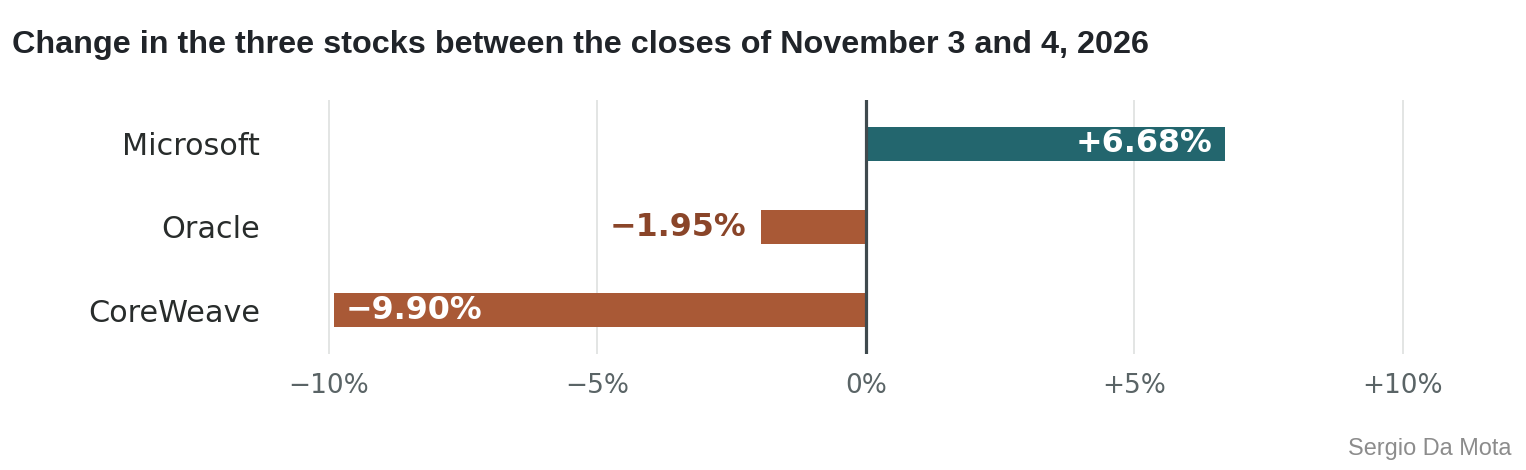
One explanation put forward that day was that a brake on construction would make capacity already in place more valuable. Prices alone cannot pin the gap on the vote. On November 4, Oracle was also closing two capital raises of $10 billion each, one in shares and the other in debt.
From the server room to the bank
In Abilene, Texas, what matters is the date the power comes on. In New Mexico, a bank sold a slice of the Project Jupiter loan at around 85 dollars per 100 of debt. Is that cheap enough to pay for the wait? With 1 dollar of fees and a target of 10% a year, the buyer has to get back at least 93.22 dollars of principal within three years, if all the interest in the model is paid. An extension can almost wipe out the price advantage.
Sources US Department of Energy · Reuters on the session · Oracle's capital raises · The loan resale
Who sells what in a data center?
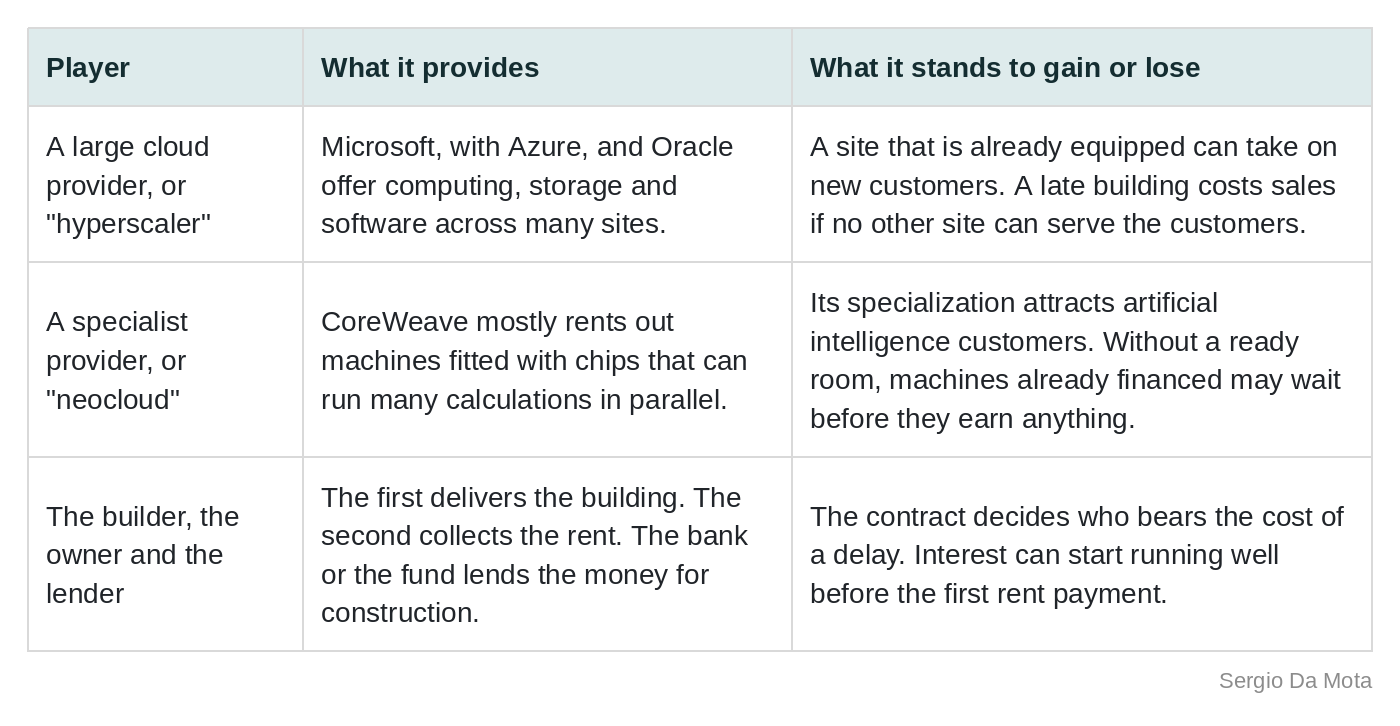
The owner can rent out a room supplied with power and cooling. The tenant installs servers in it and sells computing remotely. That service is called the cloud. The end customer can be a bank, a software publisher or a lab training an artificial intelligence model. The company that builds the building, the one that pays its rent and the one that rents out the machines can therefore all be different.
Why electric power is becoming political
Chips give off heat. To run without interruption, they need power, fiber optics, cooling and backup supply. How much water is needed depends on the technology chosen. In Abilene, Crusoe plans closed-loop liquid cooling, with no evaporation for that system.
The public Lawrence Berkeley National Laboratory estimates that data centers could use 11.8% of US electricity in 2030, and 9.5% to 15.3% depending on its scenarios. Residents and elected officials therefore have two concrete questions. Who will pay for the extra power lines? And what happens if the customer that made them necessary leaves the site?
Sources How the cloud works · CoreWeave's business and risks · Planned facilities in Abilene · Power scenarios for 2030
What the elections changed in Texas
The midterms are the US elections held halfway through a presidential term, two years after the presidential election. On November 3, 2026, voters were filling all 435 seats of the federal House of Representatives and about a third of the Senate. Each state could also elect its own leaders. President Donald Trump remains in office.
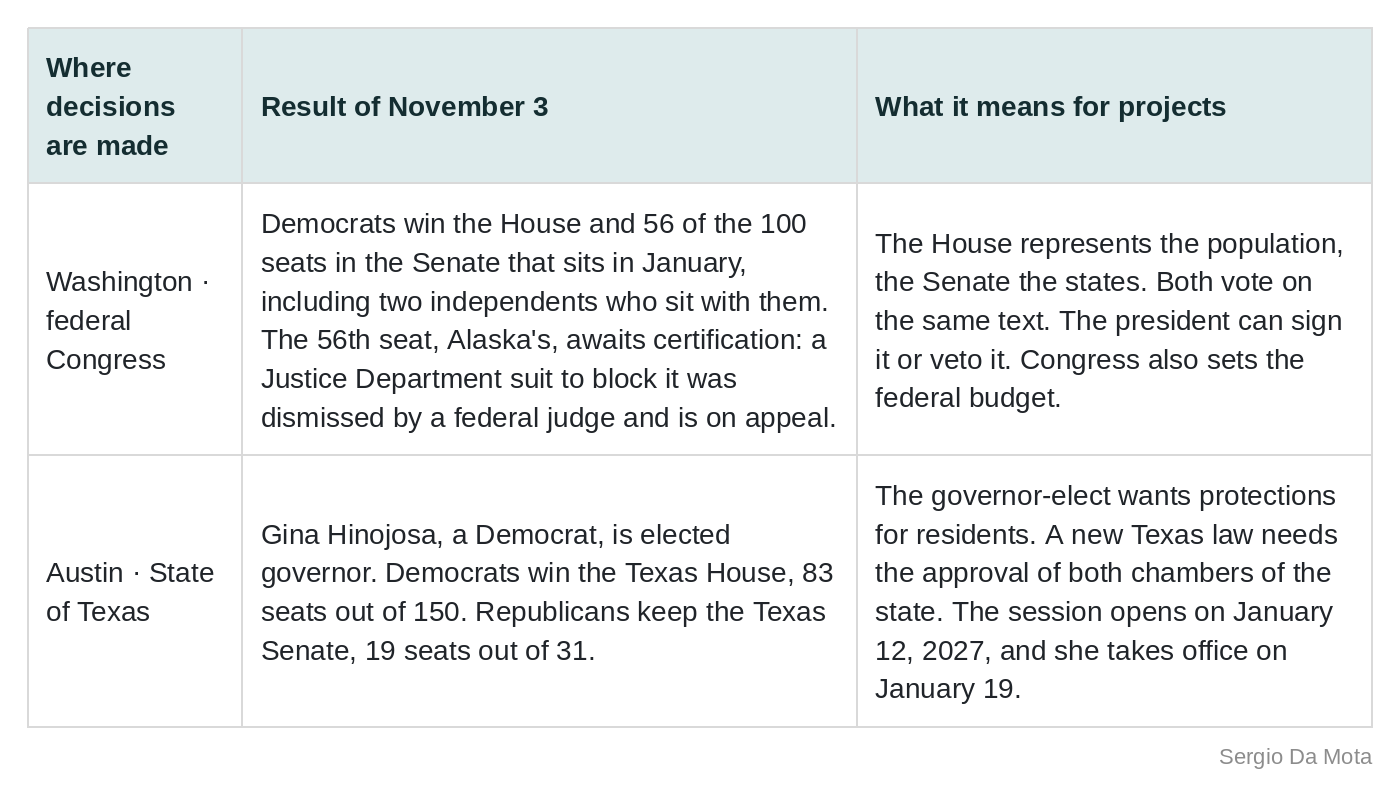
Timing matters. On September 21, Greg Abbott, the outgoing Republican governor, had already ordered a pause in environmental permits for data centers. On November 9, a Texas senator filed Senate Bill 296. Among other things, it proposes a two-year moratorium for certain projects. On November 17, the Texas environmental agency confirmed that it had resumed reviewing applications.
As of November 19, the bill is still only a proposal. It would take effect in the ordinary way on September 1, 2027, or immediately if it wins a two-thirds majority in each chamber. For Abilene, one would have to check which works it covers and how far along they are. That is the reason for this inquiry: an electoral majority changes the risk of future rules, while the construction schedule depends on the decisions actually taken.
Sources Elections and the role of the chambers · Federal result · The Alaska appeal · Texas result · Gina Hinojosa's pledge · The September 21 directive · Senate Bill 296 · Reviews resumed
Abilene and the date of the first payment
In Abilene, Crusoe is developing two new buildings for Microsoft. The neighboring campus hosts Oracle, which supplies computing to OpenAI. Each site has its own customers and contracts.
Lancium is involved in the electrical development. The city grants tax abatements subject to conditions. The Texas environmental agency is reviewing the permit for the gas-fired power plant. The grid operator is studying the connection to the public grid separately.
Three dates an investor must tell apart
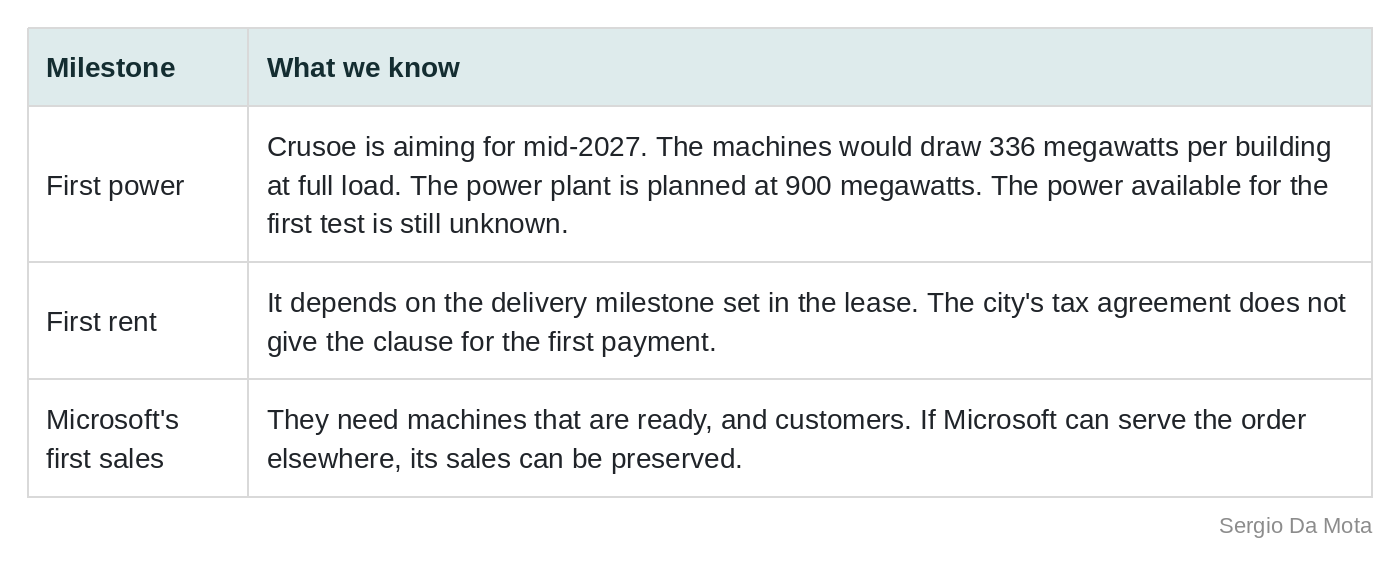
The file for the power plant, number 182126, contains a preliminary decision. The transformers appear on the plans. To date the first test, what is missing is confirmation of the power source and of the day it will be ready.
What Energy Transfer's $821 million represents
On September 22, the Alerian MLP ETF, a fund of energy infrastructure partnerships, fell from 54.35 to 53.67 dollars. Had it followed the fund, an Energy Transfer unit would have gone from 20.90 to 20.64 dollars. It closed at 20.40. The gap computed before rounding prices to the cent, 0.2385 dollar, multiplied by 3.443 billion units, gives 821 million of relative market value. The fund itself holds Energy Transfer among its largest positions, so this "relative" gap is measured against a basket that includes the stock. A leak in Michigan and the stock's earlier weakness make it harder to pin this gap on Texas.
The construction agreement was public in August. In November, in the prepared remarks of its November 3 results call, Energy Transfer gave the volume: "in furtherance" of its Crusoe agreement, it had "executed a 250,000 MMBtu per day, 10-year firm transportation agreement with an A-rated hyperscaler", which it did not name. Each MMBtu is one million British thermal units, a measure of the energy contained in gas. Suppose 1 dollar net per MMBtu after costs and ten annual payments at full capacity: that gives 91.25 million a year. At an 8% rate, together they are worth 612 million at the planned start-up. Pushing every payment back by a year cuts their value by 45 million. Cancelling them outright costs 612 million. To reach 821 million, the net fee would have to be about 18.11 dollars per MMBtu in the case of a delay, or 1.34 dollars in the case of a cancellation. Since a transport contract earns a fee rather than the price of the gas, 1 dollar net per MMBtu is probably generous, and a delay would still need eighteen times that: on these numbers, a delay at Abilene cannot by itself explain the September 22 gap. The thresholds would rise if the sums were discounted from the start-up back to September 2026. The real net fee and the share that belongs to the first building remain unknown.
Sources Crusoe's announcement · The city agreement · Permit register · Number of units · Michigan · The August 4 agreement · Third-quarter results, November 3
Which stocks can track this thesis?
Over the twenty sessions from October 22 to November 18, the three technology stocks traded more dollars a day than the two pipeline operators. Liquidity is how easily you can buy or sell without moving the price too much. The amount traded gives a clue. The contract each company holds then determines the risk being studied.
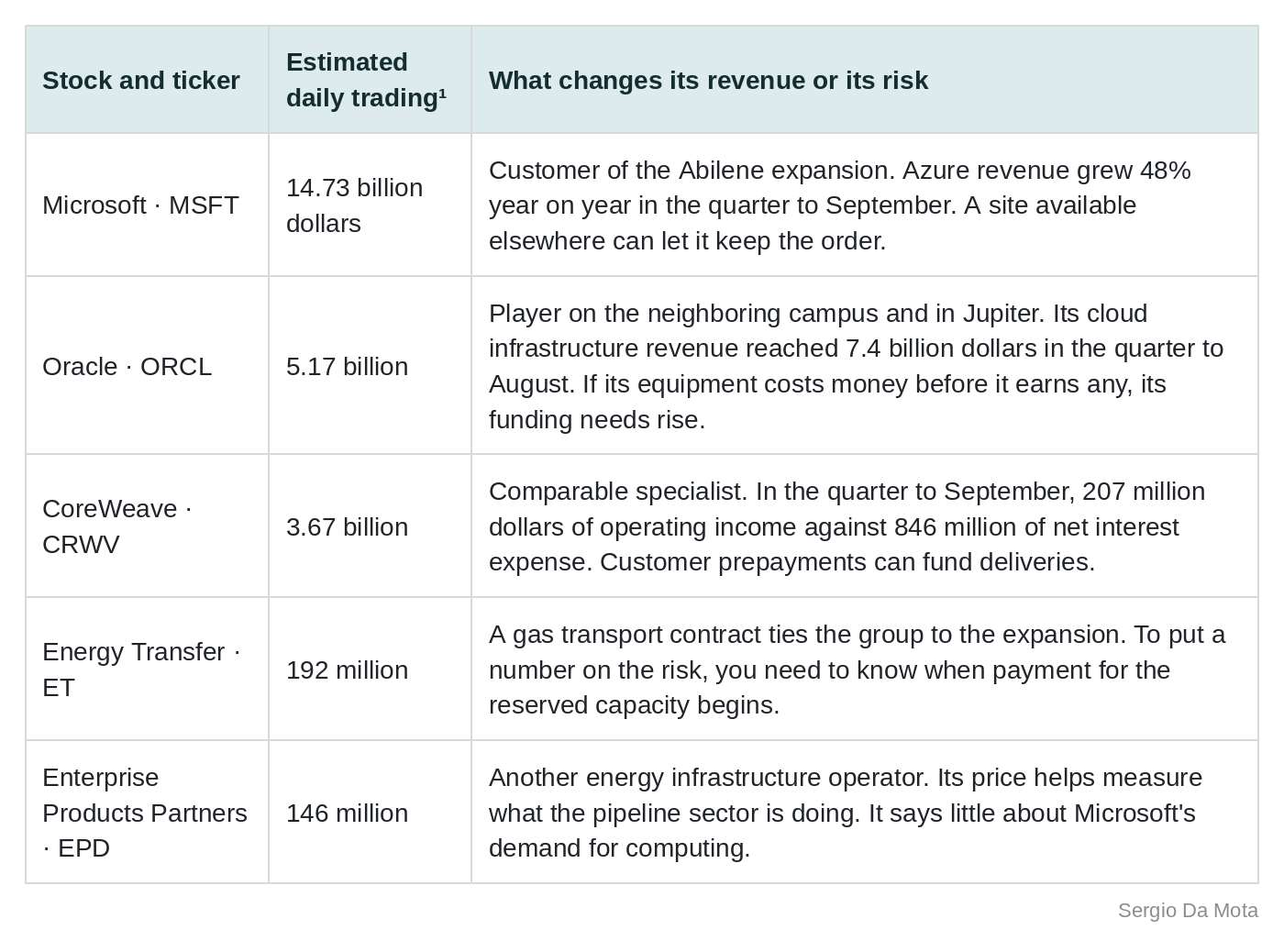
¹ For each day, the closing price times the number of shares traded, then averaged over twenty sessions, in US dollars. The measure covers the shares. It measures neither the cost of trading an option nor the price at which a large quantity could be bought or sold at once.
Microsoft and CoreWeave shed light on delivery risk, but their share prices also depend on their other contracts. From November 3 to 18, Microsoft lost 2.44% and CoreWeave 11.00%. CoreWeave reported its results on the 10th. That gap, already realized, does not put a number on the gain from a future bet between the two stocks. The Jupiter loan allows a more direct comparison: its price can be set against the dollars the buyer hopes to receive.
Sources Microsoft's results · Oracle · CoreWeave · CoreWeave's delivery risks
The loan sold by HSBC puts a price on risk
In New Mexico, Project Jupiter offers another vantage point. HSBC, whose initials stand for Hongkong and Shanghai Banking Corporation, found a buyer for part of its construction loan. According to Bloomberg News, the deal, struck several weeks earlier, came to light on November 16.
The whole loan comes to about 18 billion dollars. The slice HSBC sold was about 300 million dollars of face value, the reference amount to be repaid. It reportedly changed hands at around 85 dollars per 100. At exactly 85, the buyer would pay 255 million. The 45 million gap to face value is simple arithmetic. To know the loss the bank booked, you would need the exact price and the value of the loan on its books before the sale.
Why accept that price? In September, Oracle had invoked a force majeure clause, which under certain conditions allows a party to seek changes to a contract when an event beyond the parties' control occurs. The uncertainty was about payments if the power came late. Blue Owl, whose funds put up the project's equity and which owns the developer, STACK Infrastructure, said that the commitments remained in place. On November 6, the New Mexico authority took the hearing on the emissions of the local power system off the calendar, pending a new opinion. The buildings and power generation fall under separate permits. HSBC's exact reason for selling remains unknown.
Three scenarios for credit
Local delay. An amendment gives the project more time and the lenders keep receiving their interest. Sector strain. Several projects push back their revenue and borrow at higher cost. On November 17, the Financial Times reported that two other banks had put up to 800 million dollars of loans tied to several projects up for sale. Only the prices of completed sales will show how deep the discounts are.
Systemic risk. The same lenders take losses on several projects, then also cut lending to companies outside technology. The Federal Reserve puts new debt tied to advanced computing at more than 680 billion dollars in 2026 through October. As of November 3, a presenter before the Treasury's advisory committee on borrowing saw no clear crowding out of non-tech credit yet. I would revise this diagnosis if lending restrictions appeared among those borrowers.
Sources The sale reported by Bloomberg News · Reported amounts and price · The clause and the parties' response · The November 6 decision · Other loans for sale · Federal Reserve report · Treasury minutes · Permit scope according to Oracle
At 85 dollars, how much has to come back?
Let us stand in the loan buyer's shoes. For 100 dollars of principal to be repaid, the buyer pays 85 dollars to the seller. With 1 dollar of assumed fees, 86 dollars go out on day one. The 85 figure rounds the price of a past sale. The price at which a lender could buy today is unknown.
What we know. The journal Project Finance International describes four buildings financed separately. The lenders count on the assets and contracts of each project to be repaid. Having Oracle as a tenant does not on its own guarantee that the loan will be repaid. Its initial term is four years, with two possible one-year extensions. The published interest rate is floating: one-month Term SOFR, a rate derived from the US overnight rate on secured loans (the Secured Overnight Financing Rate), plus 2.50 points, with interest paid monthly.
What I assume. I study 100 dollars already lent, with no further sums to advance (even though a buyer of a construction loan usually takes over the duty to fund future draws), no borrowing by the buyer and no taxes. I assume three years remaining, interest paid at the end of each year and the principal repaid in one go. I freeze the reference rate at 3.92%, the level of overnight SOFR on November 17, so annual interest comes to 6.42 dollars: an annual model at a fixed rate simplifies a loan that pays a floating rate every month. I set a minimum return of 10% a year for the exercise. That threshold can differ from one investor to another.
The maximum price depends on the amount repaid and on the date
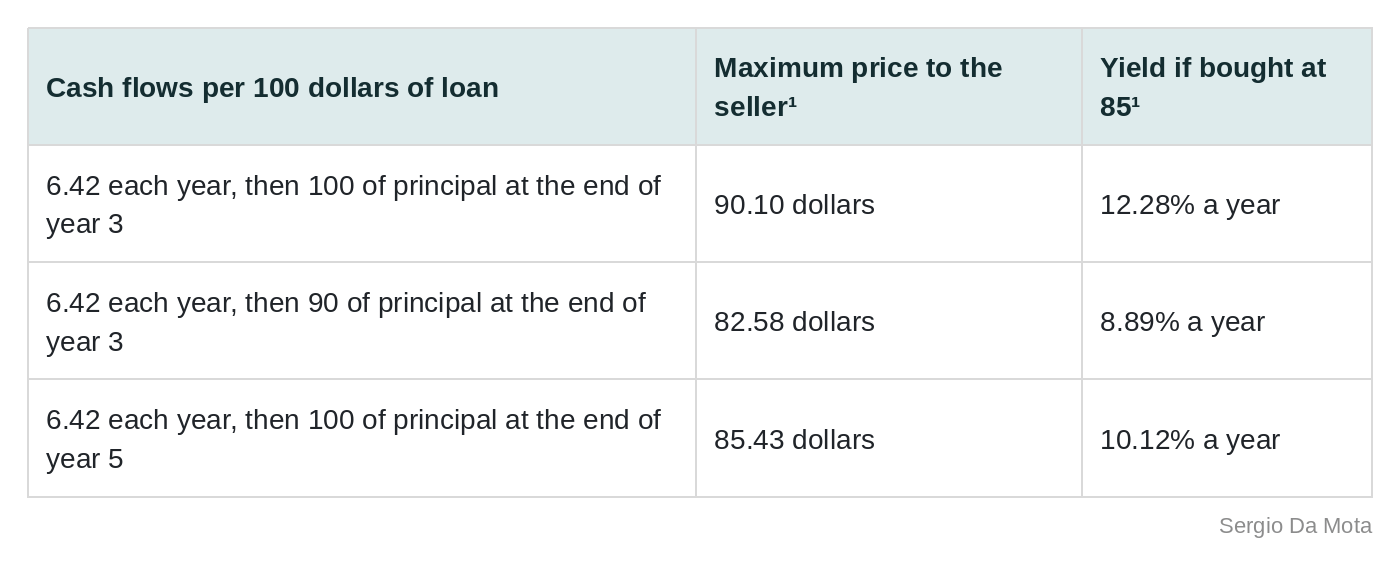
¹ Interest is also paid in the final year. The maximum price leaves 10% a year after the dollar of fees. First row: 6.42 ÷ 1.10 + 6.42 ÷ 1.10² + 106.42 ÷ 1.10³ = 91.10 dollars. After 1 dollar of fees, you can therefore pay 90.10 to the seller. With a required return of 12%, the same ceiling drops to 85.60.
Reading at 85. The three interest payments bring the minimum principal to recover in year 3 down to 93.22 dollars: 86 × 1.10³ − 6.42 × (1.10² + 1.10 + 1). A loss of principal of more than 6.78 dollars means missing the target, even if every interest payment has been made.
Sources Original financing terms · Reference rate of November 17 · Reported sale price
Does the discount pay enough to wait?
At the indicative price of 85, two years of extensions leave only 0.43 dollar of margin against the maximum price of 85.43, even if everything is paid in the end. The reported quote is too approximate to exploit such a small difference.
The case where the interest stops
Suppose the buyer receives no interest and gets back only 50 dollars after three years. Those 50 dollars are worth 37.57 at the start when you require 10% a year. The scenario in which everything is paid within three years is worth 91.10 before fees. Between these two outcomes alone, a cost of 86 leaves room for a weight of at most 9.5% on the bad case: (91.10 − 86) ÷ (91.10 − 37.57). This figure measures the risk the price can absorb in this example. How often such a loss actually happens remains to be established.
The document that would change the scenario
November 19, 7 p.m. Geneva time. The meeting set in New Mexico is the first status conference in the air permit case for the on-site power plant. The December 7 hearing has been cancelled, and it will not be rescheduled until the state's Air Quality Bureau files its revised recommendation. December 2026. In a sworn declaration of July 17, an Oracle executive stated that several gas supply, power purchase, option and construction agreements depended on certain activities starting by December 2026. A certificate for the required works or a written extension of the agreements would reduce this timing risk. You would then have to check whether that actually protects the payment of interest and the repayment of the loan.
My verdict. I take 82.58 as an illustrative study ceiling, not a price to pay, if I expect three interest payments of 6.42 and only 90 of principal back after three years. At 85, that scenario returns 8.89%, below my 10% requirement. An obligation to advance more money, or unpaid interest, would invalidate this calculation. A change in the rate or the maturity means recalculating the ceiling. To judge an offer, I am missing the identity of the building being financed, the sums still to be lent, the collateral and the order in which creditors get repaid, as well as a firm price. Any edge worth exploiting on this private loan depends on that information.
Sources Order on the November 19 conference · Oracle's declaration on December, paragraph 8(b) · Financing terms · Permit scope
Editor's note (November 24, 2026)
Since this article was written, the bidding for ING's sale of data center loans, which included a slice of the New Mexico financing, closed on November 19 without drawing enough interest to clear the debt. On Monday, November 23, Oracle's stock rose 12.3% while its five-year credit default swap moved by about 2 basis points. After the November 19 status conference, no new hearing date had been announced as of November 24, and under the November 6 order none can be set before the revised recommendation is filed. With coupons taken from the three-year SOFR swap (about 4.50% on November 23) instead of the 3.92% held fixed above, the ceiling in the first row rises from 90.10 to 91.53, and the yield at 85 from 12.28% to 12.92%, close to the "about 13%" of our analysis, Patient Zero.
CrossVol Research
For education only. This is not investment advice.
This article is by Sergio Da Mota, CrossVol Derivatives Team. The analysis and the views are the author's own; CrossVol Research publishes them for educational purposes.
CrossVol Research is the research desk of CrossVol (crossvol.com), an options analytics platform for derivatives traders.
How to cite: Sergio Da Mota, CrossVol Research, "Who Pays While a Data Center Waits for Power? ($MSFT $ORCL $CRWV)", 24 November 2026. https://newsletter.crossvolresearch.com/p/who-pays-data-center-power-delay