


By Djellal Djouad
The volatility risk premium (VRP) is the systematic gap by which option-implied volatility exceeds the volatility that later actually gets realized. In plain terms, implied vol is usually higher than realized vol because option sellers demand payment for bearing the risk of a sudden move, and buyers pay up for protection they may never need.
That single sentence answers most of what people search for. The rest of this piece unpacks how the premium is measured, why it decreases along the term structure, what a worked energy peer group looks like, and the moment when the whole thing turns against you.
What Is the Volatility Risk Premium
The VRP is the compensation earned by whoever sells volatility. When you sell an option, you take in premium priced off implied vol. Your profit or loss over the life of that option depends on how much the underlying actually moves, which is realized vol. If implied vol was 22 and the stock only delivered 16 vol points of movement, the seller kept the 6 point difference as edge.
Across long samples and across most liquid markets, that difference is positive on average. Implied sits above subsequent realized. This is not a market inefficiency waiting to be arbitraged away. It is a risk premium in the same family as the equity risk premium or the credit spread. Investors dislike the outcomes that volatility spikes are correlated with, namely equity drawdowns, funding stress, and forced deleveraging. They pay to avoid those outcomes, and sellers get paid to accept them.
The key word is systematic. On any single day the premium can vanish or invert. Averaged over months and across names, it persists because the underlying fear it prices is real.
How It Is Measured
The cleanest measure of the VRP is implied volatility minus subsequently realized volatility, expressed in vol points. Take the 30 day implied vol observed today, then compare it against the realized vol that the underlying prints over the following 30 days. A VRP of plus 5 means implied ran 5 vol points rich to what actually happened.
Because you need the realized leg to complete, practitioners often use a proxy in real time: current implied minus trailing realized over a matched window. It is not perfect, but it flags where the premium is stretched or compressed right now.
Two dimensions matter. First, tenor. You can measure the premium at 30 days, 60 days, or 90 days, and the number usually differs across the curve. Front tenor implied vol carries more event and gap risk, so the front end premium tends to be fatter. Second, cross section. Index level VRP is generally smaller and steadier because diversification damps index realized vol, while single name VRP is larger and more dispersed because idiosyncratic risk and earnings gaps push implied higher relative to what individual names ultimately deliver.
A Worked Example
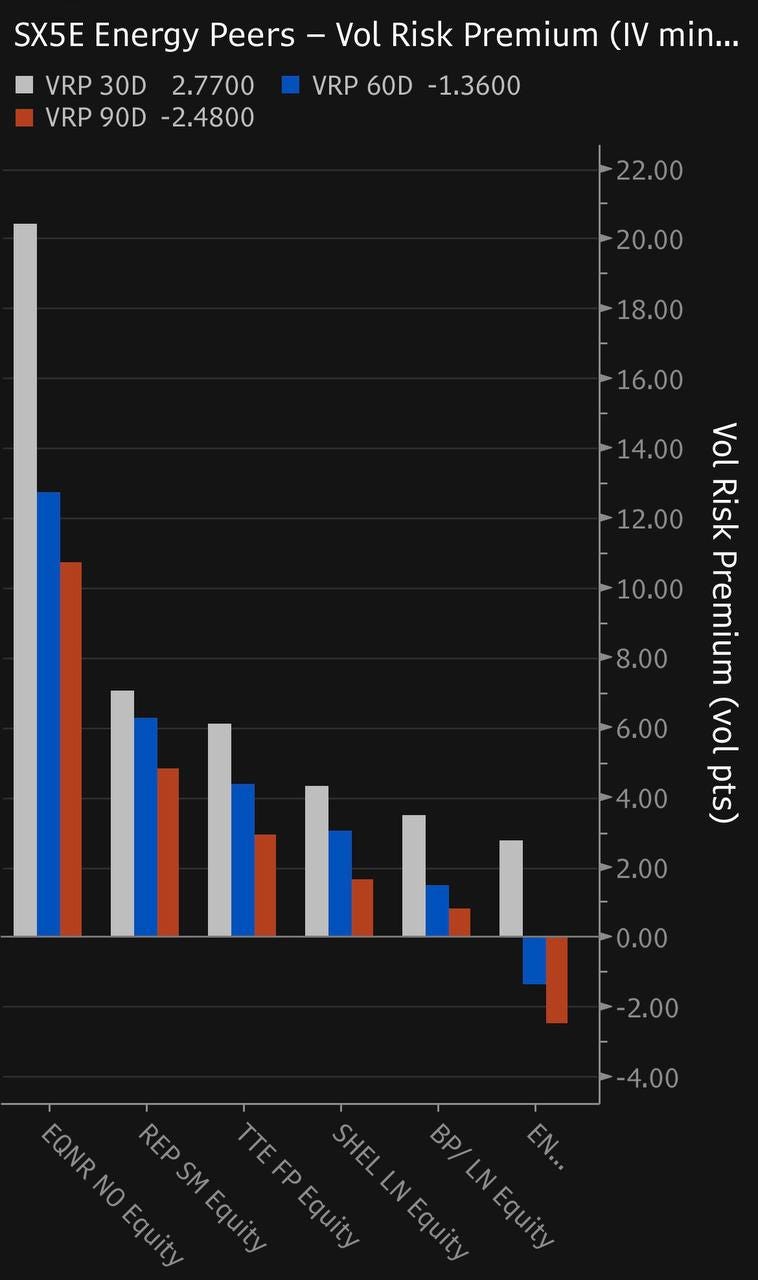
Consider an energy peer group inside a European index. Measuring 30 day implied against 30 day realized, the premium runs from about plus 2.8 vol points on the tightest name to plus 20.5 vol points on the richest. That spread of nearly 18 vol points across a single sector is the dispersion the premium is measured against, and it is why VRP is a relative value tool as much as a directional one.
Now walk out the term structure. On most of these names the premium decreases from 30D to 60D to 90D. A name showing plus 12 at the front might print plus 8 at 60 days and plus 5 at 90 days. The front carries the near term event risk, earnings, guidance, and headline gaps, so that is where sellers get paid the most per unit of risk.
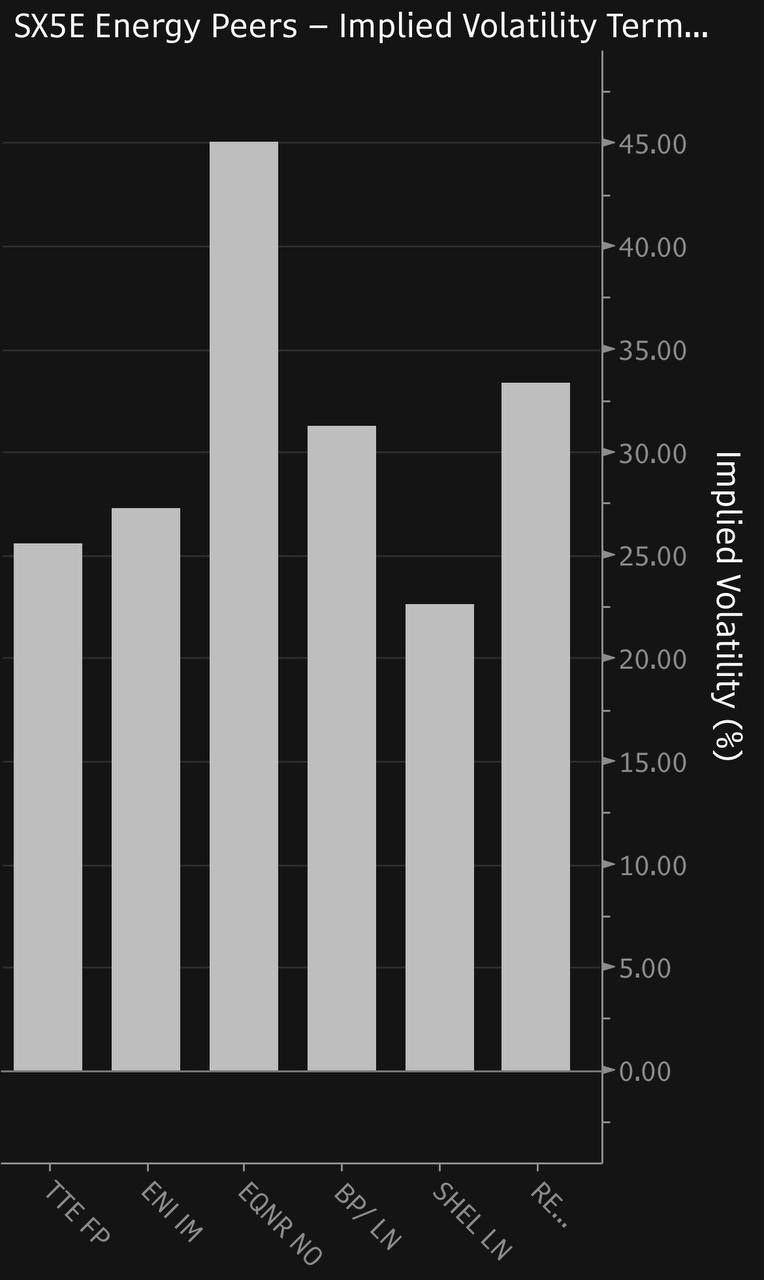
One name breaks the pattern. Its front end premium is positive, but the back end VRP goes negative, running about minus 1.4 to minus 2.5 vol points at the longer tenor. A negative VRP means 90 day implied vol is actually cheap relative to the realized vol the name has been delivering. The market is pricing less future movement than the stock has shown. That can happen when a name has been genuinely more volatile than the option surface reflects, or when a known catalyst sits just beyond the front window and the back end has not caught up. A negative back end premium is a signal to stop selling that tenor and consider owning it, because you would be short something priced below its own realized track record.
How It Is Harvested and When It Fails
There are three main ways to harvest the VRP. The most direct is short vol: sell options, delta hedge, and collect the gap between implied and realized. The cleanest expression is variance, either through variance swaps or a strip of options that pays off on realized variance versus a strike set at implied. And there is the tail, which is the part everyone underweights. The premium exists precisely because sellers are exposed to a fat left tail.
Here is the honest part. The VRP is not free money. It is compensation for a real risk, and that risk gets paid out in correlated crashes. On calm days the seller pockets the difference. Then a shock arrives, realized vol explodes past implied, correlations across names snap to one, and every short vol book that looked diversified turns out to be the same trade. The dispersion you saw across the energy peer group collapses. That is the moment the premium is handed back, often erasing months of steady carry in a few sessions.
The practical takeaway is that harvesting the VRP is a sizing and tail management problem, not a signal problem. The signal is almost always there. Survival depends on how you cap the left tail, whether through spreads instead of naked options, hard notional limits, or an explicit tail hedge that bleeds during the calm and pays during the break.
Related CrossVol Research
For a live application of these ideas to the exact peer group above, see our note on energy vol, TotalEnergies skew, and the sector term structure. To see where dealer positioning shapes the realized vol that the premium is measured against, explore the CrossVol gamma exposure dashboard.
FAQ
What is the volatility risk premium? It is the systematic gap by which option-implied volatility exceeds the volatility that the underlying subsequently realizes. Option sellers earn this premium as compensation for bearing the risk of a sudden move, and it persists on average across most liquid markets because the fear it prices is real.
Why is implied vol higher than realized vol? Because buyers pay for protection against gaps and crashes they may never see, and sellers demand payment for accepting that tail risk. Volatility spikes cluster with equity drawdowns and funding stress, outcomes investors will pay to avoid, so implied stays structurally above realized on average.
How do you capture the volatility risk premium? Mainly through short volatility positions, selling delta hedged options to collect the implied minus realized gap, or through variance swaps that pay the difference directly. The edge is real but the risk is a fat left tail, so success depends on sizing and explicit tail management.
Can the volatility risk premium be negative? Yes. When implied vol sits below the realized vol an underlying is actually delivering, the premium is negative, often at longer tenors where the surface has not caught up to a genuinely more volatile name. A negative VRP is a signal to stop selling and consider owning that tenor.
Djellal Djouad
Further reading