


Educational case study. This is not investment advice and not a recommendation to trade. Prices are October 5, 2026 settlements, the book is illustrative, and options and futures can lose far more than you expect.
Brent settled at 100.32 on Monday for the December contract. The thirty year Treasury yields 5.66 percent, after touching 5.70 percent on Monday, a level last seen in 2002. A gallon of regular gasoline costs 4.37 dollars, up almost 40 percent from a year ago. The midterms are four weeks away, on November 3.
The war with Iran has been running since February 28. The spring ceasefire collapsed on July 8, and since then Washington has kept to limited strikes while a naval blockade squeezes Iranian exports. The President has also been unusually explicit about timing. Asked whether the bombing could ramp up after the midterms, he told TIME, in an interview published on October 1, that it was possible. At a rally in Mobile, Alabama, the next day he said the war would probably end right after the midterms and that oil prices would come tumbling down.
My view is simple to state. I do not think Trump resumes large scale strikes on Iran before November 3. I think he does after the vote, whether Republicans hold Congress or lose it. This piece is about how to express that calendar with options, and about the two parts of the structure that do most of the work, a put ratio before the vote and a tail hedge underneath it.
Why the vote sets the oil calendar
Gasoline is the most visible price in American politics, and this White House is already spending its ammunition to hold it down. The 172 million barrel release from the Strategic Petroleum Reserve agreed in March ends with a final offer of up to 40 million barrels, made on September 29, and the reserve already sits at its lowest level since 1982. The pattern is not new. In 2022 the last 15 million barrels of that year's release were announced on October 19, three weeks before the midterms. A president four weeks from an election, with a 4 dollar gallon, does not choose to add a Gulf escalation on top of it.
After the vote the logic flips, and it flips whichever way the vote goes. If Republicans hold Congress, the electoral cost of escalation disappears for two years. If they lose, and Democrats lead the generic ballot by eight to nine points in the main averages, the clock that matters becomes the lame duck. The House already passed an Iran war powers resolution 220 to 204 on September 15, with seven Republicans in favor, and a new Congress takes office on January 3. That is a reason to act sooner, not later. The buildup points the same way. The carrier Theodore Roosevelt left San Diego on September 27, an amphibious group with about 2,000 Marines sailed the next day, and US officials put the extra forces at nine to ten thousand, due in the region by late November.
The physical market explains why I expect a drift lower before the vote rather than a collapse. Crude flows through Hormuz are back near prewar levels, but product flows are still a fraction of normal, China has halted October fuel exports, and global inventories drew more than 500 million barrels between February and August. OPEC+ held its November targets on October 4 and meets again on November 1. Before the vote the ceiling on Brent is political and the floor is physical. After the vote the distribution turns binary, an escalation that spikes oil or the deal the President keeps promising, which would send it lower.
What the options market already prices
The October 27 expiry is the last monthly Brent option before the vote. At the money vol is 47.3. The 25 delta put trades at 50.1 against 48.5 for the 25 delta call, and the 10 delta put at 54.1 against 52.5 for the 10 delta call.
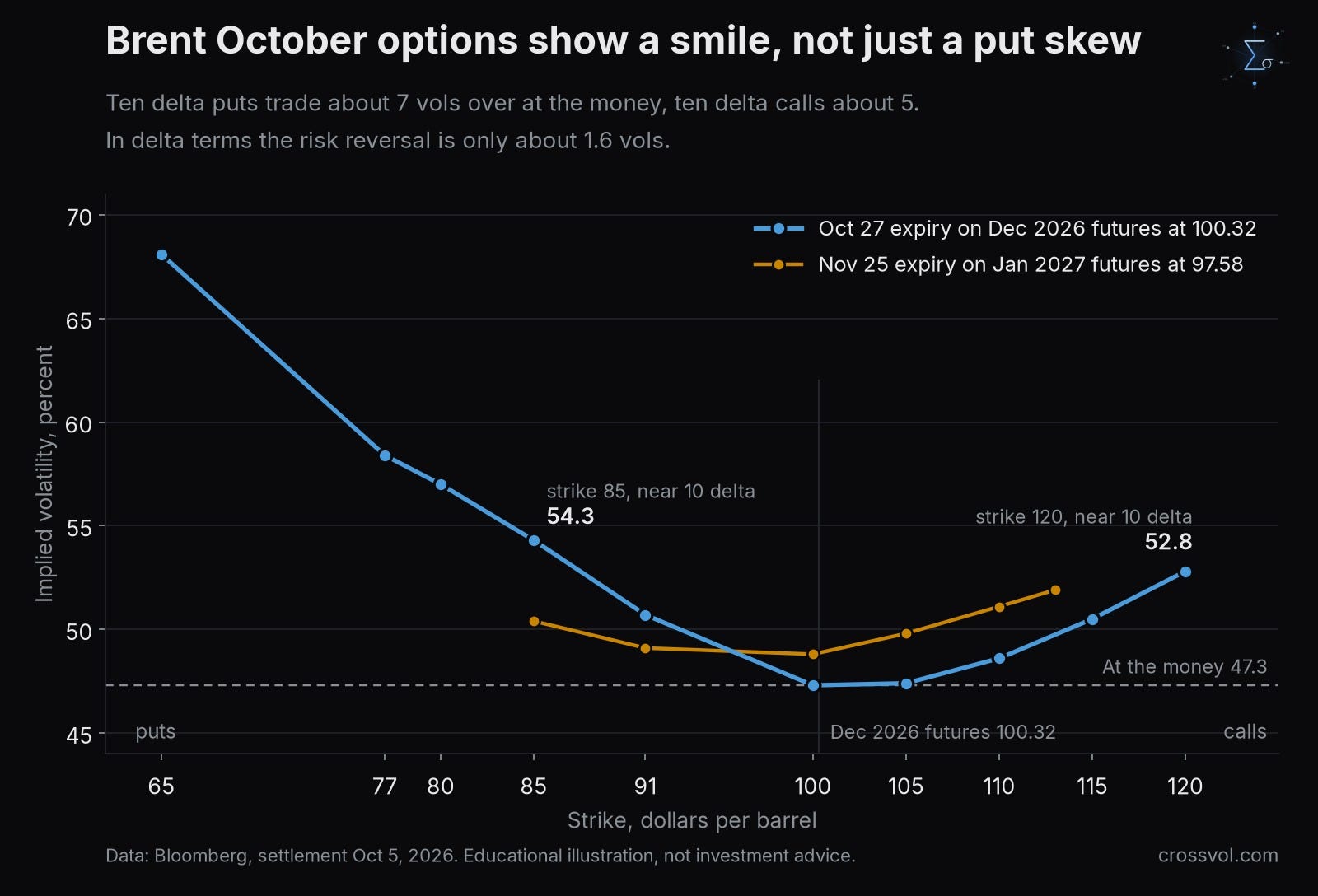
So the risk reversal is only about 1.6 vols in delta terms. Both wings are bid over at the money, the puts by about 7 vols and the calls by about 5. Measured by strike the tilt is larger, a put 15 to 20 percent out of the money sits 3.5 to 4 vols above a call the same distance away. The market is pricing two tails at once. Since mid July, traders have bought large volumes of cheap downside put spreads as protection against an abrupt end to the war, and that demand is part of what keeps the puts bid.
The November 25 expiry, which covers the January contract and the weeks after the vote, is more balanced still. There the 110 call trades at 51.1 vol and the 85 put at 50.4. After the vote the market already pays as much for upside as for downside.
The ratio logic
Before the vote I want to own a drift lower, not a crash. That is exactly what a put ratio is built for. The structure is a 3 by 5 on the October 27 expiry. Buy three puts at 91, sell five puts at 77.
Each strike has a job. The 91 put settled at 1.47 dollars a barrel with about a 20 delta. It is the exposure. It starts paying as soon as Brent slips under 91, which is where SPR barrels, steadier Gulf flows and jawboning from the White House could take it before November 3. The five 77 puts settled at 0.16 with a 3 delta. They are the statement that a collapse before the vote is unlikely while the physical floor holds, and they shape the payoff so that it peaks exactly at 77.
The arithmetic deserves a line of its own. Three times 1.47 is 4.41. Five times 0.16 is 0.80. Each 3 by 5 unit costs 3.61 dollars a barrel. Selling more options than you buy does not make a structure a credit, and a 3 delta option pays very little in dollars even when its vol looks rich. The true 10 delta put is the 85 strike at 0.63, and a 1 by 2 in 91 and 85 would cost only about 0.21. I still prefer 77 for the short strike, and the reason is the thesis itself. A short strike at 85 sits inside the range I expect oil to visit before the vote. A short strike at 77 sits below it.
Sized at 100 lots on the short leg, about 10 million dollars of Brent, the ratio is long 60 puts at 91 and short 100 puts at 77, for 72 thousand dollars. At expiry it is worth nothing above 91, 360 thousand at 85, 660 thousand at 80, and it peaks at 840 thousand at 77. Below 77 it gives money back at 40 thousand dollars per dollar of Brent, because 40 more puts are sold than bought, and below about 57.80 the plain ratio starts to lose, with no limit.
The tail hedge logic
Every ratio has a weak spot, the part you are net short. Here it is 40 puts below 77. Before the vote the event that reaches that zone is not a slow recession, it is the war ending early, the same deal the President promises for after the election, only sooner. That is the gap a tail hedge exists to close.
Buying 40 puts at 65 for 0.02 costs 800 dollars, about one percent of the ratio's premium. It does three things. It limits the give back to the 12 dollars between 77 and 65. It turns the floor into a gain, because below 65 the payoff locks at 360 thousand however far Brent falls. And it removes the open ended short, which means the structure can be held through headlines and margin calls rather than cut at the worst moment.
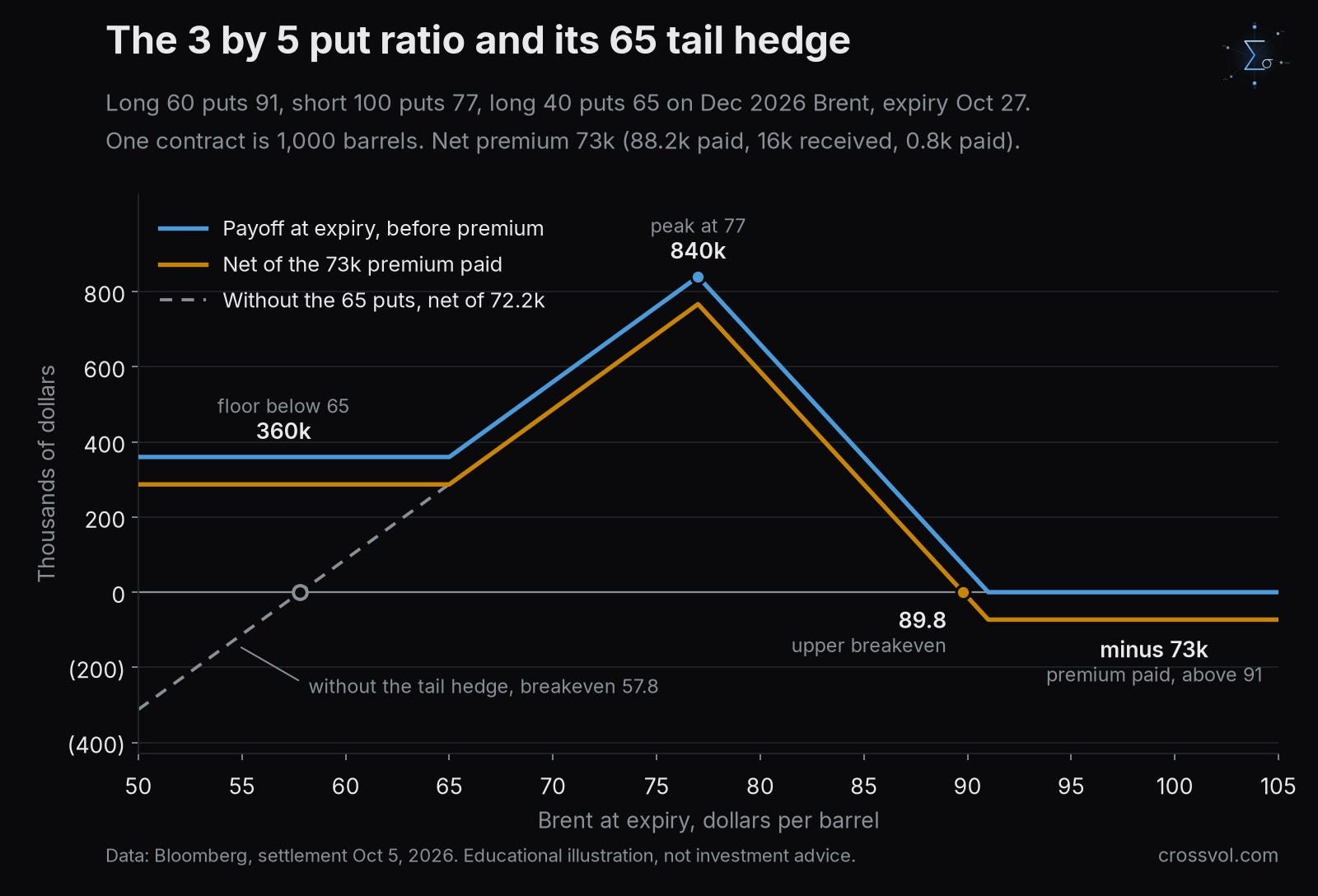
Why 65 rather than 70 or 60? A tail hedge is chosen for its strike, not its delta. At 65 it is close to free and the worst give back is bounded at 12 dollars. Further down the protection is cheaper but the unprotected zone gets wider. Closer in it starts to cost real money and eats the payoff the ratio was built for. With the tail in place, the full put structure costs 73 thousand dollars, is never worth less than zero at expiry, and makes money net of premium anywhere below about 89.80.
The bond leg, and an exact DV01
The macro leg is short 10 million face of the on the run thirty year, the 5.125 percent of August 2056, which closed at 92.273, or 92 and 8¾ thirty seconds, to yield 5.664 percent. A post vote escalation means a second oil shock on top of a 4 dollar gallon, with the long end already near 5.7 percent. I want to be short duration into that.
Every hedge ratio downstream is built on this leg's DV01, so it has to be exact. DV01 is the change in the bond's full price, accrued interest included, for a one basis point move in yield. The textbook form is modified duration times full price times 0.0001. For an October 6 settlement, accrued interest for 52 of the 184 days in the coupon period is 0.724, so the full price is 92.998. Modified duration is 14.499. The product gives 0.1348 points per 100 of face for one basis point, which is 1,348 dollars per million of face and about 13,480 dollars per basis point for the 10 million short. Repricing every cash flow with the yield bumped half a basis point either side gives the same 1,348 dollars per million. A risk field quoted around 13.48 is therefore dollars per basis point per 10,000 of face. To get a million you multiply by 100, not by 10,000.
For large moves DV01 is not enough, so every scenario below reprices the bond in full. A 100 basis point rise earns about 1.21 million. A 100 basis point fall costs about 1.51 million, and the gap is convexity working against a short. Carry is a small cost, a 5.125 percent coupon paid against about 3.92 percent of repo earned, roughly 20 thousand dollars into November 25, which the scenarios below leave out.
Hedging the scenario that hurts both legs
The scenario that hurts the whole book is the one the President describes, a deal, oil tumbling, yields following it down. Correlation cannot hedge it. Brent and the thirty year yield have moved with a 0.63 correlation over three months of daily data but only 0.35 over a year, which explains about 12 percent of the variance. The hedge has to be direct, calls on Treasury bond futures.
Two choices make it work. The expiry is the December options, which expire on November 20, after the vote and inside the window where a deal would land. And the size comes from DV01, not notional. A bond future moves like its cheapest to deliver bond divided by its conversion factor. The rule of thumb says that with yields below the 6 percent notional coupon the lowest duration bond in the basket is cheapest, here a 2042 issue. The delivery screen says otherwise. The 2044 to 2046 bonds trade about 5 basis points cheaper than the 2043 issues, and the 2.5 percent of February 2045 ranks first, with a conversion factor of 0.6179.
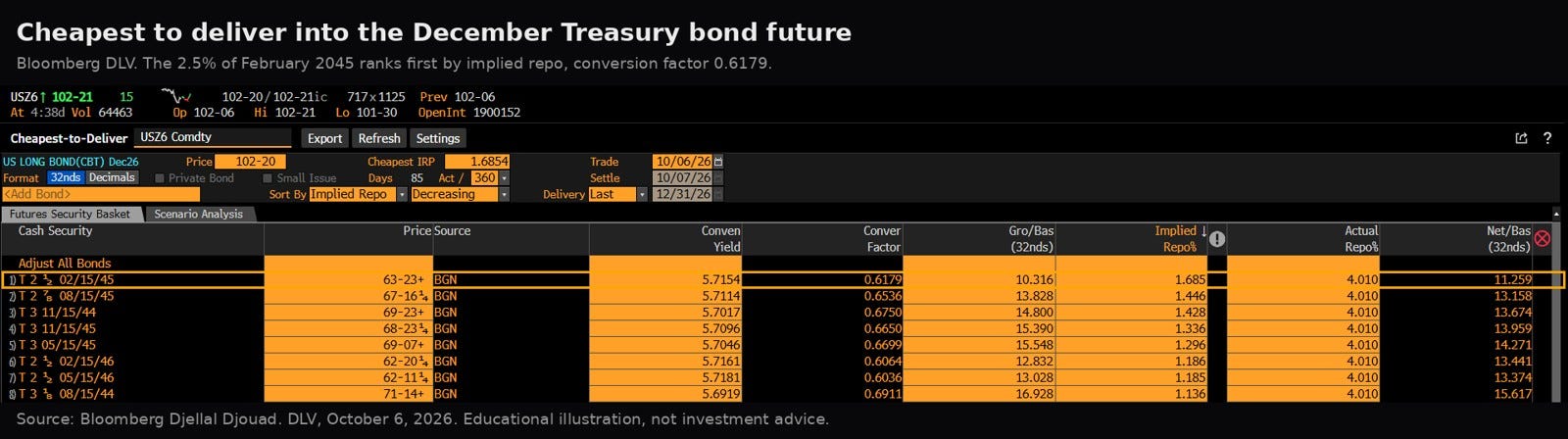
With a duration near 13 years rather than 11, that bond makes the future move about 137 dollars per basis point per contract. So 98 contracts at delta one carry about 13,400 dollars per basis point, the same as the short. Sized on the shorter bond, the hedge would have been about 20 percent too large.
The 104 calls settled at 1 and 16/64, or 1.25 points, 1,250 dollars a contract, on 13.9 vol and a 37 delta, so 98 of them cost 122.5 thousand. On day one they offset about 37 percent of the short's DV01, and the book keeps most of its short duration. If yields collapse and the future runs through 104, the calls take over close to one for one. A short bond plus calls on matching DV01 is a synthetic put, a short with a floor that starts once the future trades through 104. The surface helps here too, because on bond options the downside carries the premium, with out of the money puts on the December expiry about 1 to 1.5 vols over equidistant calls. One refinement for anyone running the true thirty year at size. The classic contract tracks bonds of 15 to 25 years, while the Ultra Bond, whose cheapest to deliver is currently the 2.25 percent of February 2052 and which moves about 170 dollars per basis point per contract, matches a thirty year short much more closely.
After the vote, the calls
The post vote leg is 100 calls at 105 on the January contract, expiring November 25, three weeks after the vote. They settled at 4.37 dollars a barrel, 437 thousand dollars, the most expensive line in the book, which is fair, because this is the bet. Two refinements are worth weighing. A 105 and 113 call spread costs 1.73 instead of 4.37 but caps the payoff, which matters if an escalation closes the Strait again. And November 25 may be early if the window that counts is the lame duck before January 3, in which case an expiry in late December fits better.
Every leg at its own expiry
Every price in the book is the October 5 settlement, as Bloomberg's historical price screens show.
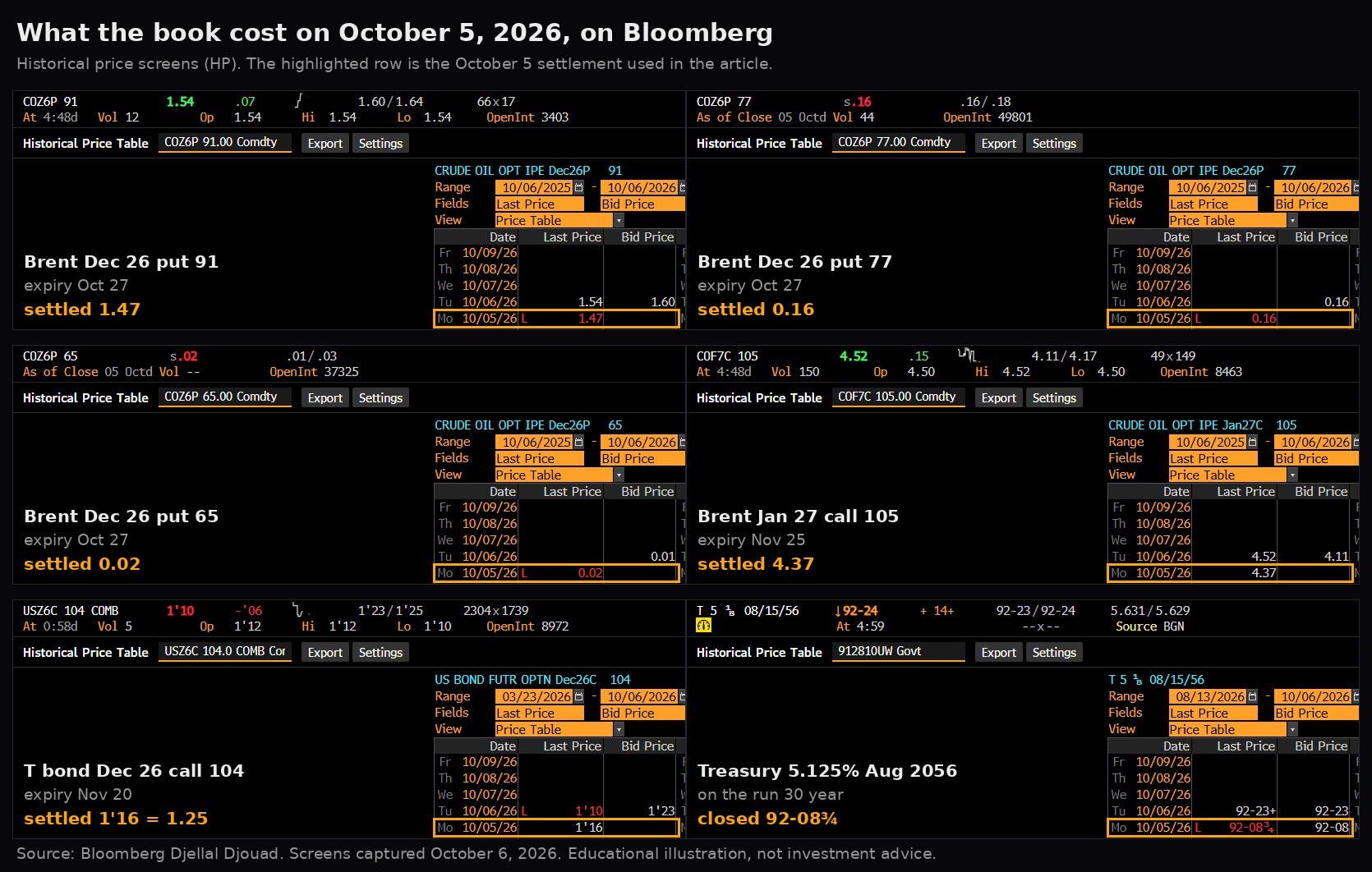
Together the book pays 632.5 thousand dollars of premium. Priced with every leg at its own expiry, and before the 20 thousand of carry, the grid has the shape of the thesis.
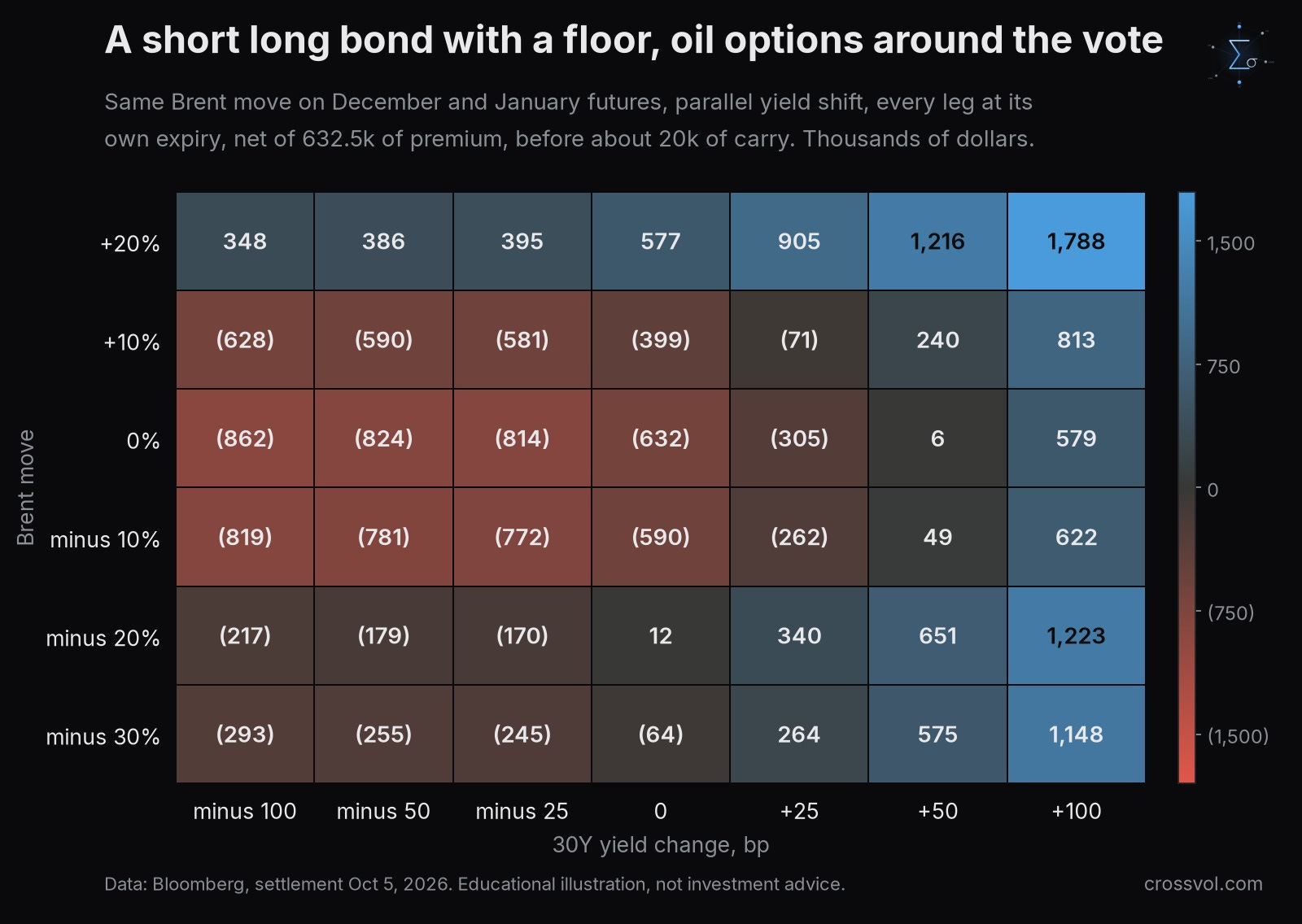
Yields up and oil up is where it earns, about 1.79 million with Brent up 20 percent and the long end up 100 basis points. With Brent flat it earns 579 thousand if yields rise 100 basis points and loses 862 thousand if they fall 100, the worst cell on this grid, because the bond calls put a floor under the short. The floor is not perfect. In a 200 basis point rally the loss grows to about 1.04 million, because the thirty year gains convexity faster than the bond the future tracks. A 20 percent Brent selloff with flat yields is roughly flat, the ratio pays for the calls.
In the order the legs expire
The calendar matters more than the grid. The Brent puts settle on October 27, the bond calls on November 20, the Brent calls on November 25, and the short is marked there.
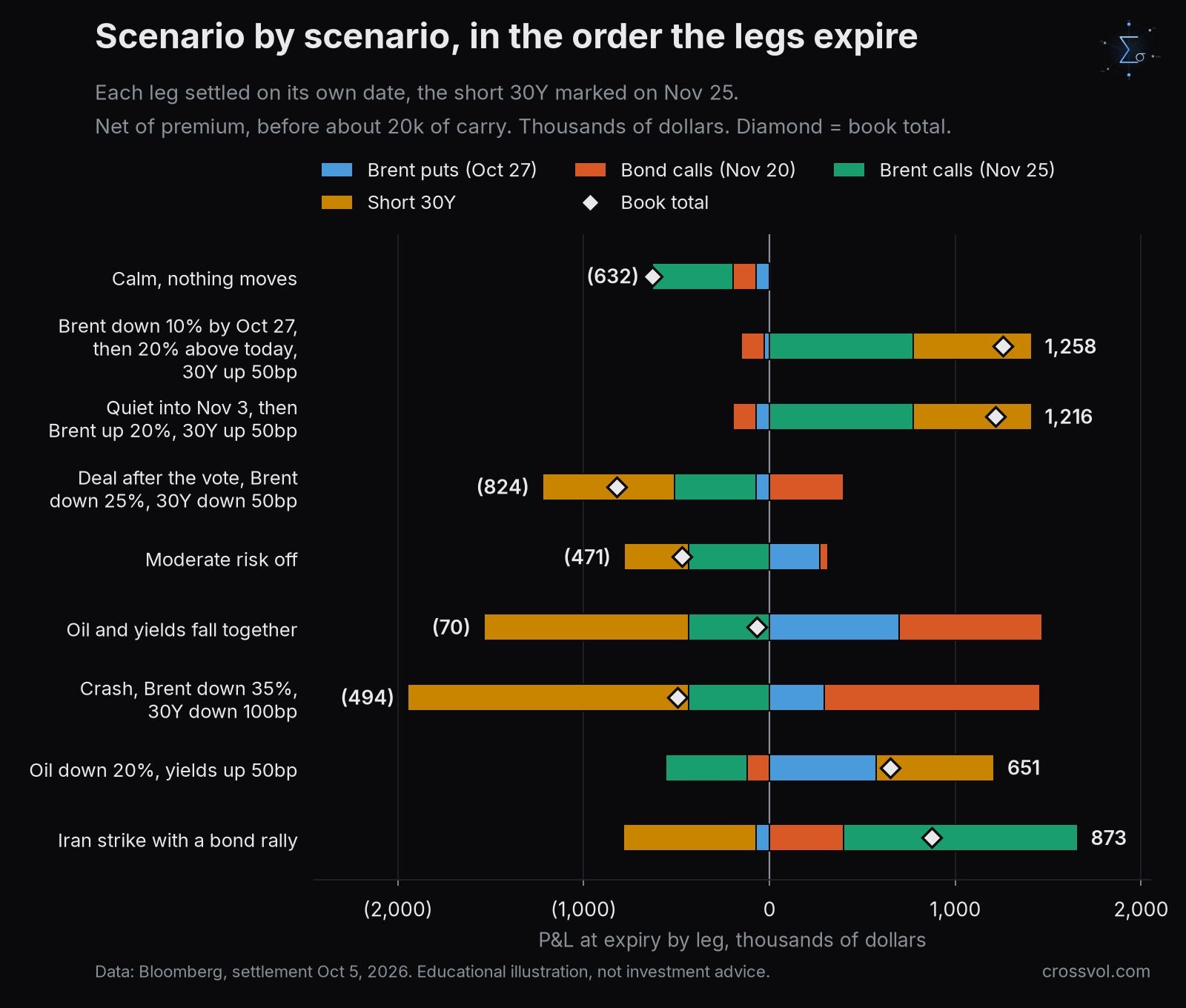
If the thesis plays out, with Brent down 10 percent by October 27, then 20 percent above today's level by November 25 and the thirty year up 50 basis points, the book makes about 1.26 million. Quiet into the vote and the same spike after makes about 1.22 million. An escalation before the vote lands in the same place at expiry, so being early on timing is not fatal. A Gulf strike that sends Brent up 25 percent while bonds rally on fear still makes about 870 thousand, and an oil selloff with yields higher makes about 650 thousand.
If the President gets his deal instead, and Brent falls 25 percent after the vote with yields down 50 basis points, the book loses about 824 thousand. That is the price of being wrong, and it is bounded, because the Brent calls can only lose their premium and the bond calls absorb more than half of the bond loss. The put structure, tail included, has already expired by then. The risk off cases before the vote cost between 70 thousand and 494 thousand. If nothing moves at all, the book loses its premium, 632.5 thousand, plus about 20 thousand of carry.
Five checks before trusting any scenario grid
Check every DV01 against modified duration times full price, and read the cheapest to deliver from the delivery screen rather than from a rule of thumb. Check put call parity on the settlements. At the 100 strike the call minus the put should equal the future minus the strike, and here it does to the cent at 0.32. Read deltas from the chain rather than from the label a strike was given. Recompute the net premium from settlements to see whether a structure is a credit or a debit. And price each leg at its own date, or say clearly that you have not.
The political clock does not make a trade by itself. It tells you where the risk sits in time. Before November 3 the risk is a drift lower and an early deal, which the ratio and its tail hedge are built for. After November 3 it is the escalation I expect, or the deal I do not, and the book is shaped so that the first pays and the second is survivable.
This article is for educational purposes only. It is not investment advice, a solicitation, or an offer to buy or sell any security or derivative. The positions are hypothetical, priced from October 5, 2026 settlements, and ignore transaction costs, margin, liquidity and taxes. Options and futures carry a high risk of loss, and short option positions can lose more than the premium received.
$BNO $USO $TLT
Data: Bloomberg, CME.
Very great work
This one is more than impressive.