


By Djellal Djouad
Broadcom credit protection widened this week, and the tape read it as a warning. It is not one, at least not the kind the reflex assumes. The widening is not the market pricing a weaker Broadcom. It is the market beginning to price something new that Broadcom is building next to itself, off the balance sheet, at a scale that could one day dwarf the company's own debt.
Here is what happened. Broadcom is reported to be raising more than 60 billion dollars of debt for an AI chip financing vehicle, a structure that reportedly includes a roughly 30 billion dollar junior tranche, with Broadcom guaranteeing a portion of the senior secured tranche. The bond market did not treat that as distress. Broadcom bond trading volume ran more than five times its daily average on 21 August, and clients were net buyers. That is repricing, not a selloff.
Strip the noise and the design is old. This is project finance wearing an AI logo. A special purpose vehicle, legally separate from Broadcom, buys and owns the compute, the XPUs and TPUs, and leases it to AI labs under long-term agreements. The lead tenant is reportedly Anthropic, ahead of its IPO, and the point is precisely that the labs do not carry the assets. The SPV owns the chips, leases them, services its debt from the lease cash flows. Broadcom is chip supplier, sponsor, and, the part that matters for credit, partial guarantor.
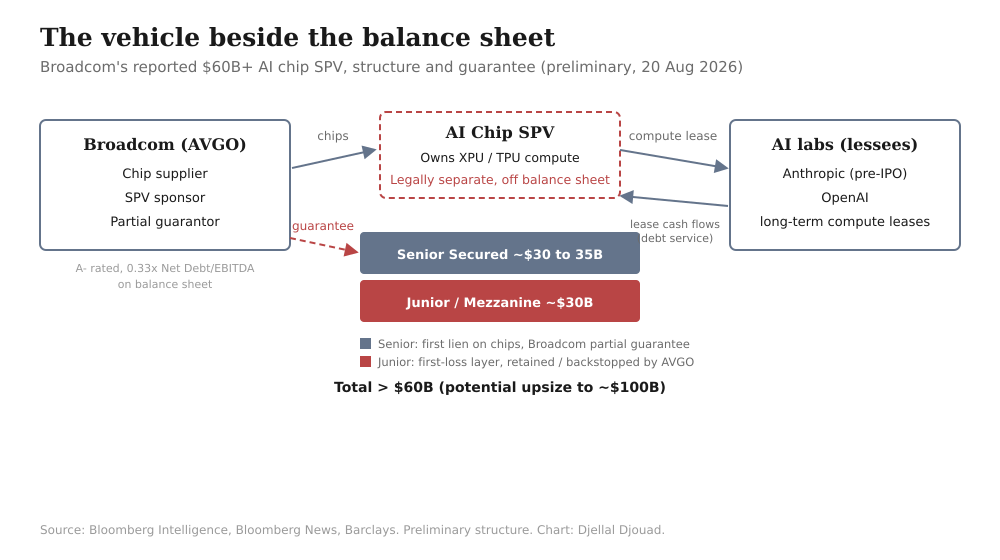
On its own numbers Broadcom is not a credit under stress, and that is the whole tension. S&P rates it A minus. Net debt to EBITDA sits near 0.33 times, with about 72 billion of EBITDA and 50 billion of free cash flow. The risk is not the reported balance sheet. It is the contingent one being built in parallel. A partial guarantee call of 20 to 30 percent on the initial 60 billion adds 12 to 18 billion to net debt, moving leverage from 0.33 times toward 0.5 to 0.6 times. Still investment grade, but a genuine step-change. And the junior tranche Broadcom reportedly retains is the first-loss layer, absorbing chip depreciation before any senior lender is touched.
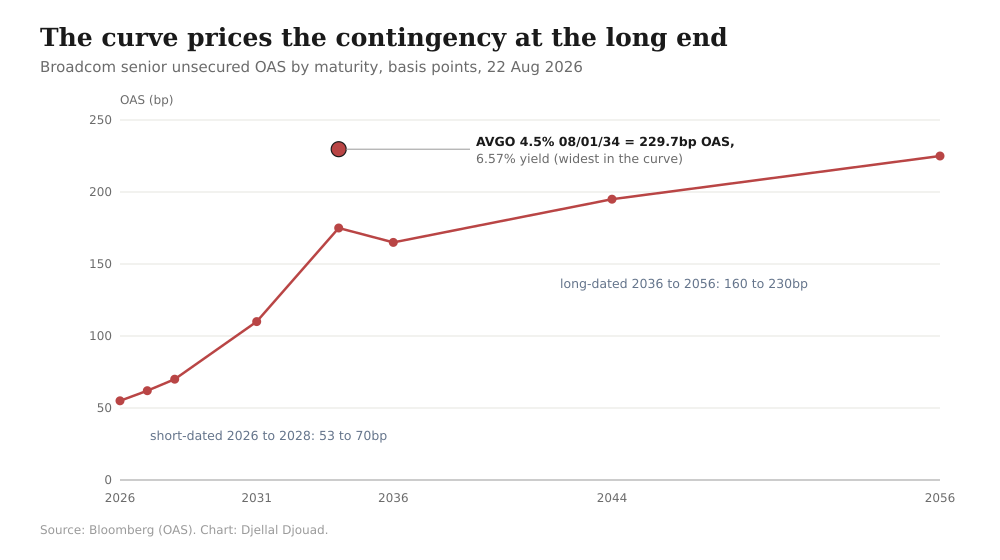
The bond curve is already voting. Broadcom's short paper trades around 53 to 70 basis points. The 2036 to 2056 bonds trade at 160 to 230, and the 4.5 percent of 2034 is an outlier at 229.7. A curve that steep is not pricing today's operating credit. It is pricing the probability that the contingent story gets worse before it resolves, out where a guarantee written today would land.
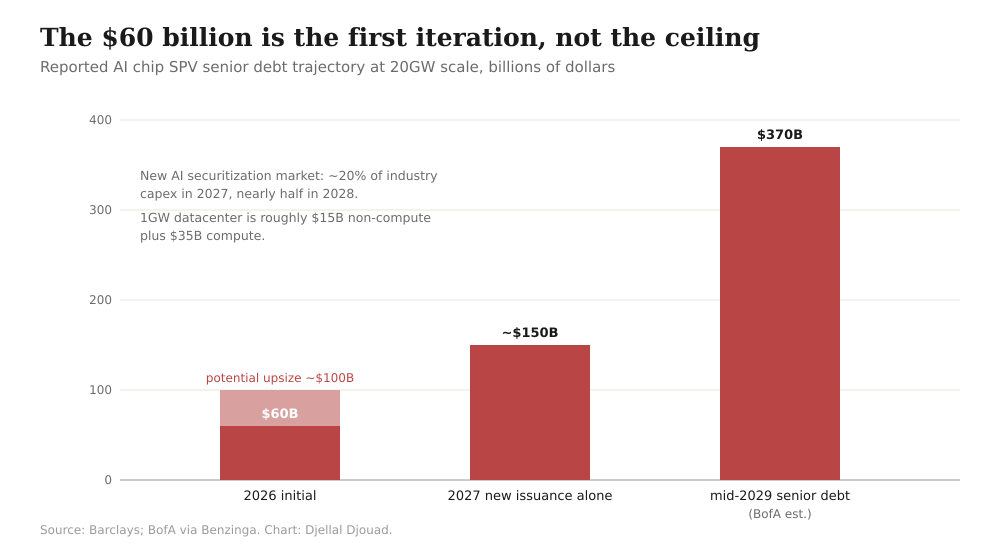
And 60 billion is the first iteration. Broadcom intends to finance 20 gigawatts of compute through a new securitization market, and a BofA analyst estimates the vehicle could reach 370 billion of senior debt by mid 2029. The SEC has loosened post-crisis rules for AI datacenter asset-backed securities, cutting the cost of issuance and the transparency along with it. Bond traders have already flagged roughly 70 billion of phantom liabilities across the AI complex, obligations that do not appear on balance sheets but could materialize at the worst possible time.
Is this a serious credit stress? Not yet, and that is the honest answer. But the architecture of a future one is being built in real time, and the tail sits on the calendar. Nvidia reports Tuesday, and a disappointment on datacenter demand would call the whole AI capex cycle into question. When a bond veteran running 28 billion says do not get too greedy, the desk listens.
I laid out the full version of this failure mode, the moment an off-balance-sheet contingency becomes a hard liability, in The Coming Crash, and the hyperscaler CDS divergence it produces in The China AI Disruption Thesis.
Read the full desk analysis, with all six infographics and the source work, on djellaldjouad.com: https://djellaldjouad.com/blog/broadcom-ai-chip-spv-hyperscaler-cds/
Djellal Djouad
Further reading