


By Djellal Djouad
Crude ran to fresh highs this week on a war that keeps widening, and the options market went quiet at exactly the wrong moment. Dubai touched 100 dollars a barrel, Shanghai crude sits near 102, both up roughly two thirds on the year, and WTI settled around 91.50 into a thin pre-Labor Day close. The tape reads like a market pricing tightness and a geopolitical premium into the front of every curve. Then you look at the volatility surface and it says the opposite. OVX fell all week while US missiles were landing on Iran's coast. That gap, between a physical market screaming tight and an options market drifting off to sleep, is the whole story.
This is a setup, not a trend. The barrels are moving, the spreads are re-steepening, and the fuse is priced cheap.
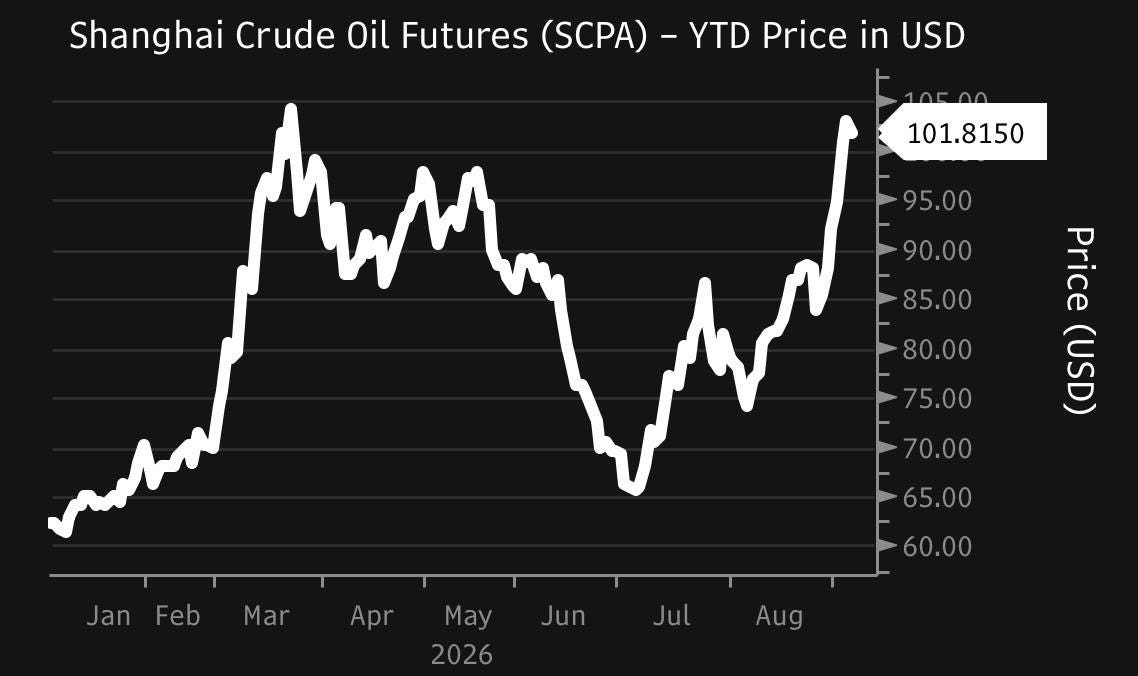
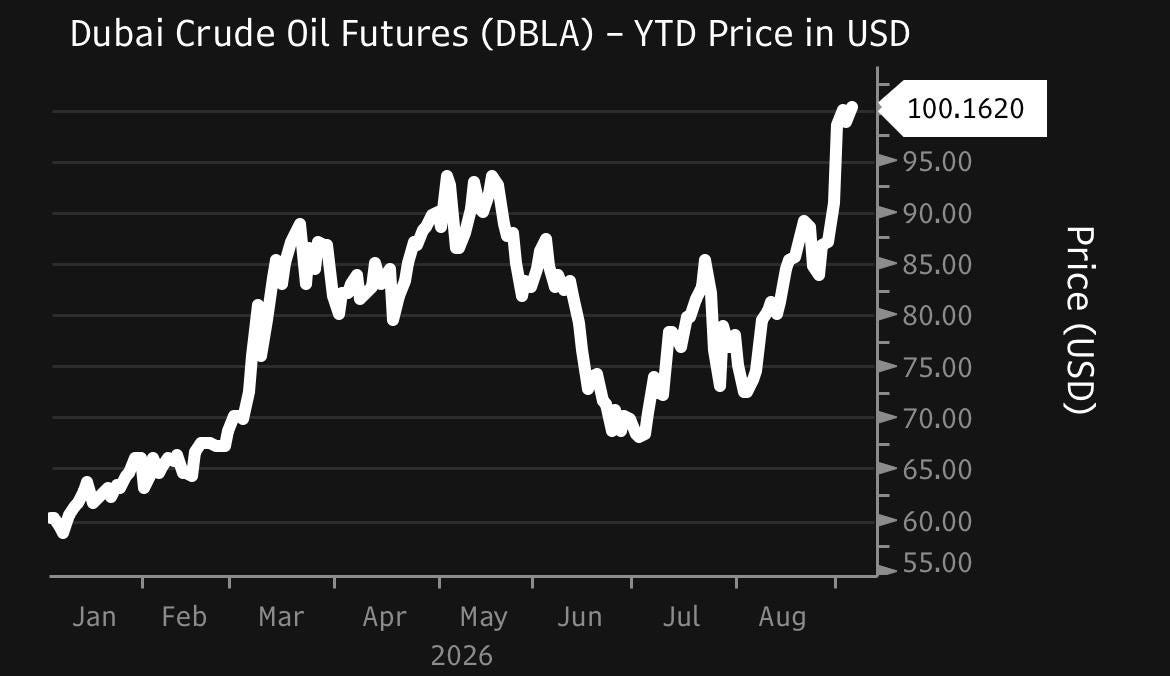
The war running the tape
The dominant driver was the Strait of Hormuz. The US carried out a second round of strikes in three days, hitting radar and mine-laying capability along Iran's southern coast, and Iran answered with drone and missile volleys on US bases across the region. President Trump said the strikes would likely be short-lived and asserted Washington controls the Strait, while US lawmakers described the conflict as stalled with no end in sight. By early Saturday there were reports of explosions near Kharg Island, Iran's main export terminal, with local sources saying a small Iranian tanker had been hit in a US missile strike, no casualties reported. The UAE fended off an Iranian drone and called for a more realistic approach to ending the fighting.
Two other fronts fed the same premium. US envoys Witkoff and Kushner are set to carry a peace proposal to Moscow and then Kyiv this weekend, though people close to the Kremlin sounded pessimistic, and Russia struck Ukraine's security service headquarters with a drone ahead of the talks and reportedly hit a cargo ship and a tanker near Odesa. In Caracas, Chevron, Eni, and GE Vernova signed energy deals alongside US Energy Secretary Chris Wright to lift Venezuelan output, an arrangement described as tens of billions in investment that also threatens the billions Caracas owes Beijing and, per reporting, blindsided parts of the US oil industry cut out of the talks.
The tanker math nobody can see
Here is the number that should frame the whole supply debate. Goldman Sachs estimates actual Persian Gulf exports at 15 to 16 million barrels a day against visible AIS flows of only about 10 million, as a surge in dark tankers crosses Hormuz with tracking switched off. In other words, a third or more of Gulf supply is currently invisible to the screens most of the market watches. That alone should make anyone cautious about calling a supply crunch from the tracking data.
The visible flows tell a tighter story. Saudi observed crude exports slumped to roughly 3 million barrels a day in August, the lowest in at least nine years, and UAE crude and condensate hit a five-month low of 2.7 million. Iraq is hiring tankers to run Hormuz, raised September Basrah offers by 9 to 10 dollars a barrel, and still pushed August exports to 2.369 million barrels a day, its highest since the war began. Six Saudi supertankers reached the Mediterranean after a monthlong Cape of Good Hope voyage, Glencore chartered a supertanker to move 2 million barrels of North Sea Forties to China as the arbitrage reopened, a Qatari LNG carrier turned back after nearing Hormuz, and Russia's Arctic crude exports fell to an eight-month low near 329,000 barrels a day. Supply is not gone. It is rerouting, hiding, and paying up to move.
Where the barrels are going
Asia is doing the bidding, and it is aggressive. Indian and Chinese refiners chasing Gulf spot barrels drove Dubai to nearly 100 dollars and lifted physical premiums for Oman and Abu Dhabi grades. India rotated its book hard, cutting Russian imports 26 percent month on month to 2.08 million barrels a day from a July record of 2.82 million, while boosting Venezuelan crude 64 percent to 358,000 barrels a day, the most since 2020 and enough to make Venezuela its third-largest supplier. HPCL bought three Aframax cargoes of US WTI, ONGC committed 736 million dollars to strategic reserves, and Indian Oil ran refineries above capacity and lifted LPG output 30 percent as Hormuz disruptions bit.
China is the quiet counterweight. Its oil consumption fell 9 percent year on year in the second quarter, led by a 16 percent slump in transport as EV adoption accelerated at high fuel prices, and crude processing dropped 11 percent. Chinese refiners paid the richest premiums for Russian ESPO in over four months as Hormuz cut off Iranian supply, Asian buyers took at least eight VLCCs of October US crude on the Murban arb, and Rosneft's Sechin claimed China cut imports by 5.5 million barrels a day this year, which he argued prevented another 30 dollars of upside. That is the release valve under this rally. Demand destruction is already running in the background.
The product squeeze is the real fire
If crude is tight, refined product is on fire. US retail diesel hit a record 5.85 dollars a gallon Friday, past the June 2022 peak, with refineries running at 98 percent and no room to add supply at the margin. The US diesel crack set a fresh all-time record above 106 dollars a barrel on Tuesday, the gasoil to Brent crack sat near 76, and Goldman more than doubled its diesel margin forecasts, citing strikes on refineries in the Middle East and Russia. Singapore light distillate stockpiles fell to a 2021 low of 10.7 million barrels, a rare South Korean diesel cargo is steaming to Western Europe to cover winter, and hedge funds pushed net-long gasoline bets to 89,263 contracts, the highest this year, into record September pump prices. The crude curve is where the premium shows. The product market is where the shortage actually hurts.
The curve is pricing a premium it expects to fade
Both WTI and Brent are in steep backwardation. WTI runs from 91.48 in October down to 72.53 a year out, Brent from 96.28 to 77.70, and the one-year calendar spread sits near 19 dollars on WTI and 18.60 on Brent, both historically wide. That shape is a market saying the front is tight now and expects relief later. Treasury Secretary Bessent put a number on the later, saying he expects oil to fall to 40 to 50 dollars once the Iran conflict ends. The curve is not pricing a permanent war premium. It is pricing a temporary one, and that is a very different bet.
The five signals, and why the fuse is cheap
Now the part the price does not show. Line up five gauges and the picture is a coiled spring, not a trend.
First, options are cheap against the actual tape. WTI 30-day realized volatility is running near 51 percent while OVX implied vol sits at 44.96, a negative risk premium of about 6 points. Implied normally trades at a premium to realized because sellers demand compensation. When it inverts, the market is underpricing the moves it is already living through.
Second, OVX compressed into escalation. It fell from 49.13 Monday to 44.96 Friday even as strikes intensified and a tanker was hit near Kharg, and it sits well below the three-month average of 53 and the July 23 peak of nearly 69. That is desensitization, and it leaves roughly 24 vol points of room if a genuine surprise lands, a Hormuz closure, a strike on Saudi infrastructure, or a ceasefire shock to the downside.
Third, calendar spreads are re-steepening. The WTI one-month spread went from minus a penny on July 6 to 5.18 at the July 23 peak, softened to about a dollar in mid-August, and snapped back to 2.91 this week as strikes resumed, with the three-month spread back to 6.02. Physical tightness is returning in real time, and a revisit of the July highs implies another 2 to 3 dollars in the front spread alone.
Fourth, positioning is elevated but not stretched. WTI managed money net longs sit around 94,000 contracts, roughly 6 percent below the six-month peak near 100,000, so there is still room to add, while hedge funds turned the most bullish on Brent since May, lifting net longs by 37,837 to 261,435. The warning is in the July tape, when WTI net longs collapsed from about 98,000 to 62,000 in three weeks as OVX spiked to 69. Positioning that unwinds fast amplifies moves in both directions.
Fifth, the macro overlay cuts the other way. Strong August jobs data pushed the odds of a September Fed hike above 50 percent, a hike would firm the dollar and pressure risk, and Bessent's 40 to 50 dollar target means any ceasefire is a sharp reversal risk. Bloomberg Intelligence flagged that energy credit spreads at record lows may be peaking if oil reverts to pre-war levels.
Put it together and the setup is binary, not directional. Options are cheap, spreads are re-steepening, the war is unresolved, and the next catalyst decides the sign. The clearest analog is July itself, when OVX ran from 40 to 69 in 17 days and the front spread went from flat to 5.18. That is what a repeat shock looks like.
What to watch
The OPEC+ meeting this weekend is expected to hold October quotas steady, with Novak confirming no new cuts on the table and the war itself preventing members from delivering earlier agreed hikes. Beyond that, next week brings monthly outlooks from the EIA, OPEC, and the IEA, the APPEC conference in Singapore, US CPI that will settle the Fed's September call, and the outcome of the Witkoff and Kushner peace mission. Any one of them can light the fuse. Right now the market is charging you almost nothing to own the move.
The one-line read
Crude ran to fresh highs on a widening war while OVX fell all week, leaving realized vol above implied, the calendar spreads re-steepening, and positioning with room to add. The curve prices a premium it expects to fade, Asia is already destroying demand at these prices, and the product market is where the real shortage burns. The July playbook, 40 vol to 69 in 17 days, is sitting right there. This is a cheap fuse on a binary setup, and the next headline out of Hormuz, Singapore, or the Fed decides which way it burns.
Djellal Djouad
Sources: Bloomberg, Bloomberg First Word, Bloomberg News, Financial Express, bne IntelliNews, Economic Times of India, Associated Press, week of September 1 to 5, 2026. US-Iran strikes and Hormuz, Russia-Ukraine peace mission and strikes, Venezuela energy deals. Tanker flows and dark fleet estimates, Saudi, UAE, Iraq, Russia Arctic exports. Indian and Chinese demand, Russian and Venezuelan import shifts, China consumption and ESPO premiums. US and global refined product cracks, diesel and gasoline records, Singapore stockpiles. WTI and Brent forward curves and calendar spreads, OVX and realized volatility, CFTC and ICE positioning, OPEC+ quotas and the week ahead.
Access the full desk: crossvol.com, 99 dollars per month.
Further reading